The article advises Indian exporters to expand their offerings to include European goods, addressing the 'missing container' problem and preventing European competitors from encroaching on their GCC client relationships.
- Indian exporters risk losing GCC clients to European competitors.
- Offering European goods alongside Indian products can secure client relationships.
- GCC buyers prefer fewer, strategic suppliers with diverse product portfolios.
- Expand product offerings to capture a greater share of the client's spend.
- Cross-trade opportunities maximize profits within existing client relationships.
AMBAEX Market Intelligence
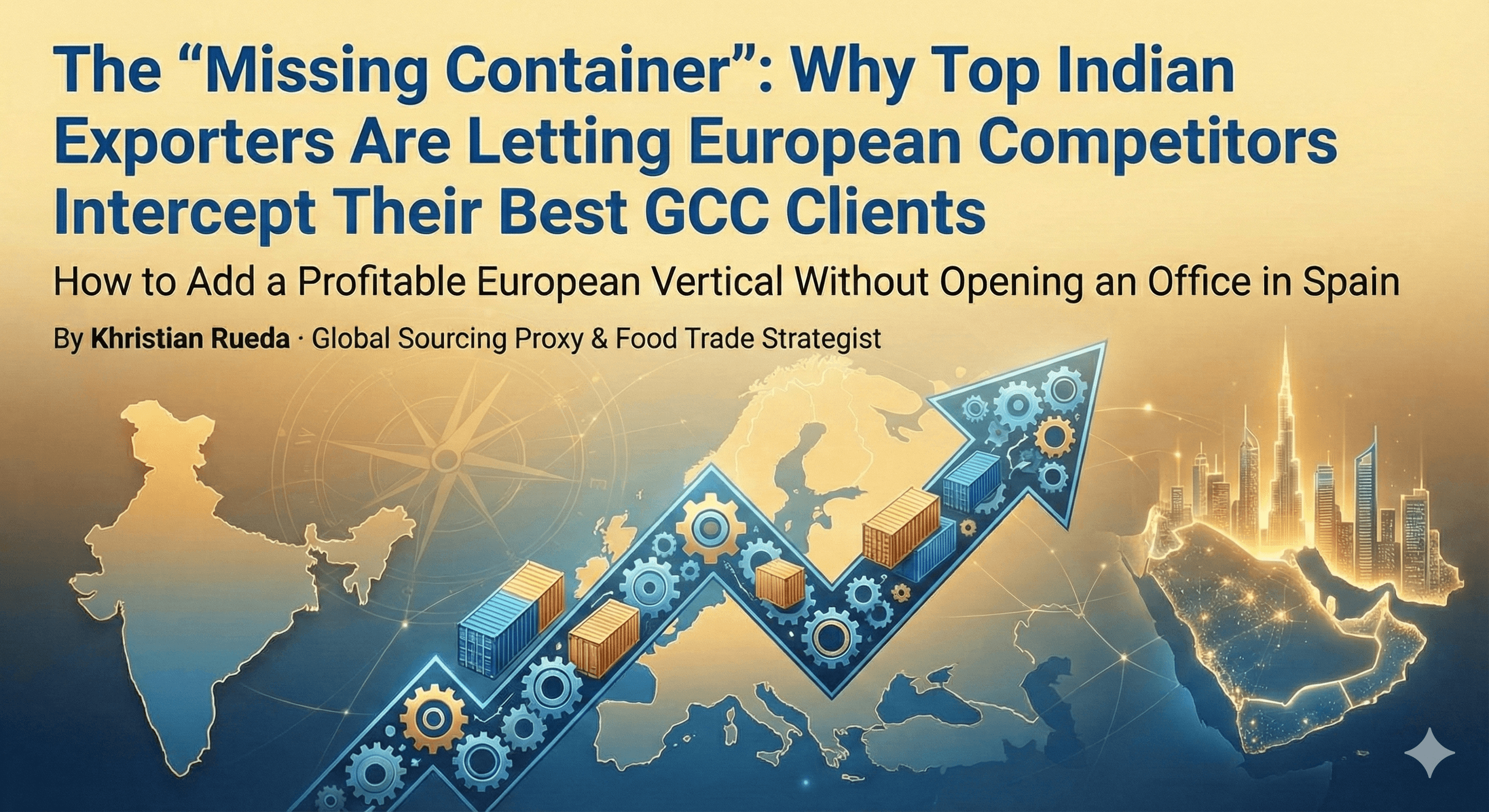
The “Missing Container”: Why Top Indian Exporters Are Letting European Competitors Intercept Their Best GCC Clients
How to Add a Profitable European Vertical Without Opening an Office in Spain
If You Own the Relationship, Why Give Away the Margin?
If you are a successful Indian exporter, you already own the hardest part of the business: the relationship. You have spent years building trust with buyers in Dubai, Riyadh, Singapore and West Africa. They rely on you for rice, spices, pulses and fresh produce—and in highly import‑dependent markets like the UAE, where more than 80 % of food is imported, that trust is gold (UAE food import dependence and F&B import share).
But every time your buyer needs olive oil, canned tuna, pasta or vinegar, you have to say: “No, we don’t do that.” So they hang up the phone and call a Spanish or Italian trading company. Today that trader sells them olive oil; tomorrow they might offer them basmati rice.
In a Gulf region where the EU already supplies a significant share of imports and total EU–GCC trade in goods exceeds €160 billion a year (EU–GCC trade facts and EU trade with GCC‑6), there is no shortage of European suppliers trying to enter your accounts.
It is time to close that door. It is time to own the global portfolio.
The “Cross‑Trade” Opportunity: One Relationship, Full Basket
Your GCC and APAC buyers do not want 50 different suppliers. Modern B2B research shows buyers increasingly prefer fewer, strategic suppliers who can cover more of their needs, with flexible terms and cross‑border capabilities (B2B procurement strategies and B2B buyer expectations).
Your clients would rather buy European goods from you—on the same credit terms and with the same problem‑solving they already trust. The only reason they do not is simple: you are not in Spain or Italy, and you cannot easily:
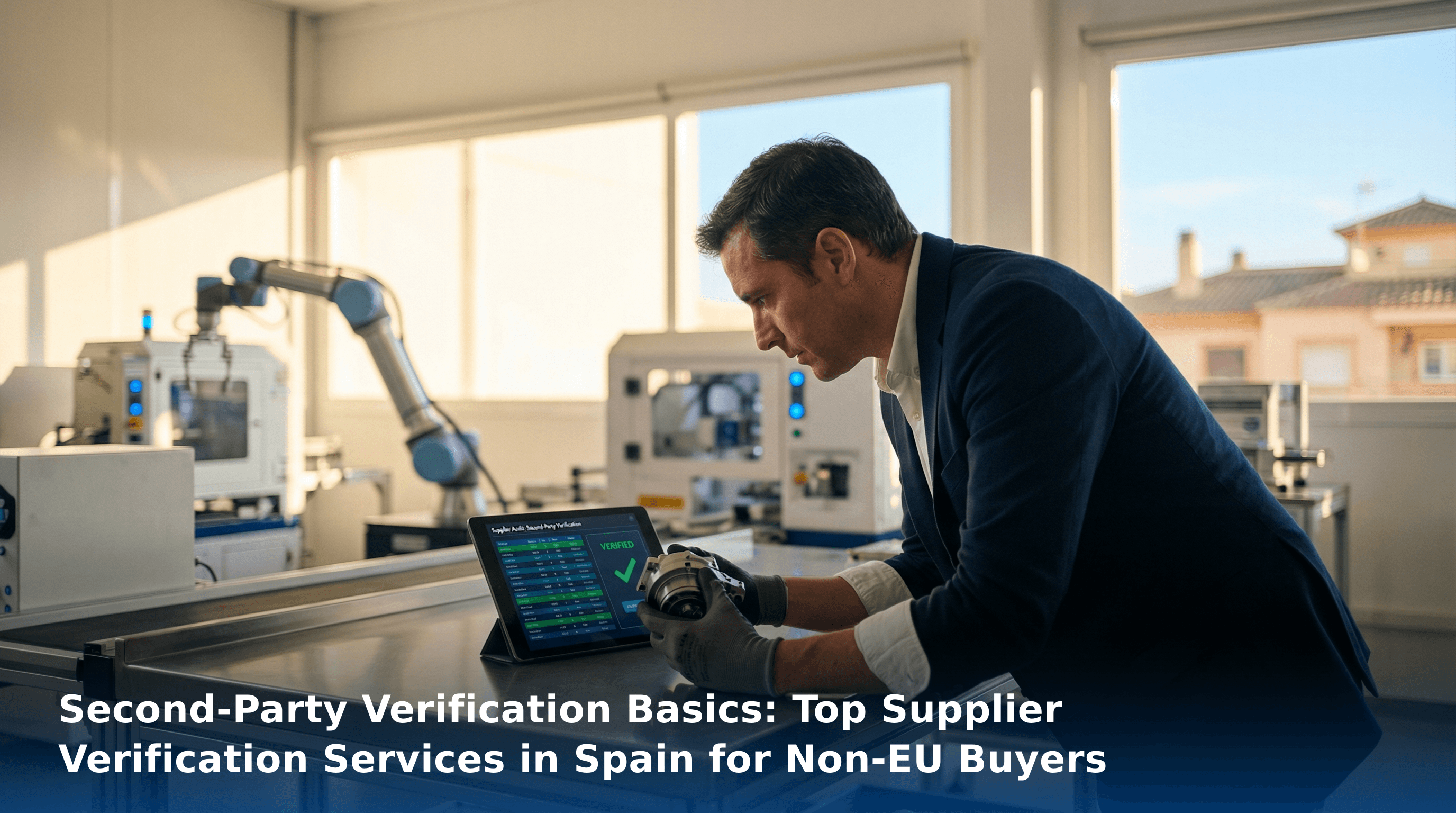
- verify factories or run pre‑shipment inspections on European suppliers;
- check Halal compliance (especially against stricter SMIIC standards) for GCC buyers;
- negotiate realistic payment terms with unknown European producers.
Meanwhile, EU–India trade is tightening. Eurostat data show EU imports of Indian food, drink and tobacco reaching about €0.39 billion in November 2025, with strong growth over the past decade (EU–India trade by SITC). Policymakers on both sides are pushing for deeper access in food and beverages. That means more European products will be looking for Indian and GCC routes—through someone. The question is whether that “someone” is you or a European competitor.
The Alternative to a Costly European Office: Your “Virtual Sourcing Office”
Opening a physical office in Spain is expensive. Between incorporation, legal and notary fees, licences and basic office rent, a small foreign company can easily spend €8,000–15,000 just to start—before salaries, travel and taxes (Starting a business in Spain and Cost breakdown).
You do not need a full European subsidiary to control sourcing. What you need is a Sourcing Proxy: a virtual sourcing office in Spain that works only on your side.
With a Sourcing Proxy, you can execute cross‑trade deals (Spain → Dubai, Spain → Singapore, Spain → West Africa) without touching the product yourself—while keeping full control of supplier choice, specifications, pricing and documentation.
How We De‑Risk European Sourcing for Indian Exporters
1. The “Halal Firewall” – Critical for GCC Clients
Many European factories still struggle with strict Halal expectations. They may use ethanol‑based flavourings, animal‑derived E‑numbers or co‑pack in facilities handling pork. One mistake can destroy years of trust with a Gulf client.
My role: act as your Halal firewall in Spain. I physically inspect ingredients, processes and documentation against SMIIC‑style requirements before you even quote the product. If a line cannot meet your client’s Halal expectations, you will know it before the first container—not after a scandal.
2. Private Label: Your Brand on European Product
If you only ship the factory’s brand, you are building the Spanish producer’s equity—not yours. Yet most SMEs in Spain are open to OEM and private label when approached correctly and when they trust the buyer’s volumes.
My role: identify factories willing to work under your brand, with realistic MOQs, and help manage artwork, compliance and specifications. That is how “Royal India” Olive Oil or “Farm‑to‑Gulf” Vinegar becomes a real brand, not just an idea on PowerPoint.
3. Contract Terms & Pre‑Shipment Inspection (PSI)
Buying from a new European supplier remotely often means 100 % advance payment and blind trust that the right goods will be loaded.
My role: negotiate on the ground for better terms than a cold email can achieve—split payments, CAD or documentary terms where possible—and then carry out a full PSI before the container is sealed: quantities, labelling, documentation and visual quality. If something is wrong, we fix it at the loading dock, not at Jebel Ali.
The Economics: What You Lose by Saying “No”
Think about one mid‑size Dubai client importing 5–10 containers of European foods per year. At a modest net margin of just US$1,500–2,000 per container, that is US$7,500–20,000 of annual profit you currently gift to a European trader—per client.
Multiply that by your top 10 accounts across GCC and APAC, and the “missing container” quickly becomes US$75,000–200,000 a year in lost profit, plus the strategic risk of letting competitors deepen their relationships with your buyers.
Old way:
Your buyer purchases olive oil and tuna from a European trader. You earn US$0 and watch a competitor build trust inside your key account.
New way:
You buy Ex‑Works Spain with a Sourcing Proxy verifying suppliers → you add your margin → you ship to Dubai under your brand and documents. You earn the margin and reinforce the relationship.
Compared with the fixed cost of a European office, a Sourcing Proxy model converts these deals into variable, deal‑linked costs—you pay only when you move profitable business, not 12 months of rent and salaries.
Why Expanding Your Portfolio Now Makes Strategic Sense
Global data show that GCC countries and Singapore are deepening their dependence on imported food and beverages while upgrading quality:
- The UAE imports over 80 % of its food needs, with around 16.9 million tonnes imported in 2022 (UAE food imports).
- In the UAE, 56.6 % of all food and beverage trade is based on imports (UAE F&B import dependency).
- The EU already supplies a notable portion of GCC imports and EU–GCC goods trade totals about €162 billion a year (EU–GCC relations, EU–GCC trade fact sheet).
At the same time, consumer and F&B trend reports in GCC hubs and Singapore point toward stronger demand for Mediterranean diet products, premium European chocolates and biscuits, and reliable Halal‑compliant imports with transparent origin.
If you stay focused only on rice, pulses and spices, you invite others to capture this growth. If you become a one‑stop procurement partner for India + Europe, you increase share of wallet, improve container utilisation and make it harder for competitors to enter your accounts.
The Next Step: Own the Global Portfolio, Without The Burocratic European Nightmare
You have already conquered the hardest part: Indian sourcing and long‑distance exports. The next step is not “more spices.” It is becoming a global procurement partner for your clients—offering both Indian and European baskets with one trusted interface.
I am currently finalising sourcing mandates linked to major European trade shows such as Alimentaria and Barcelona Wine Week, and visiting Spanish plants to secure cross‑trade opportunities into GCC, Singapore and West Africa.
If you want to explore adding a Spanish / European vertical to your export catalogue—without the fixed cost and risk of opening a European office—let’s talk.
Khristian Rueda
Sourcing Proxy · Spain
Connecting Global Buyers to Verified Spanish Producers