This article details why Europe is the premier global hub for nanoencapsulated functional ingredients, highlighting its advanced R&D, stringent safety, and commercial scale-up for non-EU buyers seeking product stability, bioavailability, and market advantage.
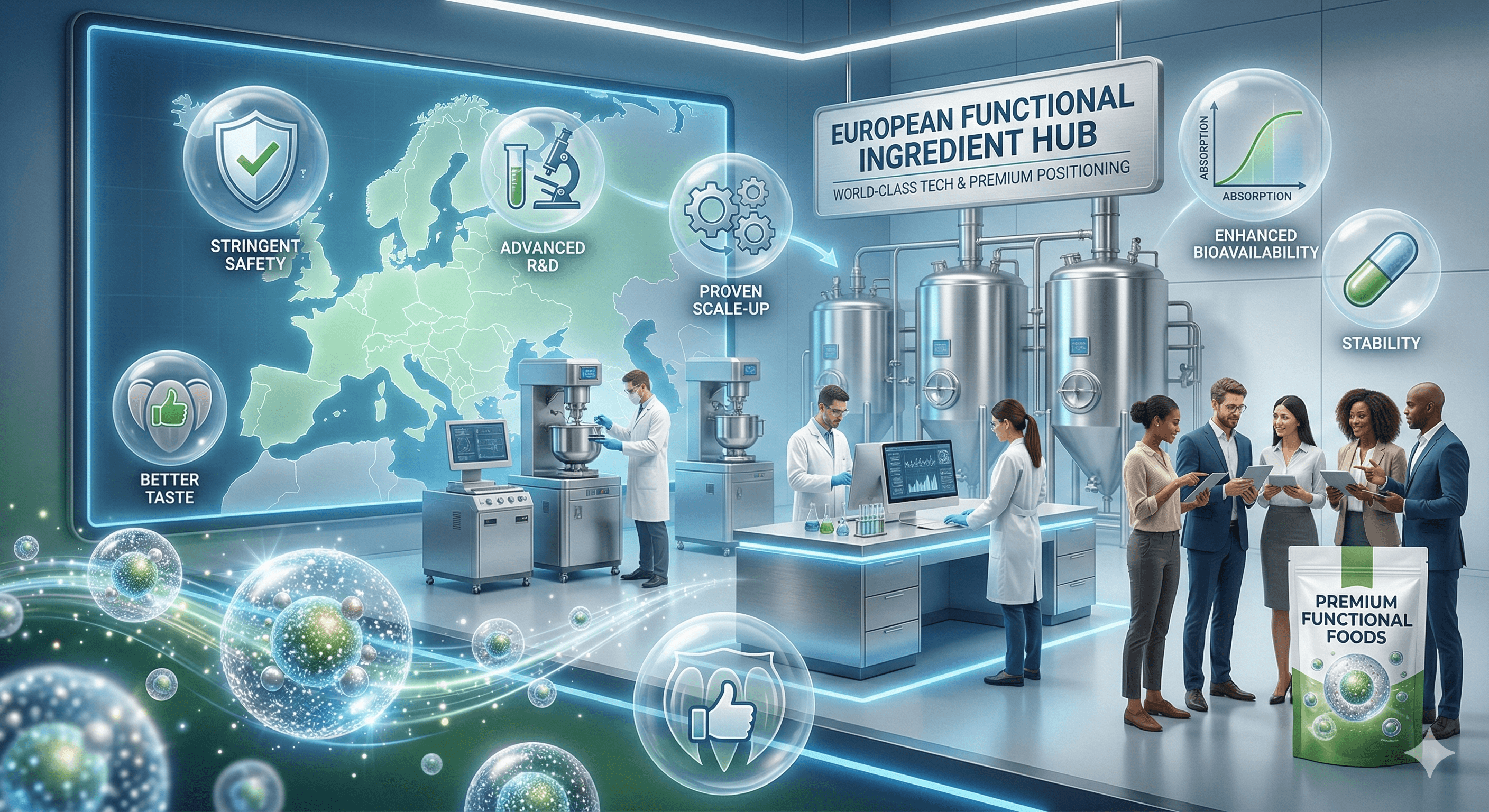
- Europe is the premier hub for nanoencapsulated functional ingredients, excelling in R&D, safety, and scale-up.
- The European food encapsulation market is projected to grow from €3.4 billion in 2024 to €6.3 billion by 2033.
- Nanoencapsulation addresses critical issues like ingredient degradation, poor bioavailability, and sensory defects.
- Non-EU buyers gain proven technology, world-class safety, and premium market positioning from European suppliers.
- Germany holds the largest share (26.5%) of the European market, followed by France, UK, Spain, and Netherlands.
AMBAEX Market Intelligence
Why Europe Is Your Safest Hub for Nanoencapsulated Functional Ingredients
Europe leads in nanoencapsulation R&D, safety assessment and scale‑up for functional foods and nutraceuticals. Here's why non‑EU buyers should source nanoencapsulated ingredients from EU suppliers.
If you're a non‑EU brand looking to upgrade your functional food, beverage or nutraceutical line with advanced delivery technologies, Europe's food encapsulation market should be at the top of your shortlist.
Nanoencapsulation—wrapping sensitive bioactives like omega‑3, vitamins, probiotics and polyphenols inside nano‑scale carriers—solves three persistent problems: ingredient degradation during processing and storage, poor bioavailability in the gut, and off‑flavors or sensory defects in finished products.
Europe is not just a large market for this technology; it is the region where nanoencapsulation is most advanced in terms of R&D investment, regulatory credibility and commercial scale‑up. For buyers outside the EU, sourcing nanoencapsulated ingredients or finished products from European suppliers delivers a triple advantage: proven technology, world‑class safety standards, and a clear argument for premium positioning in your home market.
Europe's Encapsulation Market: Size and Momentum
The European food encapsulation market was valued at €3.4 billion in 2024 and is projected to reach €6.3 billion by 2033, growing at a steady pace driven by functional foods, nutraceuticals and clean‑label demand.
Within this market, nanoencapsulation is the fastest‑growing technology segment, outpacing traditional microencapsulation and spray‑drying methods. This growth is concentrated in three high‑value application areas: fortified bakery and cereals, functional beverages (dairy and plant‑based), and nutraceutical supplements.
Germany leads the European market with a 26.5% share, followed by France, the UK, Spain and the Netherlands, where ingredient giants and specialist SMEs operate side‑by‑side.
What Makes Nanoencapsulation Different from Conventional Encapsulation
Traditional encapsulation protects ingredients during processing and masks unwanted tastes, but it often does little to improve how the body actually absorbs and uses those ingredients. Nanoencapsulation addresses that gap directly.
By reducing particle size to the nanometre range, nanoencapsulation increases the surface area of the active ingredient, making it more accessible to digestive enzymes and transport mechanisms in the gut. For poorly soluble compounds like curcumin, coenzyme Q10, or fat‑soluble vitamins, this can mean a two‑ to ten‑fold improvement in bioavailability compared to standard formulations, as documented in food science literature.
For non‑EU buyers, this translates directly into product claims: higher efficacy at lower doses, better consumer perceptibility of results, and stronger differentiation from competitors still using first‑generation delivery systems.
Why Europe Leads in Nanoencapsulation Technology
Several factors combine to make Europe the global centre of gravity for nanoencapsulation R&D and commercial application.
1. Long‑Standing Investment in Food Science
European universities and research institutes—particularly in Germany, France, the Netherlands, Spain and the Nordic countries—have invested decades in colloid chemistry, emulsion science and delivery system engineering. This research base feeds directly into commercialisation through specialised ingredient companies, contract manufacturers and technology transfer programmes.
2. Regulatory Maturity and Clarity
Unlike some regions where nanomaterial regulations are still evolving, the EU has developed a structured framework for assessing and approving nano‑enabled food ingredients. The European Food Safety Authority (EFSA) has published detailed guidance on how to evaluate the safety of nanomaterials in food, including requirements for physicochemical characterisation, toxicological testing and exposure assessment, as outlined in their nanotechnology guidance documents.
For non‑EU buyers, this regulatory maturity is a de‑risking mechanism: ingredients that have successfully navigated EFSA's review process carry a level of safety assurance that is recognised and respected by regulators worldwide, including in Asia, the Middle East and the Americas.
3. High‑Quality Manufacturing Infrastructure
Europe is home to some of the world's most advanced food processing facilities, with cGMP‑compliant production lines specifically designed for sensitive ingredients. In Spain, the Netherlands and Germany, contract manufacturers and ingredient producers have invested in nanoemulsion, liposome and spray‑drying equipment capable of producing functional ingredients at commercial scale without degrading actives, as reported by industry publications.
This manufacturing sophistication means that non‑EU buyers can order consistent, batch‑to‑batch reliable ingredients with full traceability and documentation.
Key Application Areas Where Nanoencapsulation Delivers
For non‑EU importers and brand owners, the most commercially relevant nanoencapsulation applications fall into three categories.
Functional Beverages
Water‑based beverages are notoriously difficult for fat‑soluble ingredients. Nanoemulsions allow formulators to add omega‑3, vitamin D, CoQ10 or curcumin to clear or opaque drinks without sedimentation, turbidity or oil ring formation. European suppliers have mastered these systems, producing ingredients that remain stable across shelf life and temperature variations, according to nutraceutical industry analysts.
Fortified Bakery and Cereals
Bakery applications subject sensitive ingredients to high heat and mechanical stress. Nanoencapsulation protects actives during baking and then releases them during digestion. European ingredient companies supply encapsulated versions of iron, calcium, vitamins and omega‑3 specifically designed for breads, biscuits and breakfast cereals, with documented stability data from pilot and commercial trials.
Nutraceutical Supplements
In supplements, bioavailability is the name of the game. European suppliers have developed liposomal and phytosome delivery systems for curcumin, quercetin, resveratrol and other polyphenols that significantly increase absorption compared to standard powdered extracts, as highlighted in industry coverage. For non‑EU brands competing in crowded supplement markets, these bioavailability claims provide a credible point of differentiation.
What Non‑EU Buyers Should Look for in European Nanoencapsulation Suppliers
Sourcing nanoencapsulated ingredients from Europe requires a structured approach to supplier evaluation. The technology is advanced, and not all suppliers have equal capabilities.
1. Verifiable Production Scale
Many European nanoencapsulation specialists operate at laboratory or pilot scale. Before committing to a long‑term supply agreement, non‑EU buyers should confirm that the supplier has demonstrated commercial‑scale production capability—meaning they can produce kilogram or ton quantities, not just grams, with consistent quality, as scaling challenges are well documented in the industry.
2. Regulatory Documentation and Safety Data
European suppliers accustomed to working with EU buyers will typically have robust regulatory files, including GRAS or Novel Food status where applicable, full physicochemical characterisation of their nanoparticles, and stability data under various storage conditions. These documents should be requested during due diligence and reviewed by your technical team or a qualified third party.
3. Customisation Capability
The best European suppliers offer customisation: adjusting particle size, encapsulation efficiency, release profile and ingredient load to match your specific application and target market. Suppliers who only offer off‑the‑shelf ingredients may not deliver the same competitive advantage.
4. On‑Site Verifiability
Given the complexity of nanoencapsulation, there is no substitute for seeing the facility and quality systems in person. Buyers who conduct on‑site audits—or engage a trusted third party to do so—gain confidence that the supplier actually owns and operates the claimed equipment and follows documented procedures.
Why On‑the‑Ground Verification Matters for Advanced Ingredients
Nanoencapsulation is not a commodity business. It is a technology‑driven field where the difference between a supplier's marketing claims and their actual manufacturing capability can be significant. A laboratory with a pilot‑scale homogeniser may be able to produce impressive samples, but scaling that process to commercial volumes without losing functionality requires engineering expertise, quality systems and production discipline that only become visible during an on‑site visit.
For non‑EU buyers, particularly those in regions where nano‑specific regulations are still developing, there is an additional layer of risk: ingredients that perform well in your product but later trigger regulatory questions because of insufficient documentation. European suppliers who have already navigated EFSA or national authority reviews are better equipped to provide the data your own regulators may eventually request.
This is where independent verification becomes a strategic advantage. A third‑party auditor with technical knowledge of encapsulation technologies can assess whether a supplier's equipment, processes and documentation match the claims in their brochure—and whether they are likely to remain reliable over multiple production cycles.
The Ambaex Approach: Verifying Nanoencapsulation Suppliers in Spain and Southern Europe
AMBAEX operates in Spain, Portugal and Italy as a buyer‑side verification partner, combining technical understanding of advanced food technologies with on‑the‑ground presence in Southern Europe. For non‑EU buyers sourcing nanoencapsulated ingredients, we provide:
- Supplier identification and pre‑screening focused on genuine nanoencapsulation capability, not just marketing claims.
- On‑site audits that examine production equipment, quality systems, cleaning validation, batch records and staff competence.
- Documentation review covering regulatory files, stability data, certificates of analysis and supply agreements.
- Ongoing monitoring for repeat orders, ensuring that quality and consistency are maintained over time.
We are compensated only by the buyer, not by suppliers, ensuring that our assessments are focused entirely on your risk and quality objectives.
Turning European Nanoencapsulation into a Market Advantage
For non‑EU food, beverage and nutraceutical brands, the decision to source from Europe is not just about finding a supplier—it is about anchoring your products in a region known for scientific rigour, regulatory integrity and manufacturing quality.
Nanoencapsulation is one of the most promising technologies in the functional ingredients space, but its benefits—higher bioavailability, cleaner labels, better sensory profiles—are only realised when the technology is executed correctly by suppliers with genuine capability.
Europe offers the deepest pool of such suppliers, but navigating that pool requires the same disciplined approach you would apply to any high‑value procurement: clear specifications, structured due diligence, on‑the‑ground verification and ongoing performance monitoring.
Make Europe Your Nanoencapsulation Sourcing Hub
The European food encapsulation market is projected to reach €6.3 billion by 2033, and nanoencapsulation is its fastest‑growing segment according to market forecasts. For non‑EU buyers, this momentum represents an opportunity to upgrade product portfolios with ingredients that deliver real, verifiable performance advantages.
AMBAEX helps buyers in Asia, the Middle East and the Americas identify, evaluate and monitor European suppliers of advanced functional ingredients—including nanoencapsulated actives—with on‑the‑ground presence in Spain, Portugal and Italy.
Discuss your nanoencapsulation sourcing requirements →
info@ambaex.com | ambaex.com/contact
Zero Kickbacks. Physical Verification. Procurement Intelligence in Southern Europe.