European food fraud is surging due to economic pressures, presenting a critical risk to GCC/APAC buyers, particularly in wine and olive oil, necessitating on-site audits over reliance on documentation.
- Food fraud in Europe has increased over 1000% since 2020.
- 2025-26 is projected as peak risk for food fraud targeting foreign buyers.
- Economic tightening drives increased instances of supplier fraud.
- On-site audits are essential to verify supplier legitimacy.
- Reliance on documents alone increases risk of costly scams.
AMBAEX Market Intelligence
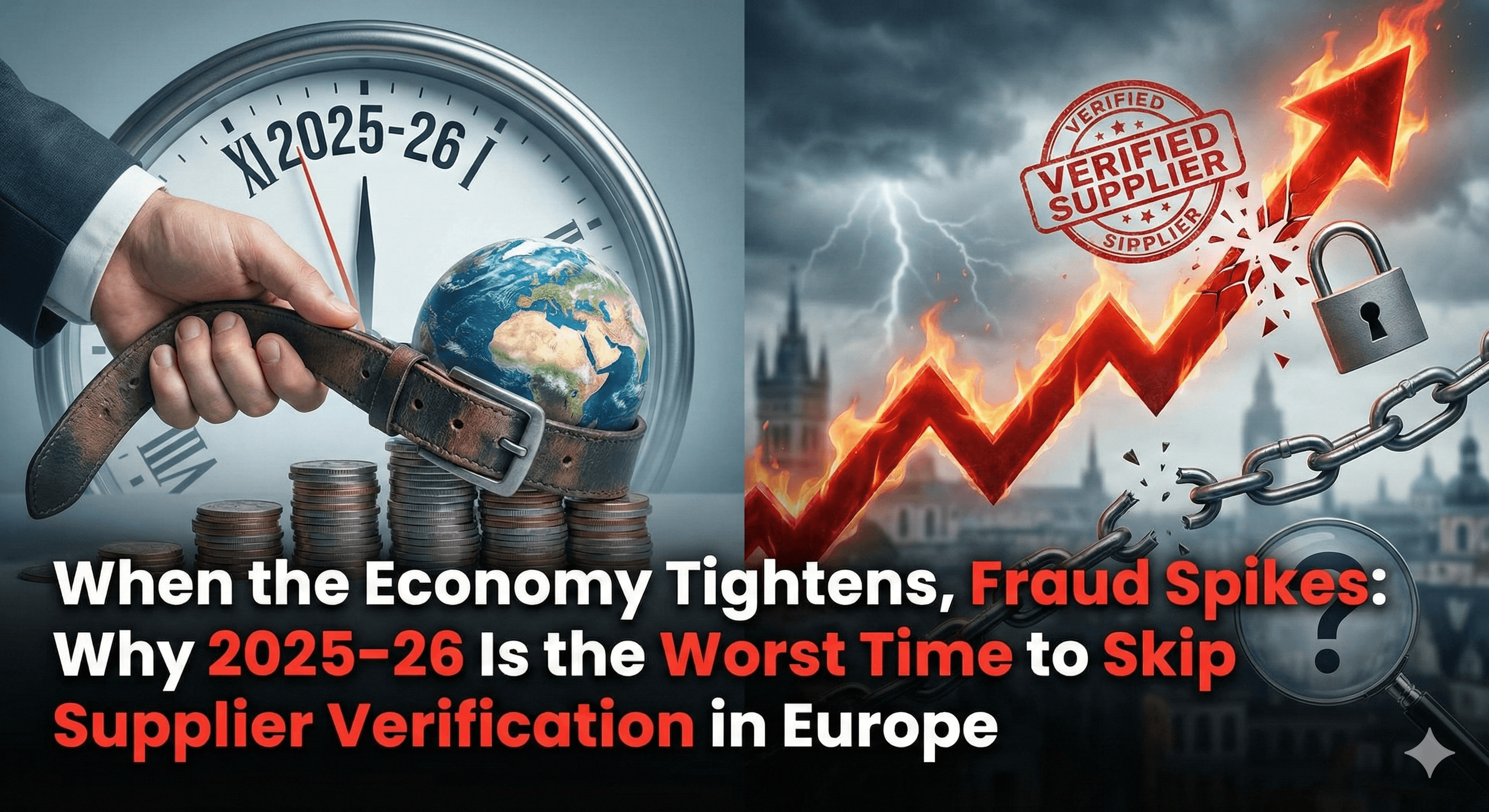
When the Economy Tightens, Fraud Spikes: Why 2025–26 Is the Worst Time to Skip Supplier Verification in Europe
Historic Wine Scandals, Today’s Olive‑Oil Crackdowns, and What They Mean for GCC & APAC Buyers
Executive Snapshot: One Missing Audit, One Missing Container
A GCC importer wires €85,000 to a “marble supplier” in Alicante. The pro‑forma invoice looks professional, the website uses real factory photos, and the Spanish bank account matches the company name. When the client asks us to check the supplier after the fact, the “warehouse” address leads to a residential flat. The container was never booked.
Cases like this are often dismissed as bad luck or poor due diligence. In reality, they are symptoms of a broader pattern: in periods of economic pressure, food and agrifood fraud in Europe escalates sharply, and foreign buyers who rely on documents instead of audits carry most of the risk.
This brief looks at what the data actually show since COVID, how it mirrors older European wine scandals, and why 2025–26 is structurally more dangerous for non‑EU buyers in categories like wine, olive oil and “Mediterranean” foods.
1. Evidence: Food & Wine Fraud Is Not an Anecdote, It’s a Curve
Several independent sources now point in the same direction: recorded food‑fraud incidents have expanded drastically since 2020, particularly in Europe and in high‑value categories such as oils, wine, honey, nuts and cereals.
1.1 A Ten‑Fold Rise in Recorded Food‑Fraud Alerts
An analysis of global incident databases by SGS DigiComply describes a 1,041 % increase in recorded food‑fraud cases between 2020 and 2023, with thousands of new alerts logged in 2024 alone as inflation, supply‑chain shocks and war‑related disruptions increased incentives to cheat (Food Fraud Explosion, 2024 Global Food Fraud Report).
A 2024 spotlight on food fraud and food safety notes that fraud has shifted from occasional scandals to a “continuous background risk”, estimating global economic losses from food fraud in the tens of billions of euros annually (Food Fraud & Food Safety Spotlight 2024, FAN Global Food Fraud Report).
1.2 EU Data: Olive Oil, Wine and Other Mediterranean Staples Under Pressure
Within the EU, the Agri‑Food Fraud Network coordinates cross‑border enforcement. Its annual reports show hundreds of notifications per year, with olive oil, wine, fish, meat, honey and cereals repeatedly among the most affected categories.
Recent sector‑specific reporting is even more explicit:
- In 2024, olive‑oil fraud and mislabelling cases in the EU reached record levels, with enforcement actions across Spain, Italy, Portugal and Greece targeting lampante oil sold as extra virgin, blends misdeclared as PDO/PGI, and origin fraud (Olive‑oil fraud and mislabelling at record high, Olive oil a major target for food fraud, Inside Europe’s fight against fake olive oil).
- Italian authorities have singled out olive oil as a “leading focus” in recent crackdowns, reflecting both the economic value of the category and its vulnerability to fraud under price pressure (Olive Oil a Leading Focus in Italy’s Crackdown on Food Fraud).
- Global fraud‑monitoring reports highlight growing issues in wine, nuts, dairy and cereals, especially where climate‑driven supply drops intersect with strong demand (2024 Global Food Fraud Report, Sharp rise in fraud for nuts, dairy and cereals).
For a non‑EU buyer of wine, olive oil or “Mediterranean” products, this means your risk exposure today is not the same as it was a decade ago. The baseline level of attempted fraud in the system is objectively higher.
1.3 Economic Shock as a Multiplier
The timing is not random. Since 2020, European food producers have faced:
- pandemic disruption and post‑COVID debt burdens;
- energy‑price spikes following Russia’s invasion of Ukraine;
- double‑digit cost increases for glass, packaging and logistics; and
- droughts and heatwaves that reduced yields in key wine and olive‑oil regions.
Fraud‑risk work drawing on the classic “fraud triangle” shows that when pressure (to survive financially) rises at the same time as opportunity (complex, poorly monitored supply chains) and rationalisation (“just this once”) increase, the probability of fraud jumps (Integrating social vulnerability into food fraud risk, Food Fraud Explosion). That is exactly the environment buyers are walking into in 2025–26.
2. Historic Scandals vs. Today’s Macro Drivers: The Same Triangle, New Fuel
To understand why current conditions are so risky, it helps to look back. Europe has seen some of the most infamous wine frauds in history. What matters now is not the chemistry, but the pattern behind them—and how similar that pattern looks today.
2.1 Austria 1985 & Italy 1986: When Harvests and Margins Collapse
In 1985, parts of the Austrian wine industry added diethylene glycol (a toxic antifreeze component) to bulk wine to mimic sweetness in weak vintages. The following year, some Italian producers added methanol to cheap wines to boost alcohol content, leading to dozens of deaths and severe poisonings. Both scandals were triggered by poor harvests, high competition and economic pressure to maintain export volumes and prices.
The pattern was later echoed in other European cases:
- The Brunello di Montalcino adulteration scandal (2008), where non‑permitted grapes were blended into a DOCG wine meant to be 100 % Sangiovese, driven by the need to meet demand and maintain margins.
- The Rudy Kurniawan counterfeit fine‑wine case (2000s), where fake rare bottles were sold into a booming luxury market, exploiting huge price gaps between “trophy” wines and everyday vintages; the case later prompted interest in advanced authentication tools such as the EU‑funded TRACEWINDU blockchain traceability project and other blockchain‑based provenance systems (Bottling trust: chemistry and blockchain to combat counterfeit wine).
2.2 Today’s Environment: Different Year, Same Incentives
Fast‑forward to 2023–26 and the macro picture for many European producers looks uncomfortably familiar:
- Climate‑driven yield drops in parts of Spain, Italy and France, especially for 2022–23 vintages, reduce volumes available for export at a time when fixed costs remain high (Spanish wine export trends).
- Input‑cost inflation (glass, energy, labour, transport) squeezes margins even when volumes are stable, as highlighted in EU and industry outlooks (Global food fraud surges in 2025).
- Tariffs and trade tensions redirect flows: evolving EU–UK and EU–India arrangements, and shifting demand in China and GCC markets, change who can pay what, and where, creating price gaps and arbitrage opportunities.
- Post‑COVID credit pressure means more producers are operating close to their financial limits, making “shortcuts” harder to resist when buyers squeeze on price.
In other words, the same fraud triangle that produced the 1980s scandals—pressure, opportunity, rationalisation—is now being fed by:
- climate volatility instead of one‑off weak harvests;
- global inflation and energy shocks instead of purely local competition; and
- complex, multi‑country supply chains instead of simple domestic routes.
2.3 AI, Tariffs and Digital Illusions: Why Buyers Are Even More Exposed
There are two new accelerants that did not exist in 1985 or 2008: AI‑driven presentation and a more fragmented trade landscape.
On the one hand, AI and modern web tools make it easier and cheaper to create convincing but fake supplier identities: polished websites, AI‑generated texts and images, and doctored documents that pass superficial checks. A residential flat in Alicante can look like a global marble exporter; a tiny bottler can look like a “group” of factories.
On the other hand, tariff changes and new trade agreements open arbitrage windows. As duties shift between the EU, India, GCC, UK and North America, the incentive to misdeclare origin or to “upgrade” product quality on paper rises, especially when regulators are still adapting to new rules.
For foreign buyers, this means that:
- Documents and websites have never looked better, even when the underlying factory is weak or non‑existent.
- Price gaps between regions are wider, creating more incentive to cut corners or relabel product to capture tariff advantages.
- Official control systems are under more strain, dealing with both higher fraud volume and new digital deception techniques.
This is the context in which your own horror stories sit:
- the GCC importer who wired €85k to a “marble supplier” whose listed warehouse was a flat;
- the factory tour where the “production line” shown belonged to another company in the same industrial estate; and
- the “trusted agent” who assured that a supplier was verified, while quietly taking an 8 % commission from that supplier, not from the buyer.
These are not outliers. They are the natural result of a system where the economic incentive to deceive is rising faster than most buyers’ verification practices.