What Remote Sourcing Risks Do EU Probiotic Regulations Pose for Your Business?
For procurement professionals, the digital age offers a seemingly endless list of potential suppliers, but this remote sourcing freedom comes with significant, often hidden, risks. When dealing with specialized ingredients like probiotics within the highly regulated European Union market, relying on self-certified documents or generic online directories is not just inefficient; it's dangerous. The opaque nature of distant factories and the ever-shifting landscape of compliance pressure can lead to costly non-compliance, product recalls, and severe reputational damage. The core problem remains: digital sourcing, without boots-on-the-ground verification, creates unacceptable levels of risk.
Navigating the stringent EU and EFSA regulations for probiotics in 2026 is a prime example of this complex compliance challenge. Unlike other global markets, the EU maintains a uniquely rigorous stance on probiotic products for human consumption, a reality that often surprises companies accustomed to more permissive environments (FoodNavigator). This regulatory environment is not just about paperwork; it's about the fundamental scientific proof required to make any claim about these delicate living microorganisms. For any business sourcing probiotic ingredients from Southern Europe – be it for agrifood, nutraceuticals, or animal feed – understanding and verifying compliance at the source is non-negotiable. This is precisely where Ambaex steps in, transforming remote sourcing risk into a verified, compliant supply chain through our second-party audit service and end-to-end procurement-as-a-service model, specializing in key sectors like agrifood across Spain, Portugal, and Italy.
What Is the Core Regulatory Reality for Probiotics in the EU in 2026?
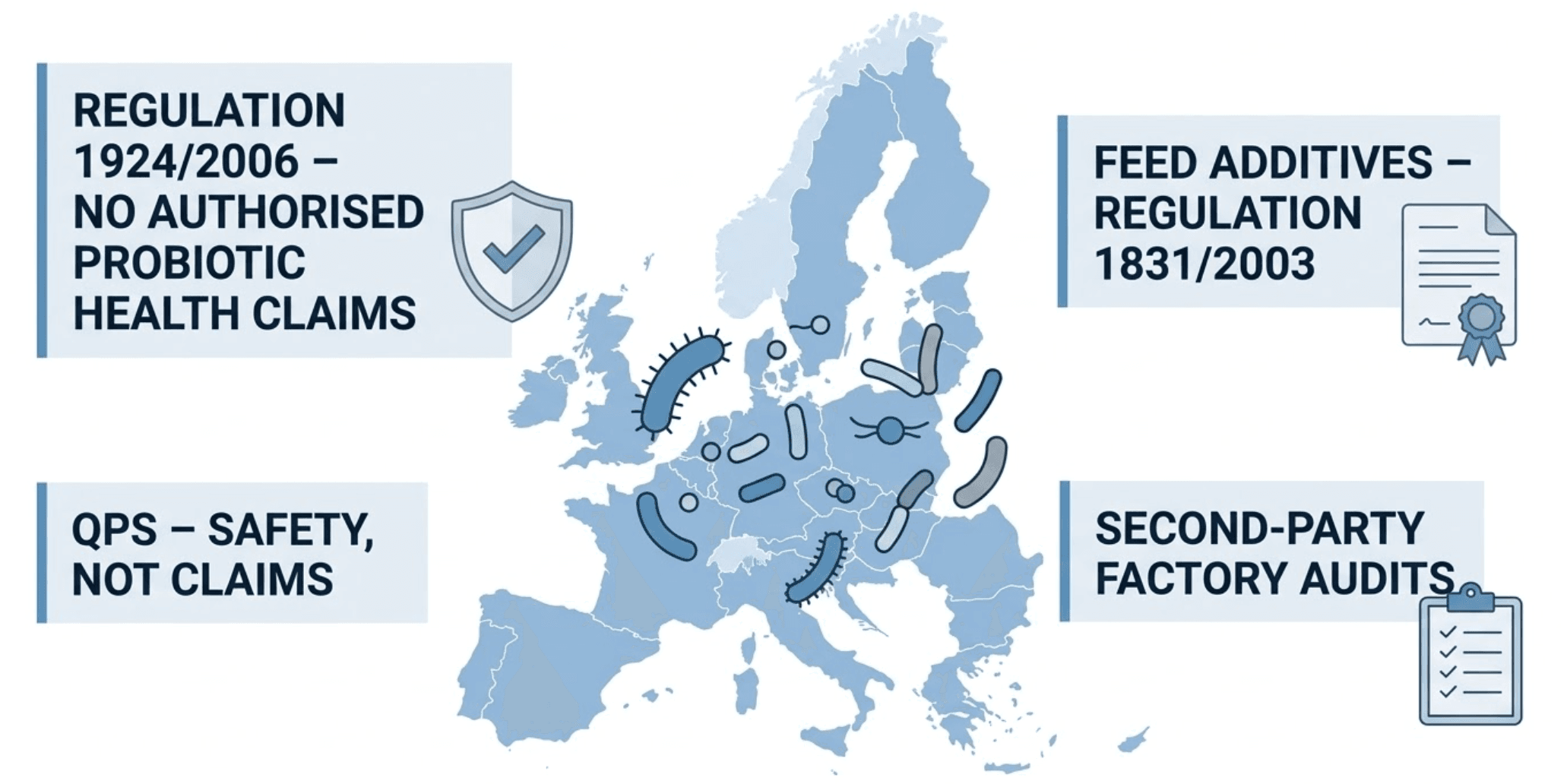
The core regulatory reality for probiotics in the EU in 2026 is uncompromising: there are currently zero EFSA-approved health claims for probiotics in human food products under Regulation (EC) 1924/2006 (EFSA). This does not prevent companies from selling foods containing live cultures; it prevents them from communicating probiotic‑related health benefits on pack at EU level (FSAI). This stringent position has remained steadfast despite numerous applications over the past two decades. Companies cannot make claims such as 'supports gut health' or 'boosts immunity' for probiotic-containing foods because no scientific consensus, as defined by EFSA, has been reached to support them for general healthy populations. This regulatory environment is arguably the strictest globally, setting a very high bar for evidence.
Some Member States have started to tolerate the word 'probiotic' on labels if no health claim is made, but this is not harmonised, and the Commission still considers 'probiotic' a de facto health claim term—so cross‑border operators should remain extremely cautious (ISAPP). This divergence creates additional compliance complexity for businesses sourcing from Southern Europe, where national practices may vary from the strict EU interpretation. The EU Ombudsman has confirmed the Commission's consistent approach that "probiotic" is generally considered an implied health claim (EU Ombudsman).
Why Are Probiotic Health Claims Rejected by EFSA?
Probiotic health claims are consistently rejected by EFSA due to a combination of factors related to scientific rigor and claim specificity (EFSA). Many applicants submit claims that are too vague, such as 'supports gut health' or 'boosts immunity,' which EFSA deems neither specific nor measurable enough. A critical deficiency lies in insufficient strain characterization; EFSA demands proof for a specific strain, not just a species, often requiring detailed genomic sequencing. Furthermore, the lack of robust human clinical trials is a major hurdle; animal studies or in-vitro research are generally not accepted as sufficient proof for human health benefits. Often, studies are conducted on sick patients, making the results inapplicable to the healthy general population that these products typically target. Finally, the claimed effect itself often lacks definitive scientific proof, failing to establish a clear cause-and-effect relationship with a broad scientific consensus. The UK advertising regulator's guidance on probiotic claims provides a practical illustration of how strictly these rules are interpreted in marketing contexts (ASA/CAP).
What Does EFSA Require for Approval That Remains Unmet?
EFSA requires a confluence of rigorous scientific criteria for probiotic health claim approval that, to date, no applicant has simultaneously met. This includes demonstrating a specific, measurable, and clearly beneficial health outcome, unequivocally proven by robust human clinical trials. These trials must be conducted on the target population, which is typically the general healthy population, to ensure relevance. The claimed effect must be clearly attributed to a specific, well-characterized probiotic strain, with its identity confirmed through advanced methods like genomic sequencing. EFSA also demands reproducible results across multiple independent studies and a clear explanation of the biological plausibility and mechanism of action (EFSA guidance). The consistent failure of all applications to meet these combined criteria underscores the formidable scientific barrier for probiotic health claims in the EU.
How Does the Qualified Presumption of Safety (QPS) List Impact Probiotic Approvals?
The Qualified Presumption of Safety (QPS) list, maintained by EFSA, impacts probiotic approvals by streamlining the safety assessment for certain microbial species but unequivocally does NOT grant or simplify health claim authorizations (EFSA Journal). Essentially, QPS status indicates that a microorganism has a history of safe use and does not pose a risk regarding toxicity, pathogenicity, or antimicrobial resistance when used in the food chain. This can significantly reduce the extensive safety data required for novel food or feed additive applications, speeding up the initial safety review process. However, safety is only one half of the regulatory equation for food probiotics.
The QPS list currently includes over 50 bacterial species, prominently featuring many Lactobacillus and Bifidobacterium strains, which are common in probiotic products. While being on this list confirms the ingredient's safety for its intended use, it provides absolutely no shortcut or advantage in securing a health claim under Regulation (EC) 1924/2006. As experts at Biosafe explain, this distinction is one of the most misunderstood aspects of the EU's regulatory framework for probiotics (Biosafe). For companies sourcing from Southern Europe, verifying that a supplier's probiotic strains are on the QPS list is a crucial step for safety and regulatory groundwork, but it's critical to understand its limitations. A second-party factory audit service in Spain or Italy, like Ambaex's AVS, can confirm proper handling and documentation for QPS status, but it cannot confer a health claim where none exist.
Why Do Probiotics for Animal Feed Succeed Where Human Food Probiotics Fail in the EU?
Probiotics for animal feed succeed where human food probiotics fail in the EU primarily due to entirely different regulatory frameworks and distinct thresholds for approval regarding efficacy (Biosafe). While human food probiotics are regulated under the extremely strict Regulation (EC) 1924/2006 for health claims, animal feed probiotics fall under Regulation (EC) 1831/2003 on additives for use in animal nutrition (Engormix). This distinction is critical because the feed additives regulation assesses both safety AND efficacy, but with different scientific criteria and a more pragmatic approach to performance benefits relevant to animal production, rather than complex human health claims.
What Is the Key Difference in Regulatory Framework: Food vs. Feed?
The key difference in the regulatory framework between food and feed probiotics lies in the specific regulations and the scope of their evaluation. For human food, Regulation (EC) 1924/2006 imposes a global high bar, requiring human clinical proof of a specific, measurable health benefit in healthy populations, a standard yet to be met by any probiotic application (FSAI). Consequently, there are zero approved claims, and the term 'probiotic' cannot be used on food labels. In stark contrast, Regulation (EC) 1831/2003 for feed additives evaluates microorganisms as 'zootechnical additives - gut flora stabilizers.' This regulation focuses on proving efficacy in animal performance (e.g., improved weight gain, feed conversion, pathogen reduction) alongside safety. This practical, performance-driven approach has led to many approvals, fostering a thriving sector for probiotics as robust alternatives to antibiotics in animal production. EFSA's published opinions on specific feed additive applications illustrate the type of efficacy data that is accepted, such as improved weight gain and feed conversion in livestock (EFSA Journal). For Ambaex, our procurement-as-a-service approach ensures that Southern European suppliers of feed probiotics meet the rigorous efficacy data and safety requirements of 1831/2003, verifying their product's utility and compliance.
What Can Food Companies Legally Do (and Not Do) with Probiotics in the EU in 2026?
In the EU in 2026, food companies can legally navigate the probiotic landscape by focusing on factual labeling and non-claim-based communication, strictly avoiding any implied health benefits for their products (FSAI). Companies can use terms like 'live cultures' or 'contains [Specific Strain Name]' to accurately describe their product's composition. They are also permitted to state the Colony Forming Unit (CFU) count and provide clear strain identification, offering transparency about the ingredients without making any health claims. Furthermore, companies can reference the general product category, for instance, 'fermented dairy product,' rather than 'probiotic yogurt.' For deeper consumer education, companies might refer to scientific literature, but this communication must remain separate from product packaging and marketing materials to avoid implying any unauthorized health benefits. Sourcing compliant ingredients from Southern Europe means verifying that suppliers are also adhering to these tight rules for documentation and handling.
Some Member States have started to tolerate the word 'probiotic' on labels if no health claim is made, but this is not harmonised, and the Commission still considers 'probiotic' a de facto health claim term—so cross‑border operators should remain extremely cautious (ISAPP). The UK advertising regulator's guidance reinforces that any suggestion of health benefits from probiotics, even implicit, is likely to be treated as a claim requiring authorization (ASA/CAP).
What Actions Are Illegal for Food Probiotic Companies in the EU?
For food probiotic companies in the EU, several actions are explicitly illegal and can lead to severe regulatory consequences. Foremost among these is calling a product 'probiotic' without an EFSA-approved health claim, which, as previously noted, does not exist for human food (FSAI). It is also prohibited to make any unapproved health claims, such as 'supports digestive health,' 'boosts immunity,' or 'improves gut flora.' Companies cannot use images, symbols, or graphical elements (e.g., a diagram of a healthy gut or immunity symbols) that imply a health benefit without authorization (ASA/CAP). Crucially, using the QPS status to suggest health benefit authorization is misleading and illegal, as QPS only pertains to safety (Biosafe). Lastly, transferring approved feed claims to human food products is strictly forbidden. Non-compliance with these regulations can result in product withdrawal, substantial fines, and other significant regulatory actions, underscoring the critical need for rigorous second-party supplier audits to prevent such issues.
How Can Ambaex's Second-Party Supplier Audit and Procurement-as-a-Service Mitigate Your EU Probiotic Sourcing Risks?
Ambaex's second-party supplier audit and procurement-as-a-service model is explicitly designed to mitigate your EU probiotic sourcing risks by providing boots-on-the-ground verification in Southern Europe, ensuring that your suppliers adhere to the complex and evolving EU/EFSA regulations. Given the unparalleled stringency of these rules, especially for human food probiotics, relying solely on a supplier's self-declarations is a significant remote sourcing risk. Our factory audit service in Spain, Portugal, and Italy goes beyond mere document checks; we conduct physical inspections to confirm that production processes, quality control, and labeling practices are fully compliant with either Regulation 1924/2006 for food or 1831/2003 for feed, depending on your application. This bespoke approach, focused on the agrifood sector, delivers the confidence required for compliant cross-border trade.
Our outsourced procurement Spain, Portugal, Italy services mean we don't just audit; we integrate compliance verification into the entire sourcing lifecycle. From initial supplier identification to contract negotiation and ongoing quality control, Ambaex acts as your eyes and ears, ensuring that every batch of probiotic ingredient meets the non-negotiable standards of the EU. This deep-dive verification is essential because regulatory nuances, such as the precise characterization of probiotic strains and the distinction between food and feed applications, require expert, on-site assessment. By embedding ourselves with your Southern European suppliers, we preempt potential compliance failures, safeguarding your product launches and market integrity. This is not generic consulting; this is verifiable, factory-floor-level assurance.
How Does the Ambaex "Identify → Verify → Execute → Rescue" Flow Ensure Probiotic Compliance?
The Ambaex "Identify → Verify → Execute → Rescue" flow ensures probiotic compliance by systematically addressing every stage of the sourcing journey with a focus on regulatory adherence and risk mitigation.
- Identify: Market Intelligence Pass. We begin by utilizing our Market Intelligence Pass service to identify potential Southern European suppliers of probiotic ingredients who possess the fundamental capabilities and quality systems necessary for navigating stringent EU regulations. This initial screening looks for suppliers that understand the nuanced distinctions between food (Reg 1924/2006) and feed (Reg 1831/2003) applications and have a track record of high-quality ingredient production within the agrifood sector.
- Verify: AVS Second-Party Audits. This is the crucial stage for compliance. Our AVS (Ambaex Verification Service) conducts thorough second-party supplier audits directly at the factories in Spain, Portugal, or Italy. For probiotic ingredients, this means meticulously verifying: the accurate characterization and identity of specific probiotic strains (e.g., genomic sequencing documentation), adherence to manufacturing processes that maintain viability and purity, proper storage conditions, and strict control over all labeling and communication materials to ensure no unauthorized health claims are made. We scrutinize documentation related to QPS status, ensuring it's correctly applied as a safety measure, not a claim (EFSA Journal). For feed additives, we verify both safety and documented efficacy claims against Reg 1831/2003, referencing published EFSA opinions on approved feed additives (EFSA Journal).
- Execute: Deal Navigator. Once a compliant supplier is verified, our Deal Navigator service manages the contractual aspects, ensuring that supply agreements explicitly incorporate clauses related to EU probiotic regulations, quality specifications, and traceability. We then oversee the Pre-Shipment Inspection (PSI) and the management of the first compliant shipment, checking that documentation, packaging, and labeling align with all EU directives, preventing issues at customs.
- Rescue: Operational Liaison. In the event of any unforeseen compliance deviation or supply chain disruption related to these sensitive probiotic ingredients, our Operational Liaison service provides immediate, on-the-ground intervention. Whether it's addressing an unexpected regulatory change, resolving a quality issue related to strain viability, or managing a logistics challenge, Ambaex acts as your local representative, ensuring swift resolution and minimizing impact on your supply chain. This comprehensive flow ensures sustained compliance from the factory floor to your receiving dock.
How Can You Secure Compliant Probiotic Ingredients from Southern Europe?
Securing compliant probiotic ingredients from Southern Europe in 2026 demands a proactive and thoroughly verified sourcing strategy that goes far beyond standard due diligence. The EU's unique and exceptionally strict regulatory landscape, particularly the absence of approved health claims for human food probiotics, creates a high-stakes environment where missteps can be costly. For companies operating in the agrifood sector, merely knowing the rules isn't enough; you need absolute assurance that your Southern European suppliers are meticulously adhering to them at every stage of production and documentation (PJRFSi). This requires dedicated, on-site verification.
Ambaex offers this essential layer of security. Through our specialized second-party audit service and comprehensive procurement-as-a-service model, we are your boots on the ground in Spain, Portugal, and Italy. We ensure that your probiotic ingredient suppliers are not only aware of, but are actively compliant with, the nuanced requirements of Regulation 1924/2006 for food or 1831/2003 for feed. Our expertise in factory auditing, focused specifically on the complexities of food and feed ingredients, transforms the inherent risks of remote sourcing into verified, dependable supply chains. Don't leave your compliance to chance; partner with Ambaex to build a resilient and compliant procurement process for your probiotic ingredients.
Can I use the word 'probiotic' on food labels in EU?
At EU level, the term 'probiotic' on food labels is generally treated as an unauthorised health claim, so it is effectively banned in most cross‑border contexts unless an authorised claim exists—which currently it does not (EU Ombudsman). Some Member States have started to tolerate the word 'probiotic' on labels if no health claim is made, but this is not harmonised, and cross‑border operators should remain extremely cautious (ISAPP).
Does QPS list mean my probiotic is approved?
No, being on the QPS list does not mean your probiotic is approved in the sense of health claims. The Qualified Presumption of Safety (QPS) list only covers the safety assessment of microbial species for use in the food chain (EFSA Journal). It streamlines safety evaluation but does not confer any authorization for health claims, which still requires separate and stringent approval under Regulation 1924/2006, an approval that has never been granted for any probiotic (Biosafe).
Why are animal feed probiotics approved but food probiotics not?
Animal feed probiotics are approved while human food probiotics are not due to different regulatory frameworks and standards for efficacy proof. Feed probiotics are approved under Regulation (EC) 1831/2003, which assesses both safety and efficacy based on performance benefits in animals (Engormix). Human food probiotics, however, fall under Regulation (EC) 1924/2006, which sets an exceptionally high bar for efficacy, demanding robust human clinical proof in healthy populations, a standard no probiotic application has yet met (FSAI).
📚 Sources & Further Reading
- EFSA – Health claims topic page (overview of process and status).
- Food Safety Authority of Ireland (FSAI) – Probiotic Health Claims (explicitly states no authorised probiotic health claims and explains consequences).
- ASA/CAP (UK) – Food: Probiotic claims (practical explanation of how probiotic claims are treated in marketing).
- EU Ombudsman decision (summarising Commission practice on "probiotic" as an implied health claim).
- ISAPP – "Probiotic" on food labels in Europe: Spain adopts a pioneering initiative (explains non‑harmonised EU situation).
- FoodNavigator – Why the EU still restricts "probiotics" claims (journalistic overview).
- PJRFSi – EU maintains restrictions on "probiotic" claims amid ongoing debate (summarises Commission stance and Member State variations).
- EFSA Journal – Update of the list of qualified presumption of safety (QPS) (current QPS concept and list).
- Biosafe – Probiotics and beyond in the EU: A regulatory maze for food and feed (clear explanation of QPS, food vs feed, and common misunderstandings).
- Engormix – EU probiotics regulation (practical overview of probiotics as feed additives).
- EFSA Journal – Safety and efficacy of a feed additive consisting of Lacticaseibacillus… as a gut flora stabiliser (illustrates how feed probiotics are evaluated and authorised).
These sources back every key statement in this article about: no authorised human food probiotic health claims, "probiotic" as an implied health claim term, QPS as safety‑only, and the more permissive but separate framework for animal feed.