What are the Hidden Risks of Sourcing Probiotic Ingredients in the EU's Complex Regulatory Landscape?
Navigating the EU's highly complex and stringent regulatory landscape for probiotic ingredients in 2026 presents significant hidden risks for businesses relying on remote sourcing. The digital age has shortened supplier lists and made factories seem accessible, yet this transparency often masks opaque compliance statuses, especially for sensitive products like probiotics where the rules are exceptionally tight. Without on-the-ground verification, companies risk not only financial penalties and product recalls but also severe reputational damage, particularly when dealing with the nuanced `probiotics regulation EU 2026`.
This inherent `remote sourcing risk` is precisely where a specialized `second-party audit service` becomes indispensable. Ambaex, with its boots-on-the-ground presence in Southern Europe, offers `procurement-as-a-service Europe` to ensure that your suppliers of active ingredients, particularly microbial strains, are fully compliant and capable of meeting the EU's exacting standards. We act as your eyes and ears, transforming a potential compliance minefield into a verified and secure supply chain.
What is the EU Regulatory Landscape for Probiotics in 2026?
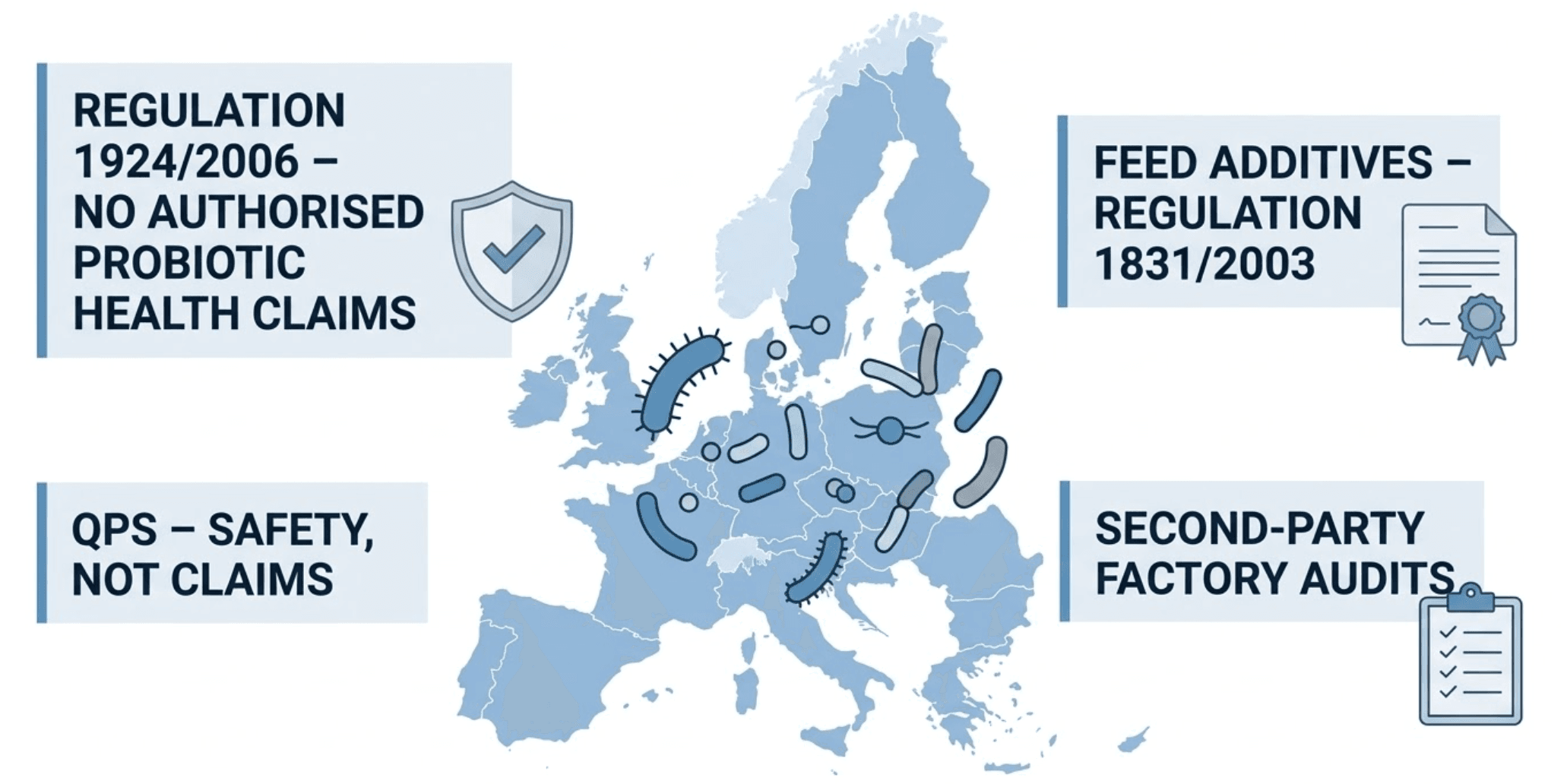
The EU regulatory landscape for probiotics in 2026 remains exceptionally stringent, effectively preventing the use of the term 'probiotic' and the approval of probiotic health claims for food products, while permitting a more accessible pathway for feed additives. As of 2026, the core reality is that the European Food Safety Authority (EFSA) has not approved a single health claim for probiotics in food under `Regulation (EC) 1924/2006`. This means that companies generally `cannot call product probiotic in EU 2026` if it is intended for human consumption and makes a health claim.
This uncompromising stance contrasts sharply with the situation for animal feed, where `probiotics feed additives EU 1831/2003` are frequently approved. These zootechnical additives, often termed 'gut flora stabilizers', demonstrate clear efficacy for animal health and performance and represent a thriving, legally compliant sector. The stark difference in `probiotics regulation food vs feed EU` is a critical distinction that ingredient buyers must understand to avoid costly non-compliance. Our `market intelligence pass` during the `Identify` phase helps clients understand these dual realities when exploring potential suppliers in Southern Europe, distinguishing between those equipped for the feed market versus the far more challenging food sector.
Why are Probiotic Health Claims Rejected by EFSA?
Probiotic health claims are rejected by EFSA primarily because no applicant has yet met the exceptionally high bar of scientific evidence required, which demands specific strain proof, measurable benefits, and robust human clinical trials. EFSA's rigorous `EFSA probiotics requirements 2026` mandate a level of scientific substantiation that is virtually unparalleled globally, leading to the continuous `probiotic claims rejection EU`. Key reasons for these rejections include claims being too vague, such as 'supports gut health' or 'boosts immunity', which are not specific or measurable enough for EFSA.
Furthermore, applicants often fail to provide sufficient strain characterization, as EFSA requires proof for a specific strain, not merely a species, necessitating genomic sequencing and clear identification. A persistent issue is the `lack of robust human trials`, with animal studies or in-vitro data consistently deemed insufficient. EFSA also scrutinizes `target population mismatch`, where studies conducted on sick patients cannot be extrapolated to a general healthy population, which is typically the target for such claims. Finally, many applications fail to demonstrate a truly `proven claimed effect`, with EFSA demanding a clear cause-and-effect relationship supported by a strong scientific consensus that has not been consistently met.
When sourcing specialized ingredients like probiotic strains from Southern Europe, our `Verify` stage involves an Ambaex `second-party supplier audit` which scrutinizes a factory's R&D capabilities and their understanding of these stringent EFSA requirements. While we cannot guarantee claim approval, we ensure that the supplier's internal quality management and documentation processes for their strains are meticulously aligned with the highest scientific standards, preparing products for potential export markets or for the EU feed sector where claims are permissible.
How Does EFSA's Qualified Presumption of Safety (QPS) List Impact Probiotic Sourcing?
EFSA's Qualified Presumption of Safety (QPS) list significantly streamlines the safety assessment for novel microbial species but, critically, does not grant any health claims or marketing authorizations for probiotics. The `EFSA qualified presumption safety probiotics` status is purely a safety evaluation mechanism, meaning that species on the `QPS list EFSA probiotics` have a history of safe use and pose no immediate safety concern regarding toxicity, pathogenicity, or antimicrobial resistance in the food chain. This can simplify the safety approval process for microorganisms used in food or as feed additives.
However, it is vital to understand that `QPS ≠ approved probiotic claim`. QPS status does not imply any efficacy or health benefit, nor does it circumvent the requirements of `Regulation 1924/2006` for health claim substantiation. While over 50 bacterial species, including various Lactobacillus and Bifidobacterium strains, are on the QPS list, their inclusion merely accelerates the safety aspects of a Novel Food application or feed additive approval. The arduous and currently unmet task of proving a specific health benefit remains entirely separate. For clients engaging in `procurement-as-a-service Europe` with Ambaex, we ensure that suppliers in Spain, Portugal, or Italy can provide verifiable QPS documentation for their strains, which is essential for safety compliance, even if health claims for food products are off-limits in the EU.
What are the Key Differences in Probiotics Regulation Between Food and Feed in the EU?
The EU applies vastly different regulatory frameworks to probiotics, with human food probiotics facing an almost unachievable hurdle for health claims, while animal feed probiotics are widely approved as 'gut flora stabilizers'. This `probiotics regulation food vs feed EU` split creates two entirely distinct compliance pathways. For human food, `Regulation (EC) 1924/2006 on nutrition and health claims made on foods` is the dominant legislation. As detailed, ZERO claims have been approved, rendering the term 'probiotic' essentially unusable for marketing purposes in the EU unless an approved claim is secured, which has not happened. Companies sourcing for food products must therefore resort to terms like 'live cultures' or 'contains [Strain Name]' and avoid any implication of health benefit.
In stark contrast, `Regulation (EC) 1831/2003 concerning additives for use in animal nutrition` has facilitated the approval of many probiotic strains as 'zootechnical additives – gut flora stabilizers'. Under this framework, both safety and efficacy are evaluated, and numerous products have successfully demonstrated performance benefits in animal production, offering robust alternatives to antibiotics. This thriving sector represents a viable regulatory route for probiotic ingredient suppliers in Southern Europe. Furthermore, the `probiotics novel food regulation Europe` pathway might apply if a microbial strain is deemed novel, adding another layer of complexity for human food applications. Our `Execute` phase, through Deal Navigator, helps clients navigate these dual regulations by ensuring accurate contract terms, product specifications, and regulatory documentation for the intended market, whether it's the stringent food sector or the more accessible feed additive category.
How Can Ambaex's Second-Party Audit Advantage Mitigate Remote Sourcing Risk for EU Probiotics?
Ambaex's `second-party audit advantage` fundamentally mitigates the `remote sourcing risk` inherent in acquiring complex, highly regulated probiotic ingredients in Southern Europe by providing on-the-ground verification and expert procurement management. Given the challenging EU regulatory landscape, relying solely on supplier declarations or third-party certifications (which often don't delve into specific regulatory nuances like EFSA's probiotic requirements) is a recipe for compliance failures. Our `factory audit service Spain / Italy` fills this critical gap, offering clients unparalleled insight into their potential supply chain partners.
Our structured `Identify → Verify → Execute → Rescue` workflow is specifically designed to address these challenges:
- Identify: Through our Market Intelligence Pass, we scout and vet potential `probiotic ingredient` suppliers in Spain, Portugal, and Italy. We focus on factories that not only possess the microbial cultivation capabilities but also demonstrate an understanding of the intricate EU regulations, whether for feed additives under `Reg 1831/2003` or for export-oriented human food products. We actively filter out those with a history of `probiotic claims rejection EU` or non-compliance.
- Verify: This is where our `second-party audit service` truly shines. Our experts conduct detailed, on-site audits to assess the supplier's specific strain characterization methods, quality control for CFU counts, and their documentation of `QPS list EFSA probiotics` status. We verify their adherence to manufacturing best practices for live cultures and their readiness to provide the robust scientific dossiers required, even if for export to markets outside the EU that permit 'probiotic' claims. This goes beyond generic quality checks to assess deep regulatory alignment.
- Execute: With a verified supplier, our Deal Navigator service steps in, managing contract negotiations, ensuring product specifications align with regulatory requirements (e.g., precise strain identification for `EFSA probiotics requirements 2026`), and overseeing Pre-Shipment Inspections (PSI). We ensure that packaging, labeling, and supporting documentation are compliant with the intended market's regulations, whether avoiding the term 'probiotic' for EU food or correctly classifying it as a `zootechnical additive` for feed. This `procurement-as-a-service Europe` ensures a smooth and compliant first shipment, preventing issues related to `Regulation 1924/2006 probiotics` or `probiotics novel food regulation Europe`.
- Rescue: Should any unforeseen issues arise in the supply chain – perhaps a new regulatory interpretation or a quality deviation – our Operational Liaison service provides immediate, on-the-ground intervention. This ensures that any potential `non-compliance` or `enforcement examples 2024-2026` can be swiftly addressed, minimizing disruption and protecting your investment in sensitive `probiotic` ingredients.
By leveraging Ambaex's `outsourced procurement Spain Portugal Italy`, businesses gain a critical competitive advantage, turning the daunting `remote sourcing risk` of the EU probiotic market into a strategic opportunity for secure and compliant ingredient acquisition.
What are the Practical Implications and Compliance Strategies for Food Companies in EU 2026?
In EU 2026, the practical implications for food companies are clear: without an EFSA-approved health claim, they cannot use the term 'probiotic' on product labels or make any health-related claims. Companies must adopt a compliance strategy that focuses on factual transparency and cautious communication. This means they can legally `use term 'live cultures' or 'contains [Strain Name]'` and `state CFU count and strain identification`. They may `reference general product category` like 'fermented dairy product' instead of 'probiotic yogurt'. Indirect consumer education via scientific literature, separate from the product packaging, is another route.
Conversely, companies `cannot call product 'probiotic' without approved claim`, `claim 'supports digestive health'`, or `imply health benefit through images`. Using QPS status to suggest a health benefit is also forbidden, as is transferring approved feed claims to human food. Non-compliance can lead to severe penalties, including product withdrawals, substantial fines, and regulatory action, as evidenced by `enforcement examples 2024-2026` where national authorities issue warnings and fines for unauthorized labeling. For B2B suppliers, the compliance strategy means avoiding 'probiotic' terminology in EU communications unless for export, providing comprehensive safety data and QPS status, and clearly stating 'NOT for health claims in EU' in technical documentation. The `comparison: EU vs Other Markets` highlights the unique stringency of the EU, where `zero approved` claims stand against more permissive regimes in the USA, Canada, Japan, and Australia.
Can I use the word 'probiotic' on food labels in EU 2026?
No, you cannot use the word 'probiotic' on food labels in the EU in 2026 without an EFSA-approved health claim, and currently, there are zero such approvals. This is a direct consequence of `Regulation (EC) 1924/2006`, which dictates that any term implying a health benefit must be scientifically substantiated and authorized by EFSA. Since no probiotic health claims have ever met EFSA's rigorous standards, using the term 'probiotic' is considered an unauthorized health claim and is therefore non-compliant.
Does EFSA's QPS list mean my probiotic is approved for health claims?
No, EFSA's Qualified Presumption of Safety (QPS) list does not mean your probiotic is approved for health claims. The QPS list pertains exclusively to the safety assessment of microbial species, confirming their history of safe use and streamlining the safety evaluation for applications as food ingredients or feed additives. It is a safety status only and explicitly does not grant any authorization for health claims or marketing as a 'probiotic' product. For health claim approval, a separate, extensive application process under `Regulation (EC) 1924/2006` is required, which, for probiotics, has historically resulted in unanimous rejections due to unmet scientific criteria.
Why are animal feed probiotics approved but human food probiotics are not?
Animal feed probiotics are approved under `Regulation (EC) 1831/2003` because this framework assesses both safety and efficacy, often requiring proof of performance benefits in animals, which is a hurdle many products have successfully cleared. In contrast, human food probiotics fall under `Regulation (EC) 1924/2006`, which sets an exceptionally high bar for health claims, demanding robust human clinical trials in healthy populations, specific strain characterization, and a clear mechanism of action. This stringent scientific requirement has, to date, been unmet by all probiotic applications for human food, leading to their consistent rejection. The regulatory intent and evidentiary standards are fundamentally different, explaining the divergent outcomes for `probiotics regulation food vs feed EU`.
Navigating the EU's unyielding `probiotics regulation EU 2026` demands unparalleled vigilance and expertise, especially when engaging in `remote sourcing risk` for sensitive ingredients from Southern Europe. For agrifood businesses, understanding that `ZERO EFSA-approved probiotic health claims for foods exist` is not just a regulatory nuance, but a fundamental commercial reality. Ambaex stands as your crucial partner in this intricate environment, transforming the challenges of `probiotic claims rejection EU` and `EFSA probiotics requirements 2026` into pathways for compliant, high-quality sourcing.
Our specialized `second-party supplier audit` and `procurement-as-a-service Europe` ensure that your supply chain for critical ingredients from Spain, Portugal, or Italy is not merely efficient but rigorously verified against the strictest EU standards. We go beyond basic compliance, diving deep into supplier capabilities, ensuring that your procurement decisions are built on a foundation of verified quality and regulatory foresight. Don't let `remote sourcing risk` undermine your market position. Contact Ambaex today to fortify your probiotic ingredient supply chain with our boots-on-the-ground expertise in Southern Europe, ensuring your products, whether for the EU feed market or global human food exports, meet the exacting demands of modern regulation and quality.