This article details the surge in wine and olive oil fraud, exacerbated by economic pressures, and advocates for buyer-side audits to mitigate risks and protect against multi-billion-euro losses.
- Food fraud incidents increased 1041% from 2020-2023.
- Annual economic losses from food fraud: up to €40 billion.
- Olive oil and wine are high-risk categories in the EU.
- Fraud includes adulteration, mislabelling, and counterfeiting.
- Economic pressures drive fraud in Mediterranean countries.
AMBAEX Market Intelligence
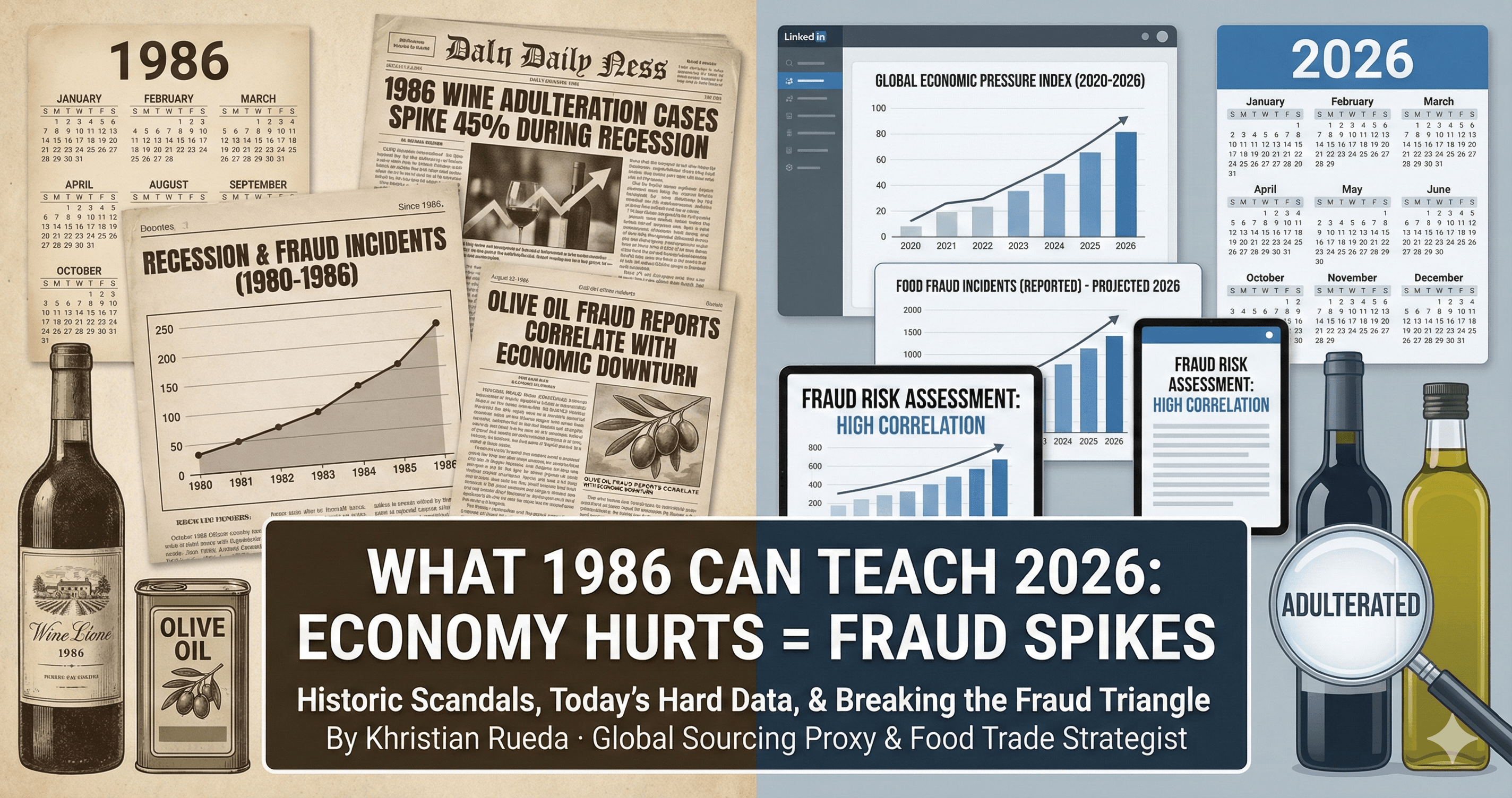
What a 1986 Crisis Teaches the 2026 Buyer: Why Wine & Olive‑Oil Fraud Spikes When the Economy Hurts
Historic Scandals, Today’s Hard Data, and How Buyer‑Side Audits Break the Fraud Triangle
1. Hard Facts: Fraud Isn’t Random, It’s a Predictable Deviation.
Since COVID, food and wine fraud has stopped being a series of isolated scandals and become a measurable trend. An analysis by SGS DigiComply shows that recorded food‑fraud incidents increased by 1,041 % from 2020 to 2023, with 2,479 incidents already logged by May 2024—on track for another ~10 % rise (Food Fraud Explosion, LinkedIn summary).
Global reviews estimate annual economic losses from food fraud at up to €40 billion per year, with oils, wine, honey, spices and seafood consistently ranked “high risk” in European and international incident databases (2024 Global Food Fraud Report).
Inside the EU, olive oil and wine are now front line categories. Freedom‑of‑information data reported by UK media show that olive‑oil fraud and mislabelling cases have reached record highs, with 182 notifications since January 2023 and suspected cases in the first quarter of 2024 several times higher than in 2018 (Olive‑oil fraud at record high, Olive‑oil fraud and mislabelling in EU). Italy, Spain and Greece account for the majority of these alerts.
In parallel, global wine‑fraud monitoring highlights rising cases of adulteration, mislabelling and counterfeiting, particularly in high‑value appellations and export markets (FAN 2024 report). Put simply: the background risk level in 2025–26 is far higher than during “normal” years.
The drivers are no mystery. Across Mediterranean producer countries, the last five years have combined:
- Inflation and energy shocks pushing up glass, fuel and packaging costs.
- Droughts, heatwaves and erratic harvests reducing yields and raising grape and olive prices.
- Post‑COVID debt and higher interest rates compressing margins for small and medium producers.
In fraud‑risk language, that means the pressure side of the fraud triangle has intensified exactly when opportunity (complex global supply chains, strained regulators) and rationalisation (“just this once, to survive the year”) are also growing.
2. Why 1986 Still Matters: Three Scandals, One Triangle
The easiest way to understand why 2026 is risky is to look at three past European wine scandals. The chemistry and the labels change; the underlying incentives do not.
2.1 Italian Methanol Wine Scandal (1986): When Cost Cutting Turns Lethal
In spring 1986, some Italian producers added methanol (industrial wood alcohol) to cheap bulk wines to boost alcohol cheaply. At least 18–20 people died and many more went blind or suffered organ damage after drinking the adulterated wine.[ LA Times – Italy jolted by poisoning, UPI – Italy battles poison wine scandal]
Investigations traced the fraud to a handful of wholesalers who doctored low‑end wine to raise margins. Hundreds of thousands of bottles were seized; Italy temporarily halted wine exports and the scandal damaged the country’s image as the world’s leading wine exporter.[ UPI – ‘Wine Massacre’ trial, Time – Poison Plonk]
It was classic fraud triangle logic: economic pressure on low‑margin producers, opportunity in fragmented low‑end markets, and rationalisation (“it’s only cheap table wine”)—until people died and exports shut down.
2.2 Brunello di Montalcino Adulteration (2008): When Reputation Meets Temptation
In 2008, Italian authorities discovered that some Brunello di Montalcino producers were blending non‑permitted grapes such as Merlot and Cabernet into a DOCG wine legally required to be 100 % Sangiovese. Around 1.3 million litres of Brunello and related wines were downgraded or declassified after the investigation.[ Wine Spectator – Brunello Investigation Ends, Vin Québec – Le scandale du Brunello]
Here, the driver was not survival at the bottom of the market, but the temptation to stretch rules in a prestige DOCG where prices are high and demand is strong. Pressure to meet volumes and margins + opportunity to blend cheaper grapes + rationalisation (“the wine tastes good anyway”) = fraud.
2.3 Counterfeit Fine‑Wine Scandals: Kurniawan & the “Jefferson Bottles”
In the 2000s, Indonesian collector Rudy Kurniawan turned his California home into a counterfeiting lab, blending cheaper wines and rebottling them as rare Burgundy and Bordeaux. He sold an estimated US$20–30 million of fake wine before being convicted and sentenced to 10 years in prison, with US$28.4 million in restitution ordered (CBS – Kurniawan sentencing, Vivino – $28m wine fraud).
Around the same time, German dealer Hardy Rodenstock built a mystique around ultra‑rare “Jefferson bottles” supposedly owned by Thomas Jefferson. Subsequent investigations and lawsuits led by collector Bill Koch showed major inconsistencies in engravings, provenance and wine composition, and the bottles are now widely considered sophisticated fakes (Wine Fraud Chronicles – Hardy Rodenstock, Decanter – Jefferson bottles case).
In both cases, sky‑high prices for rare bottles created intense incentive and plenty of opportunity within weakly regulated auction circuits. The result: counterfeit wine became an asset‑class problem, not just a food‑safety issue, and the sector turned to technologies such as chemical fingerprinting and blockchain traceability projects like TRACEWINDU to restore trust.
2.4 What These Scandals Tell Us About 2026
Across all three cases, the pattern is consistent:
- Pressure: weak harvests, intense competition, or the lure of very high prices.
- Opportunity: fragmented supply chains, opaque markets (bulk wine, auctions), and limited real‑time oversight.
- Rationalisation: “only cheap wine”, “it still tastes good”, or “everyone does it”.
In 2025–26, European producers face climate stress, cost inflation and shifting trade flows. Fraud‑monitoring data show a ten‑fold jump in incidents since 2020, with olive oil and wine among the most affected categories. The fraud triangle has not changed; the fuel feeding it has increased.
3. Modern, Everyday Fraud that Hits Importers
Most foreign buyers will never see a methanol‑level disaster. What they face instead is frictional fraud that quietly drains money and reputation:
- Adulteration: low‑grade oil or seed oil blended into “extra virgin” olive oil; sweeteners or water added to wine and juice.
- Substitution: cheaper varieties or origins substituted in PDO/PGI products; “Italian” or “Spanish” that actually comes from third countries.
- Dilution: premium lots diluted with bulk wine or lower‑grade oil.
- Mislabelling / misrepresentation: fake organic, fake Halal, wrong vintage, wrong grape percentages.
- Counterfeiting: cloned labels and brands, refilled genuine bottles.
- Document forgery: certificates of origin, analyses, or health docs edited to pass quick checks.
Incident data and EU fraud reports repeatedly flag olive oil, wine, honey, spices and seafood as structurally high‑risk categories—exactly the portfolio many GCC and APAC buyers now demand.
4. Why Foreign Buyers Are Hit Hardest When Pressure Rises
Importers arriving from GCC or Asia into Spain and Italy in a high‑pressure cycle face three structural disadvantages:
- They buy when prices are high and regulators are stretched. Enforcement agencies are chasing more cases with the same resources; it is unrealistic to expect them to catch every bad shipment before it loads.
- They rely on documents and photos, not on‑site checks. A glossy presentation or a tidy sample is cheap to produce; verifying the actual line, tanks and paperwork requires someone on the ground.
- They are exposed to parallel markets. Fake PDO seals, refilled bottles, diverted stock and “triangulated” shipments are much easier to hide from a remote buyer than from a local auditor.
This is exactly how your own three micro‑stories happen:
- €85k wired to a “marble supplier” in Alicante whose address turned out to be a residential flat.
- A factory tour where the production line shown actually belonged to a neighbour in the same industrial estate.
None of these are freak accidents; they are predictable outcomes when opportunity and pressure meet an absence of independent verification.
5. What Changes When You Add a Buyer‑Side Audit
The good news is that you do not need your own EU office to change the odds. Two or three simple rules dramatically reduce exposure:
5.1 Risk‑Rank Products and Suppliers
Treat categories like olive oil, wine, spices, honey, dairy and seafood as high‑risk by default. For any new supplier in these lines, a second‑party audit should be mandatory, not optional.
5.2 Make Second‑Party Audits a Standard Step
A buyer‑side auditor in Spain/Italy/Portugal can:
- Check that the factory exists and matches what was pitched.
- Review production records, traceability and any PDO/PGI or organic documentation.
- Assess basic quality controls, lab capacity and export readiness.
- Identify conflicts of interest (e.g., agents paid by suppliers, not buyers).
5.3 Lock in Pre‑Shipment Inspection and Traceability Checks
Before any container doors close:
- Verify quantities, labelling, batch numbers and best‑before dates against contracts.
- Perform simple traceability tests (from batch back to tank or lot) and, where needed, draw samples for lab analysis.
- For high‑value wines or oils, consider advanced tools: NFC‑tagged closures, blockchain‑linked labels, or targeted isotope / chemical tests (an approach already used in projects like TRACEWINDU and other EU authenticity initiatives).
The rule of thumb: use technology where it exists and is proportionate; rely on disciplined on‑site audits and PSIs for everything else.
6. The Role of Ambaex: A Risk Brake Between Sample and Container
Economic pressure and climate volatility are not going away. History—from the 1986 methanol scandal to Brunellopoli and modern counterfeiting—shows that when conditions tighten, fraud finds the weakest link in the chain.
If you buy from Southern Europe without an independent pair of eyes on your side, you are that weakest link.
As a buyer‑side sourcing and audit partner based in Spain, Ambaex acts as a boots‑on‑the‑ground risk brake for GCC and APAC importers:
- We map and pre‑screen suppliers in olive oil, wine and Mediterranean foods.
- We conduct second‑party audits and PSIs in Spain, Italy and Portugal before you commit serious money.
- We help you decide when a simple on‑site check is enough—and when to call in lab or digital tools.
1986 taught Europe the cost of ignoring economic pressure in the vineyard. 2026 will teach importers the cost of trusting paperwork without verification. You can choose which side of that lesson you want to be on.