AMBAEX Market Intelligence
"We Paid, They Vanished": How Non‑EU Buyers Get Trapped by Ghost Suppliers in Italy
Non‑EU buyers do get burned by "Made in Italy" ghost suppliers—especially when deals start on platforms and end with advance payments wired to firms nobody has ever visited.
Italian food, wine and FMCG suppliers are in high demand—but not every "Made in Italy" profile you see online is what it claims to be. Italian export professionals and lawyers have documented cases where foreign buyers pay Italian "suppliers" found on the web, only to discover that the goods are never shipped, partially shipped, or that the company becomes impossible to reach once money has changed hands according to Italian export industry warnings.
For non‑EU buyers under pressure to secure stock quickly, this is more than an annoyance; it's a direct hit to cashflow, credibility and sometimes their own job security.
How the ghost‑supplier scenario usually starts
Italian export practitioners describe a recurring pattern in "online export" scams as documented in industry reports:
- A foreign buyer discovers an Italian "supplier" via an online platform, directory or search.
- The profile looks professional: photos, basic product specs, maybe even scanned certificates.
- The "supplier" proposes attractive prices and asks for significant advance payment—30–50% or even 100% for the first order.
- Once the payment is wired, one of three things happens:
- goods are never shipped;
- only part of the order is shipped;
- or shipping is delayed repeatedly with excuses until the buyer gives up as described in scam case studies.
- When the buyer pushes for answers, the company becomes hard to reach: calls unanswered, emails ignored, or responses so vague that no clear solution is offered according to affected buyer accounts.
Italian legal guides on commercial disputes confirm that advance payment followed by non‑delivery or unjustified delay is considered a breach of contract, giving the buyer the right to terminate and claim damages as explained in Italian contract law guidance. The problem for non‑EU buyers is that exercising those rights in Italy, after the fact, is slow, costly and uncertain.
Root causes: why this happens (beyond "bad people")
1. Over‑reliance on platforms and paperwork
Platforms and B2B directories are useful for discovery, but they are not due diligence. Italian export specialists warn that foreign buyers often trust as noted in export fraud analyses:
- a nice website,
- a few PDFs of certificates,
- and 1–2 video calls
as if they were equivalent to a proper background check and site visit. They are not.
2. Information asymmetry and distance
For a non‑EU buyer, it's hard to verify according to Italian legal practitioners:
- whether the company actually exists at the declared address;
- whether the person on Zoom is legally authorised to bind the company;
- whether there is real production capacity behind the brochure.
Meanwhile, the supplier knows the buyer is thousands of kilometres away, unfamiliar with Italian procedures and courts, and unlikely to pursue expensive litigation over a "small" loss (50–100k).
3. Weak contracts and risk allocation
Many first orders are closed on a simple proforma invoice with generic terms. Italian legal commentary notes that, in international sales, poorly drafted contracts create big grey areas on as highlighted in international dispute guidance:
- when delivery is considered late enough to be a breach;
- what happens in case of non‑delivery;
- which court has jurisdiction;
- which law applies and what damages can be claimed.
This ambiguity often benefits the non‑performing supplier.
4. No independent verification before sending money
Italian law firms and trade advisors repeatedly emphasise that disputes often arise where foreign buyers never performed on‑site checks, never verified ownership, and never cross‑checked the supplier's track record before wiring advance payments as noted in dispute prevention guides. In other words, the risk is "baked in" before the first euro leaves the buyer's bank.
Documented warnings from Italy
A 2021 article by an Italian export wholesaler describes common scams in "Made in Italy" online exports, including as detailed in the original report:
- fake or unreliable "suppliers" found via the web;
- advance payments requested up front;
- goods never shipped or only partially delivered;
- companies that then become unreachable or very hard to pursue.
The author explicitly warns foreign buyers against sending money to unknown Italian "suppliers" identified only through online platforms, precisely because of the risk of fraud and non‑delivery according to the warning.
Italian legal practitioners also highlight that, in disputes with Italian suppliers, foreign buyers often discover too late that they have to litigate in Italy under Italian law, which increases cost and complexity compared with solving the problem before payment as explained in Italian contract guidance.
What can a non‑EU buyer do differently?
1. Move due diligence before the first payment
Basic checks that should happen before agreeing to an advance:
- Verify company registration, VAT and address through official registers or reputable intermediaries.
- Confirm who the legal representative is and that they are the person signing your documents.
- Ask for recent export references (countries, clients, volumes) and cross‑check where possible.
Guides on resolving supplier disputes in Italy explicitly recommend clear documentation and verification at the contract stage, because it makes later enforcement more realistic as noted in legal recommendations.
2. Use robust contracts and neutral jurisdiction where possible
Italian and international law firms recommend according to dispute resolution guidance:
- written contracts (not just proformas) that specify:
- exact delivery terms and deadlines,
- consequences of delay/non‑delivery (penalties, right to terminate),
- applicable law and jurisdiction or arbitration venue;
- considering neutral arbitration (e.g. ICC) or at least clarifying which court will hear disputes.
This doesn't prevent a supplier from ghosting, but it gives you leverage and makes the legal risk transparent.
3. Limit exposure on the first order
Typical risk‑management moves:
- Keep the first order smaller and structure payments in milestones (e.g. deposit + balance against shipping documents), rather than 100% up front.
- Use instruments that offer some protection (e.g. confirmed letters of credit, escrow services) where deal size justifies the cost.
- Test with one or two pallets before scaling to full containers.
Italian practitioners note that many painful disputes start with large advance payments on the very first deal with an untested partner as highlighted in contract breach analyses.
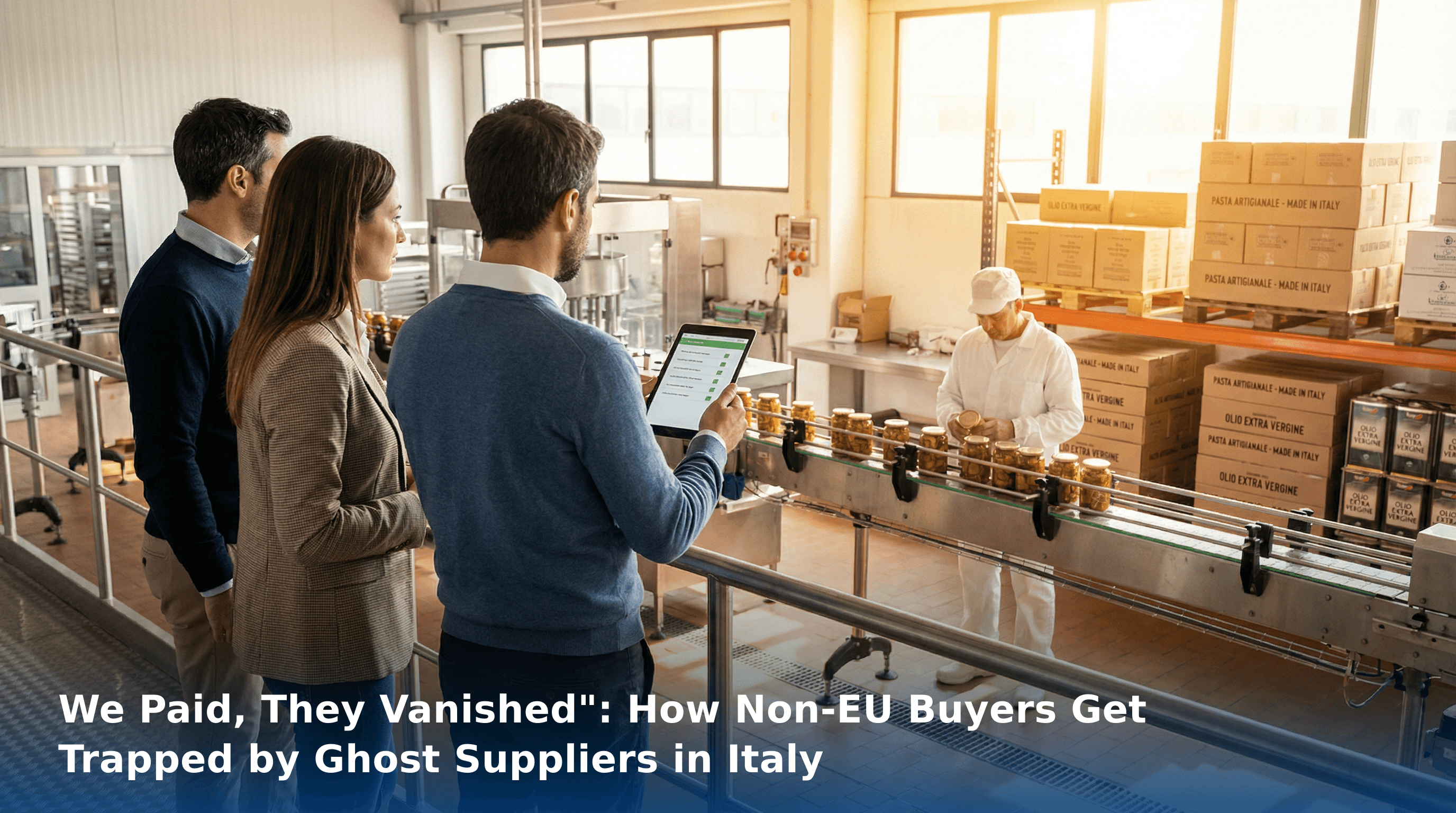
4. Engage local verification: second‑party audits and liaison
For higher‑risk or higher‑value orders, a local presence is often the cheapest insurance:
- A second‑party audit or factory visit by a trusted local partner can confirm that:
- the facility exists,
- production and quality systems are real,
- the company is actually shipping similar products abroad.
- A local liaison (consultant, law firm, or audit company) can also handle:
- formal legal notices in Italian if something goes wrong,
- on‑site checks when communication slows down or stops.
Italian dispute‑resolution guides stress the importance of formal notice (diffida) and evidence of breach when escalating; having someone on the ground makes this far more effective according to legal practitioners.
When the worst has already happened: practical first moves
If you are already in the "we wired the money, delivery date has passed, supplier is silent" situation:
- Document everything: POs, proformas, emails, messages, call logs.
- Send a formal notice (diffida) via a local lawyer, setting a short, clear deadline for cure (delivery or refund), in line with Italian practice as outlined in Italian legal procedure.
- Check your contract for jurisdiction and applicable law before starting any legal action.
- Notify your insurer if you have credit insurance or trade insurance.
- Report to relevant authorities if fraud is suspected; Italian and EU bodies (including EPPO for certain schemes) have pursued fraud involving non‑delivery and misuse of funds in agri‑food and related sectors according to European Court of Auditors reports.
None of this guarantees full recovery, but it converts an emotional reaction ("we've been ghosted") into a structured response grounded in Italian legal tools.
The strategic lesson for non‑EU buyers
The Italian market is full of excellent suppliers—but also a non‑trivial number of opportunistic or outright fraudulent actors trying to ride the "Made in Italy" brand online. Italian experts themselves are warning foreign buyers not to rely purely on platforms and PDFs as noted by Italian authorities.
For non‑EU procurement teams, the real question is:
- Do we want to keep discovering "ghost suppliers" only after sending 30–50k,
- or do we invest in structured pre‑order due diligence and local verification as a standard cost of doing business in Europe?
That's where second‑party audits, serious contracting and on‑the‑ground liaisons shift ghosting from an ugly surprise into a manageable, low‑probability risk according to international dispute guidance.
Turn Local Verification into Your Safeguard Against Ghost Suppliers
The pattern is consistent: online discovery + large advance payment + no on‑the‑ground checks = elevated risk of non‑delivery or ghosting. Italian legal and export professionals have documented this repeatedly, and the solution is not complex—it's disciplined pre‑order verification.
AMBAEX helps non‑EU buyers verify Italian suppliers before money moves, with on‑site audits, registration checks, and local liaison capability in Italy, Spain and Portugal.
Discuss how to verify your Italian suppliers before you pay →
info@ambaex.com | ambaex.com/contact
Zero Kickbacks. Physical Verification. Procurement Intelligence in Southern Europe.