This article analyzes how COVID-19, tariffs, and AI have converged to make Southern Europe a strategic diversification frontier for non-EU procurement, emphasizing the continued need for on-the-ground expertise.
- COVID-19 revealed the fragility of long, single-origin supply chains.
- Tariffs have transformed cost certainty into a moving target for procurement.
- AI promises to solve supplier risk but requires human oversight.
- Southern Europe is becoming a strategic necessity for non-EU buyers.
- Digital tools alone are insufficient; boots on the ground are crucial.
Procurement Intelligence Auditors
The New Procurement Reality: COVID, Tariffs, and AI Have Changed the Rules
Why Non-EU Buyers Are Turning to Southern Europe — And Why Digital Tools Alone Won't Get You There
Executive Summary
The last five years have reshaped procurement permanently. COVID exposed the fragility of long, single-origin supply chains. Successive tariff waves turned cost certainty into a moving target. AI promised to solve supplier risk — and delivered half the answer.
For organisations sourcing from outside the EU, one pattern has emerged clearly: Europe is no longer a "premium alternative." It is becoming a strategic necessity.
This article examines how these three forces — pandemic disruption, tariff volatility, and AI-enabled sourcing — have converged to make Southern Europe a rational diversification frontier for non-EU buyers. And why the final mile still requires boots on the ground.
How COVID Changed Procurement — Permanently
The pandemic did not create supply chain risk. It revealed how badly most organisations had underestimated it. Black Swans will always be there waiting to happen
EY research documented the cascade: stockouts, delivery delays, decreased resilience, and procurement teams scrambling to find alternatives for suppliers that suddenly couldn't ship.
The response reshaped procurement strategy at a fundamental level:
- Multi-region sourcing replaced single-country dependency — "lowest cost" gave way to "lowest risk-adjusted cost"
- Supplier database management became strategic — knowing your Tier 2 and Tier 3 suppliers moved from "nice to have" to "board-level visibility"
- Resilience and business continuity entered every RFP — procurement teams now ask "what happens if this supplier fails?" before signing, not after
For non-EU buyers who built their supply chains around Asian manufacturing hubs, the lesson was expensive but clear: concentration is a liability.
Tariffs: The Cost Certainty That Disappeared
If COVID was a shock, tariffs have become a chronic condition.
Successive rounds of trade disputes have raised input costs, created margin pressure, and forced companies to reassess sourcing strategies that were built for a different trade environment.
The complexity runs deeper than headline rates:
- Tier 2-3 exposure matters — your direct supplier may be tariff-free, but their components may not be. End-to-end visibility is now required to understand true landed cost.
- Policy shifts happen mid-contract — tariff announcements don't wait for your procurement cycle. What was profitable in Q1 becomes margin-negative in Q3.
- "Friend-shoring" is now policy — governments are actively incentivising supply chain moves toward aligned trading partners. Fighting this tide is expensive.
For procurement teams, the implication is structural: single-origin sourcing is no longer a cost optimisation. It is a risk exposure.
AI in Procurement: What It Solves — And What It Doesn't
AI has transformed procurement's ability to scan, filter, and monitor. The tooling is genuinely impressive:
- Real-time risk monitoring — AI systems now scan supplier performance, market signals, and geopolitical data to flag disruptions before they hit your dock
- Cognitive supplier intelligence — quality, sustainability, and reliability metrics can be evaluated at scale, supporting better shortlisting and consolidation
- Spend and contract analytics — routine analysis is increasingly automated, freeing procurement teams to focus on strategy and supplier collaboration
But here is what AI cannot do:
- Walk a factory floor — no algorithm can confirm whether a "manufacturer" is actually a trading company in a rented office
- Verify capacity claims — a supplier's website says 500 tonnes/month. Is that real? AI doesn't know.
- Check export documentation — can this supplier's paperwork clear customs in Dubai, Tokyo, or New York? That requires local knowledge, not data science.
- Detect financial stress — a supplier paying their raw material vendors late is a red flag AI rarely sees until it's too late
AI reduces information asymmetry. It filters and ranks. But it cannot verify operational reality. That still requires a human at the factory gate.
Why Europe Is Becoming a Strategic Sourcing Frontier
For non-EU buyers designing resilient supply chains, Southern Europe offers something Asia-centric models cannot:
Regulatory Stability
EU food safety, pharmaceutical, and industrial standards provide a compliance baseline that reduces integrity risk. A supplier meeting EU requirements is closer to meeting yours than one operating in a less regulated environment.
Logistics Advantages
Nearshoring trends are reshaping trade flows. For buyers in the Middle East, Africa, and parts of Asia, Southern Europe offers shorter transit times and lower logistics volatility than East Asian alternatives.
Sector Depth
Spain, Portugal, and Italy are not niche suppliers. They are global leaders in agrifood, ceramics and natural stone, textiles, machinery, and pharmaceuticals. The capacity exists to complement or substitute Asian supply across multiple categories.
Policy Tailwinds
EU policy explicitly promotes supplier diversification as a resilience strategy. European suppliers are being incentivised to build export capacity — which means non-EU buyers are arriving at the right moment.
The Gap: What Non-EU Buyers Still Need
The strategic case for European sourcing is clear. The execution challenge remains:
- Finding suppliers is easy. Finding the right ones is hard. — thousands of European manufacturers exist. Which ones can actually deliver at your volume, spec, and documentation requirements?
- Digital vetting has limits. — websites, certifications, and remote questionnaires create an illusion of verification. Official EU audits show that even regulated suppliers frequently fail basic compliance checks.
- Language and culture create friction. — a Spanish factory owner and a procurement manager in Riyadh or Tokyo operate in different business languages, literally and figuratively.
- Follow-through separates success from failure. — the supplier you met at a trade show is not the supplier who ships your container. What happens between the handshake and the bill of lading determines whether diversification works.
This is the gap between "Europe is strategic" and "Europe is operational."
The AMBAEX Model: Bridging the Gap
We exist to close this gap for non-EU buyers sourcing from Spain, Portugal, and Italy.
What AI Does
Digital tools scan, filter, and flag. We use them too. They're essential for mapping supplier landscapes and monitoring risk signals.
What We Do
We go where AI cannot:
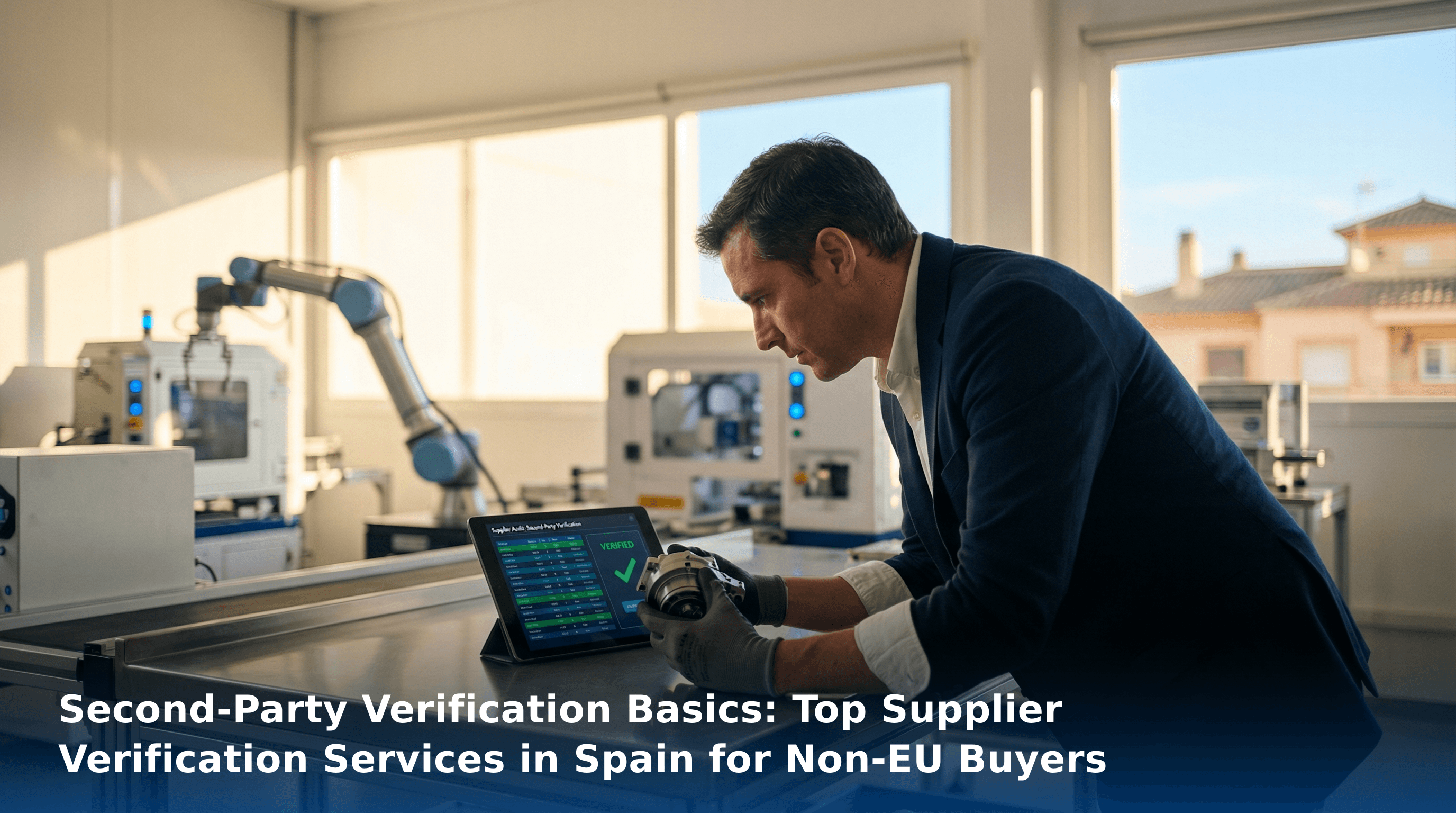
- Physical verification — factory visits within five business days, conducted in local language, following ISO 19011:2018 audit methodology
- Capacity confirmation — we check machinery, maintenance logs, workforce levels, and order backlogs. Not claims. Evidence.
- Export readiness assessment — can their documentation clear YOUR customs authority? We verify before you commit.
- Financial Solvency Signals — We review public mercantile records for debt ratios and verify on-site indicators—such as raw material stock levels and maintenance currency—to predict liquidity issues before they become your delivery delay
How We're Different
We operate under a unique integrity protocol that completely removes conflict of interest on our procurement architecture. Always buyers first, transparency first.
AMBAEX operates on a zero-kickback model:
- You pay us directly — our fee is separate and transparent
- You see factory invoices — no hidden markups (Best TCO)
- We sign a No-Kickback Affidavit — legally binding guarantee that we receive nothing from suppliers
Your interests are our only consideration.
The Three-Stage Process: Identify, Verify, Execute
For non-EU organisations building European supplier relationships, we offer a structured path from market entry to delivered goods:
Stage 1: Market Intelligence (Identify)
We don't guess prices; we know them. Local market data, trade show intelligence, and direct factory relationships enable us to build a shortlist of 3-5 verified suppliers matching your exact specifications.
Stage 2: AVS Protocol™ (Verify)
We don't trust labels; we audit them. Our Directors deploy to factory sites within five business days. We verify capacity claims, inspect quality systems, review PDO and export documentation, and assess financial stability. You receive a Green Light / Red Light recommendation — not a data dump.
Stage 3: Deal Navigator™ (Execute)
We don't assume; we inspect. Once you select a supplier:
- Terms of Contract Review: We negotiate payment terms, Incoterms, quality specifications, and penalty clauses on your behalf, for example sample matching clauses
- Pre-Shipment Inspection (PSI): Before goods leave Europe, we physically verify products against specifications
- Documentation Package: Complete documentation, certificate verification, customs coordination according to your organization needs or terms agreed
"Identify – Verify – Execute" is not a slogan. It is the only way to answer the real question: can this Southern European supplier ship the right product, at the agreed spec, in the required volume, with documents that pass customs in your region. e.g Dubai, Tokyo, or New York — not just Barcelona?
The Strategic Imperative
COVID proved that concentrated supply chains break. Tariffs proved that cost assumptions change overnight. AI proved that data alone doesn't verify reality.
For non-EU organisations building resilient sourcing portfolios, Southern Europe is no longer optional. It is a rational hedge against the three forces reshaping global procurement.
The question is not whether to diversify into Europe. The question is whether you will enter with verification — or with assumptions.
Ready to Build Your European Supply Base?
Book a 30-minute discovery call. No obligation. No pressure.
We'll cover your current concentration risks, which Southern European categories make sense for your business, and whether AMBAEX is the right fit — we're honest if we're not.
contact@ambaex.com | ambaex.com/contact
Zero Kickbacks. Physical Verification. Your procurement partner in Southern Europe.