AMBAEX · FOOD SOURCING · AUTHENTICITY INTELLIGENCE
The King of Black Truffles: Authenticating the True Tuber melanosporum
In a global market where demand for the "black diamond" outstrips what the earth can reasonably produce, every truffle on a plate represents a decision: trust in nature, or trust in an imitation.
For chefs, importers, and serious gourmets, learning to recognise the true Tuber melanosporum is no longer just a mark of good taste; it is protection against food fraud, economic loss, and the slow erosion of Europe's native truffle ecosystems (TasteAtlas).
The "black diamond" commands prices that invite imitation. In a market where genuine European winter black truffle can trade at several hundred euros per kilo, the incentives for substitution, dilution, and outright fraud are immense. Understanding what makes Tuber melanosporum unique—biochemically, visually, and ecologically—is the first line of defense.
The Living Chemistry of the "Black Diamond"
Tuber melanosporum is sometimes called the king of black truffles not only because of its price, but because of the biochemical orchestra it carries inside. Scientific analyses of its volatile fraction show a complex bouquet dominated by dimethyl sulfide and a constellation of alcohols, aldehydes, and esters, including compounds such as 2‑methylbutanal, sec‑butyl formate, and acetaldehyde in significant proportions (Wikipedia).
This complexity matters. Studies comparing T. melanosporum with its Chinese cousin T. indicum show that while both produce some overlapping volatiles, the European species displays a richer variety of sulfur‑containing compounds and a more layered aroma profile. Where T. melanosporum can fill a kitchen with an earthy, almost electric scent, T. indicum's profile is dominated by simpler notes like 1‑octen‑3‑one and 1‑octen‑3‑ol, giving a flatter, mushroomy impression (Zaguan).
For professionals, this means that a few grams of genuine winter black truffle can aromatize an entire tray of eggs or a service of risotto for dozens of guests, while imitations require heavy‑handed dosing and still fail to recreate the same depth. Biotechnologists are now isolating yeasts and other micro‑organisms associated with T. melanosporum fruiting bodies to better understand how this aroma develops, underscoring how far the "black diamond" has moved from folklore into the realm of advanced food science (PMC).
Reading the Truffle: From Knife Cut to DNA Code
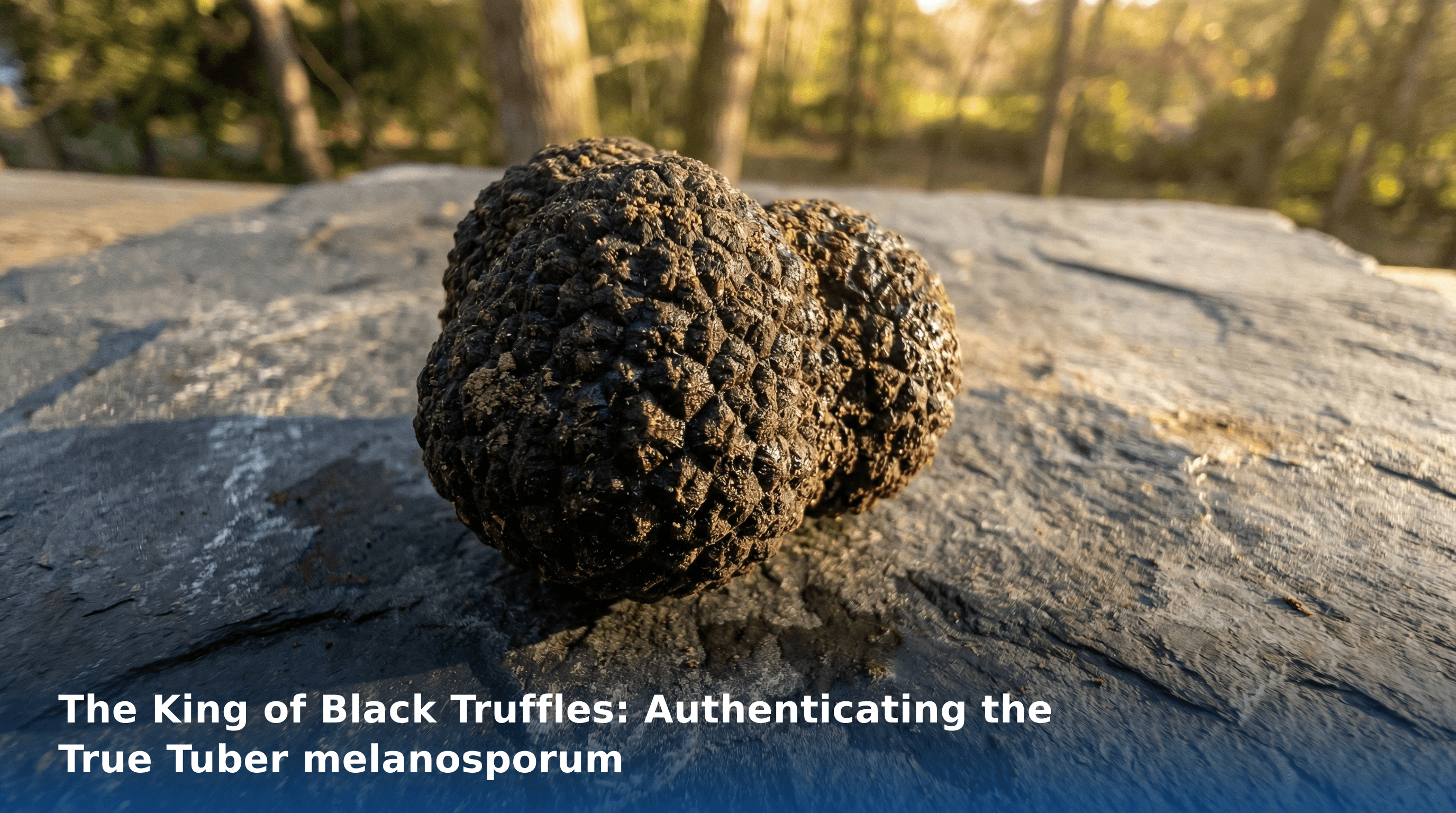
Authenticating T. melanosporum starts with what experienced hunters and buyers have always done: look, touch, smell, and ask when it was harvested. In the European winter season, typically from late November to March depending on the producing region, a ripe black truffle shows a dark, almost black interior (gleba) laced with a fine network of white veins when cut cleanly with a knife. The peridium (outer skin) is warty but regular, and the aroma is immediately present, oscillating between undergrowth, cocoa, and faint animal notes rather than just "mushroom" (PMC).
But in an industrial market, traditional cues are no longer enough. Over the past two decades, mycologists and analytical labs have developed DNA‑based "molecular barcodes" that can distinguish T. melanosporum from other black truffle species, even after processing. Polymerase chain reaction (PCR) methods using specific primers on regions such as the internal transcribed spacer (ITS) or the β‑tubulin gene can detect T. melanosporum DNA in canned products, mycorrhized seedlings, soil samples, and mixed truffle lots, down to legally relevant thresholds (Academia).
For serious buyers, this opens a new level of due diligence. A supplier who can provide batch‑level lab reports confirming species identity, along with traceability from parcel or plantation to export box, is fundamentally different from one who only offers a generic "black truffle" label. In high‑value programmes—luxury retail, fine dining groups, ingredient manufacturing—DNA certificates are increasingly used to validate origin claims, resolve disputes, and support marketing stories around "Taste of Truth" (Academia).
The Chinese Mirror and the Price of Confusion
The single greatest source of confusion in the black truffle market is Tuber indicum, often marketed as "Chinese black truffle." To the untrained eye, it looks remarkably similar: dark, warty exterior, blackish flesh, and a comparable size range, which allows it to be visually blended into melanosporum batches or used to bulk up prepared products (Smithsonian Magazine).
The difference appears on the invoice and on the plate. T. indicum typically sells for a fraction of the price of T. melanosporum—reports from European buyers describe wholesale prices starting at under €10 per kilo in some seasons—while genuine European black winter truffle can trade at several hundred euros per kilo, depending on quality and harvest conditions. Aromatically, Chinese truffles tend to be mild, with a simpler profile dominated by "mushroom" notes and far fewer of the characteristic sulfur compounds and complex aldehydes that define T. melanosporum (Science.gov).
This price gap and physical resemblance make T. indicum a perfect vehicle for fraud. Investigations and expert testimonies have documented cases where Chinese truffles are mixed into European lots, sold as "black winter truffle," or used to aromatize products that then rely on synthetic additives to mimic the missing depth. For a restaurant or retailer, the reputational risk is obvious: a diner paying for a T. melanosporum experience receives, at best, an anonymous mushroom note and, at worst, nothing much at all (Hacker News).
Biopollution: When the Copy Invades the Source
The threat posed by T. indicum is not limited to the marketplace; it also reaches into the soil. As landowners across Europe have sought to plant truffle orchards using mycorrhized seedlings, contaminated nursery stock has led to Chinese truffle mycelium establishing in European plantations that were supposed to grow T. melanosporum (iForest).
One widely cited case in Italy involved a landowner who, after a decade without a single expected truffle, invited researchers to investigate, only to discover that the roots of his trees were colonized by T. indicum rather than the intended species. Scientific work on biological competition within orchards confirms that species such as T. brumale, long considered a "contaminant," can outcompete more valuable truffles in certain conditions, underlining how fragile a plantation's species identity can be if nursery practices are not controlled (iForest).
For European growers, this "biopollution" raises deep concerns. Once an invasive or less desirable Tuber species has established itself in a plantation, reversing the situation is technically complex, costly, and sometimes impossible within a reasonable time frame. Protecting T. melanosporum, therefore, begins years before any truffle reaches a plate, with strict selection and molecular testing of inoculum, seedlings, and soil, combined with long‑term monitoring of which species actually fruit in the orchard (Academia).
Truffle Oil and the Myth of Bottled Luxury
If T. indicum is the silent impostor in the fresh truffle trade, synthetic truffle aroma plays the starring role in the processed segment. The vast majority of "truffle oil" on the global market does not derive its aroma from truffles at all but from a single petroleum‑derived compound, 2,4‑dithiapentane, dissolved in a neutral oil (Reddit).
This molecule does appear among the many volatile compounds present in some truffle species, but in nature it is only one voice in a very large choir. When used alone in high concentration, it produces a sharp, gas‑like note that bears little resemblance to the subtle, evolving aroma of a real T. melanosporum, yet consumers and even some professionals have come to associate this synthetic profile with "truffle flavour" (La Voce di New York).
Critics describe this phenomenon as a "truffle oil scam," arguing that such products flatten public expectations and allow truffle branding to be attached to cheap ingredients with no real connection to the fungus. In response, a growing number of chefs and specialty retailers now specify on menus and labels that no added synthetic aroma is used, relying instead on fresh or preserved truffle, infused at lower temperatures and over longer times to capture a more authentic profile. For buyers, asking whether an oil or condiment uses real truffle infusion or added aroma—and in what proportion—has become a basic due‑diligence question (TasteAtlas).
Biological Competitors Inside the Orchard
Even when plantations are correctly inoculated with T. melanosporum, the soil is a competitive arena. Research into species such as Tuber brumale, sometimes called the "musk truffle," shows that it can act as a strong competitor, colonizing ectomycorrhizas and soil around host trees and potentially displacing more valuable species under certain conditions (iForest).
Long‑term field experiments in mixed plantations have shown that T. brumale can dominate in transitional zones between plots, and its presence is often linked to problems in nursery production or cross‑contamination of inoculum. While T. brumale is also edible, its aroma is less complex and generally less valued in haute cuisine, which means a shift in species composition can quietly undermine the economic performance of an orchard even when yields, in kilograms, appear acceptable (iForest).
Professional growers now routinely pair field observations with lab analysis—PCR typing of root tips and fruiting bodies—to monitor which species are actually occupying their plantations over time. This data then feeds management decisions: pruning, irrigation, soil work, and even replanting, all aimed at keeping T. melanosporum ecologically dominant (Academia).
Toward a True "Sabor de Verdad"
For the haute cuisine and agri‑food sectors, the path to a genuine "Sabor de Verdad" rests on three pillars: seasonality, certification, and science. Respecting the natural winter harvest window ensures that T. melanosporum is tasted at its aromatic peak, rather than pushed into extended seasons that encourage substitutions and long‑term storage (Go Aragón).
Certification—through geographical indications, quality seals like the Transitional National Protection (PNT) for "Trufa de Teruel," and independent lab testing—creates a framework in which origin, species identity, and handling standards can be verified rather than merely asserted (Invest in Aragon). Finally, integrating molecular tools and analytical chemistry into routine quality control allows buyers and producers to move beyond intuition and marketing, anchoring their claims in measurable facts about DNA and aroma profiles.
In a world flooded with copies, shortcuts, and heavily perfumed oils, choosing real Tuber melanosporum is an act of alignment: with ecosystems that took decades to establish, with growers who invest in careful mycorrhization and monitoring, and with a culinary tradition that values depth over noise. For those designing serious truffle programmes—whether in a three‑star kitchen or a food lab—the black diamond's future belongs to those willing to verify as carefully as they season (PMC).
Ready to Source Authentic Black Truffles with Confidence?
Ambaex helps international buyers verify provenance, species identity, and supply chain integrity for premium ingredients like Tuber melanosporum. From DNA testing to on‑site audits in Spain, Portugal, and Italy, we ensure what's on the label is what's in the box.