
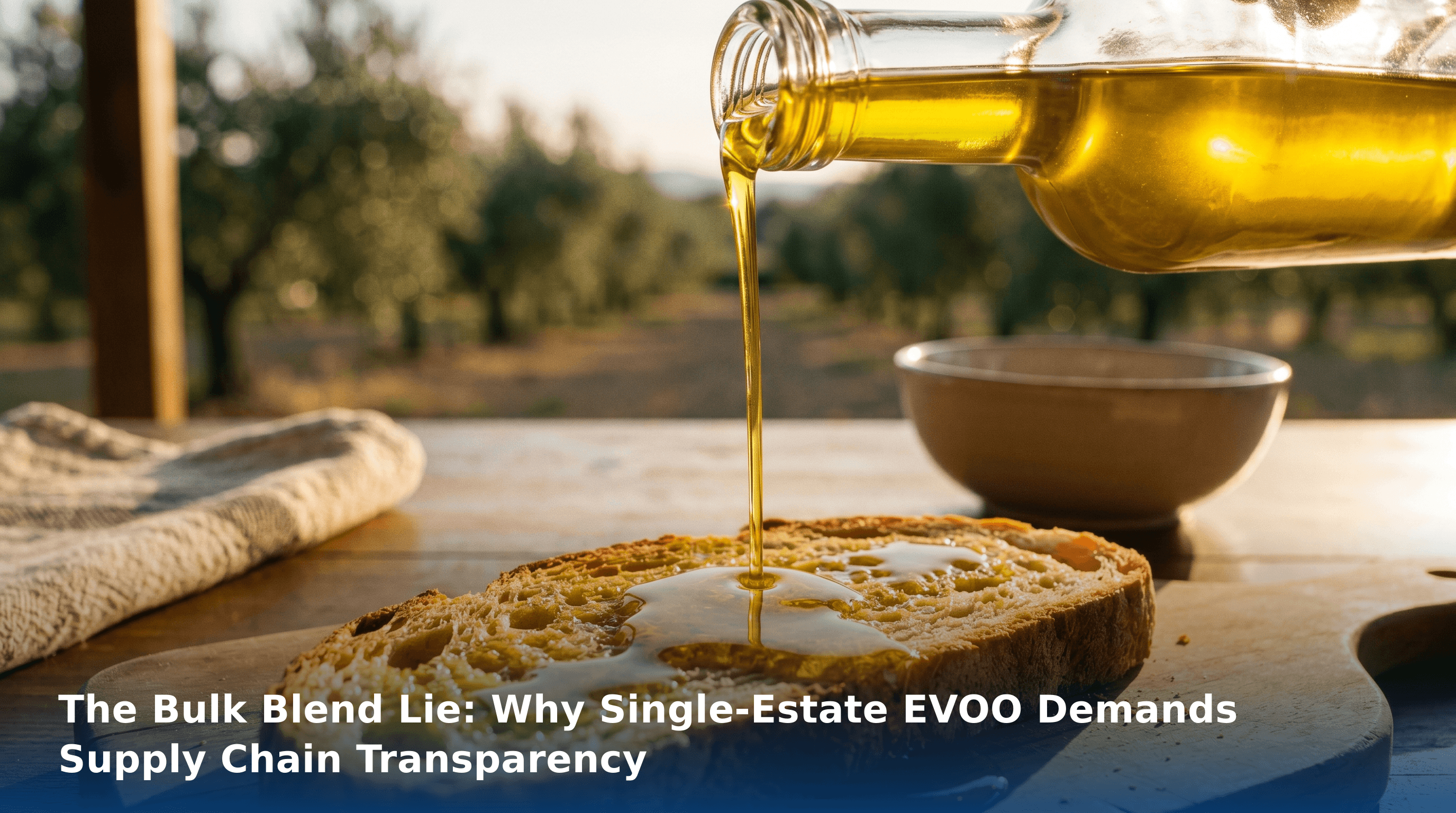
The Open Secret of Bulk EVOO Blending
Extra virgin olive oil is the most adulterated commodity in the global food trade by volume. This is not a recent finding — it has been documented by regulatory bodies, academic researchers, and investigative journalists for decades. The problem is structural, not incidental, and it persists because the mechanics of the trade make adulteration easy and detection difficult at the point of purchase.
The most common form is bulk blending: the mixing of olive oils from multiple origins, production years, and quality grades into a product that is then bottled, branded, and sold as a geographically specific or quality-certified product. This practice is legal within defined limits. An oil labelled as Spanish can contain up to a defined percentage of oil from other origins without disclosure. An oil labelled as extra virgin must meet chemical thresholds at time of bottling, but these thresholds do not prevent the use of oil that was borderline-grade at harvest and deteriorated further in bulk storage.
What this means for a professional buyer is that price is an unreliable guide to quality. An expensive bottle with a premium brand, attractive packaging, and a regional flag is not evidence of genuine single-estate or single-origin content. The label may be technically accurate while the product does not deliver what a genuine extra virgin from a specific estate, in a specific harvest year, would deliver.
The alternative — single-estate EVOO with transparent supply chain documentation — is more expensive and requires a more demanding sourcing process. For buyers who use EVOO as a finishing oil, a dressing base, or a menu-specific ingredient with provenance claims, the cost of the alternative is justified. For buyers buying in volume for general cooking applications, the calculus is different. This article addresses the former category.
How to Read a Label: The Signals That Matter
A professional buyer evaluating EVOO labels needs to look for four things specifically:
Harvest date. Extra virgin olive oil deteriorates over time. Polyphenol content — the antioxidant compounds that give high-quality EVOO its pungency, bitterness, and flavour complexity — degrades from the moment of pressing. A genuine single-estate producer knows when they harvested and bottled. They put that information on the label because it matters. Absence of a harvest date is not automatically disqualifying, but its presence is a strong positive signal and its absence is a question worth asking.
Origin specificity. "Product of Spain" is the minimum disclosure. It tells you nothing useful about the olive variety, the estate, the altitude, the soil type, or the producer's practices. A genuine single-estate oil names the estate, the region, and frequently the municipality. The more specific the origin declaration, the more verifiable the claim.
Polyphenol content. This figure, measured in mg/kg, indicates the oil's antioxidant density. High-quality early-harvest EVOO from selected varieties in ideal conditions can reach above 500mg/kg. Mass-market EVOO at the legal minimum for the extra virgin designation may test at 100mg/kg or below. Some producers include polyphenol content on the label or in their technical documentation. For buyers with access to technical data sheets, this is the most direct measure of genuine quality.
Olive variety. Picual, Arbequina, Hojiblanca, Koroneiki, Manzanilla — each variety produces a distinct flavour profile. A label that specifies variety is providing information that a blended product cannot provide consistently. Single-variety EVOO from a named estate is the most traceable and most verifiable product category.
What Early-Harvest, Single-Estate Spanish EVOO Delivers
Early-harvest EVOO — pressed from olives harvested before full ripeness, typically in October — has a flavour profile that is markedly distinct from the general commercial category. The oil is green, intensely aromatic, pungent at the back of the throat, and bitter in a way that is immediately identifiable as fresh olive rather than processed commodity oil.
This pungency and bitterness are not defects. They are the polyphenol compounds making themselves known. These compounds are also the ones with documented health properties that give high-polyphenol EVOO its designation in some markets as a nutraceutical rather than simply a food ingredient.
For professional kitchen applications, early-harvest single-estate EVOO functions as a finishing ingredient, not a cooking medium. Its character is the point. Drizzled over grilled vegetables, used as a dipping oil, incorporated into a raw preparation — the flavour is distinct and recognisable in a way that a blended commodity oil cannot be. It is, in this respect, comparable to a single-malt whisky versus a blended product: the same category, an entirely different register of use.
For buyers who communicate this to guests, the commercial value compounds. A server who can describe the olive variety, the estate, the harvest season, and the flavour character is having a different conversation with a guest than one serving an anonymous oil from a standard dispenser.
Ambaex's Mill Verification: Oil That Never Leaves the Estate Until Bottled
Ambaex sources EVOO exclusively from estates where the oil is pressed and bottled at the point of production. This is the supply chain specification that eliminates bulk blending risk at the source.
An oil that is pressed at a cooperative mill, moved to a bulk storage facility, blended with other lots for volume, and then bottled by a packaging operation has passed through multiple points where its identity can be diluted or altered. An oil pressed at the estate's own mill, matured in the estate's own inert tanks, and bottled on the estate before dispatch cannot be blended with foreign material without the estate operator's knowledge and cooperation.
Mill verification involves reviewing the estate's production records — olive intake, pressing logs, tank allocation, bottling records — and confirming that the volume of oil bottled under the estate's label is consistent with the volume of olives pressed. Discrepancies between these figures are the primary audit indicator of external blending. Where the records are clean and consistent, the product is what it claims to be.
Secure Your Supply of Verified Single-Estate EVOO
Ambaex maintains sourcing relationships with verified single-estate Spanish EVOO producers across Jaén, Córdoba, and Catalonia, with mill verification documentation provided for each lot. If you are evaluating premium EVOO sourcing or need documentation to support provenance claims on menus or in trade communications, contact us for available volumes and technical data sheets for the current harvest.