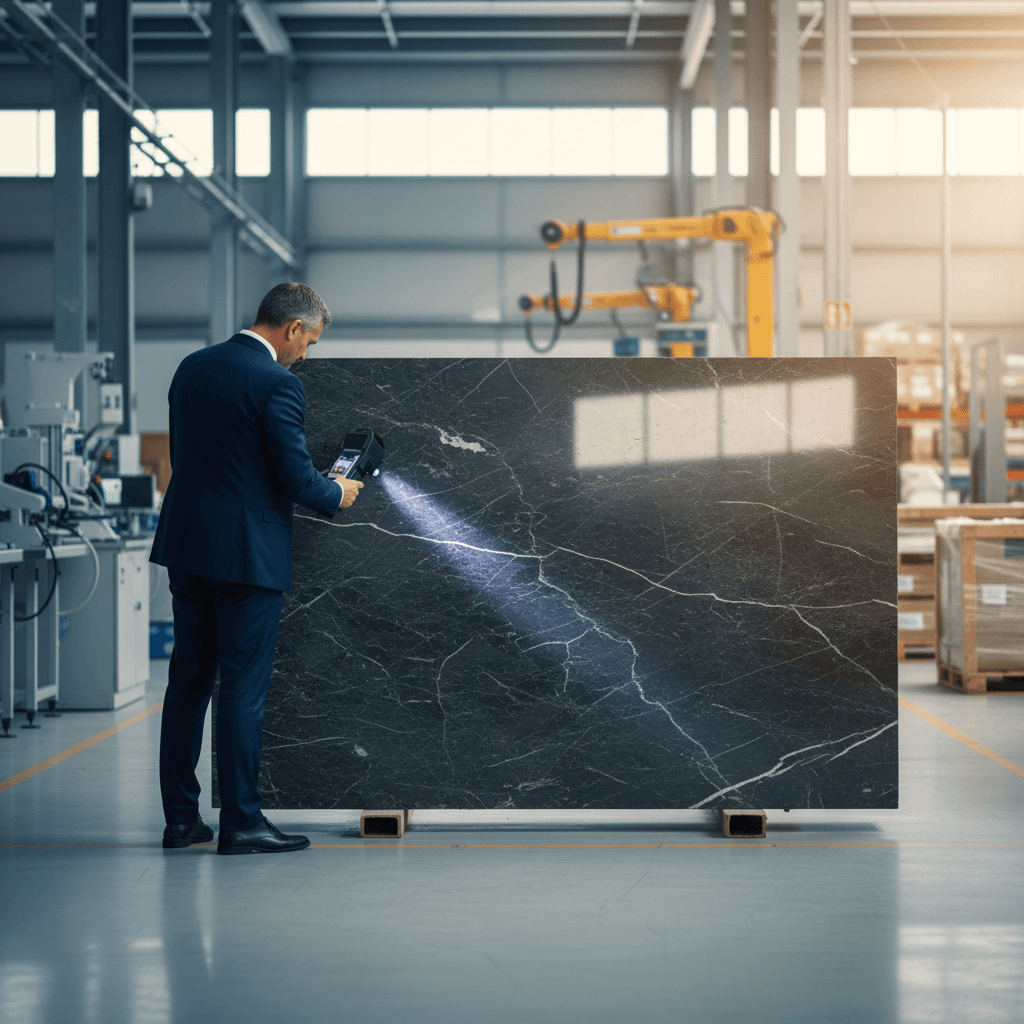
This article details five common scams used by Spanish stone suppliers—including bait-and-switch tactics and hidden defects—and emphasizes the critical role of on-site verification.
- Spanish stone suppliers may use bait-and-switch tactics.
- Hidden defects in stone can be a costly scam.
- Advance payment fraud is a risk in stone imports.
- On-site verification mitigates fraud risk.
- Stone's inherent variability enables deception.
AMBAEX Market Intelligence
Navigating the Labyrinth: How to Spot the 5 Scams Used by Spanish Stone Suppliers
Real Fraud Patterns, Red Flags, and How On-Site Verification Protects Your Investment
Executive Summary
Spain is a powerhouse in natural stone—from the creamy elegance of Crema Marfil to the dramatic veining of Negro Marquina. Its quarries yield some of the world's most sought-after materials for architects, designers, and developers globally.
But the allure of exquisite stone at competitive prices can lead buyers down a path fraught with risk. The global stone trade, like any lucrative industry, is not immune to deceptive practices.
This guide covers five common scams—bait-and-switch samples, customs fraud, hidden defects, advance payment vanish, and arbitrary surcharges—and how on-site verification in Spain eliminates each risk before you wire the deposit.
Why Stone Fraud Is a Real Risk
Unlike commodities with standardised grading, natural stone is inherently variable. Each block is unique. This creates opportunities for deception that don't exist in more standardised markets.
The fraud patterns are consistent:
- Suppliers showing premium samples, then shipping lower-grade material
- Trading companies with no quarry access presenting themselves as "direct sources"
- Hidden defects revealed only after fabrication begins
- Payment collected, goods never shipped
- Surprise fees appearing after commitment
The geographical distance between Spanish quarries and international buyers creates an information asymmetry that unscrupulous operators exploit. The solution is physical verification before payment.
Scam #1: The Bait-and-Switch Sample
One of the most insidious scams involves deliberate discrepancy between the sample provided and the actual product shipped.
What It Looks Like
You're shown pristine slabs of Crema Marfil with minimal veining and consistent background, or vibrant Rojo Alicante with rich, uniform coloration. Upon arrival, the delivered material is riddled with:
- Excessive resin fills
- Inconsistent color variations
- Unsightly patterns absent from approved samples
- Significant natural defects
The goal: maximize profit by offloading lower-grade material at premium prices.
Why It Happens
Suppliers might have overstock of lower-grade material they struggle to sell honestly. They exploit geographical distance and the difficulty buyers face conducting pre-shipment inspections. Some operate with explicit intention of deceiving new clients who haven't established trusted relationships.
Red Flags
- Supplier provides only small physical samples or stock photos
- Reluctance to share photos of the exact slabs designated for your order
- No block numbers provided
- Resistance to pre-shipment inspection
- Vague quality specifications in contracts
How to Protect Yourself
| Protection Measure | What It Achieves |
|---|---|
| Demand photos/videos of exact slabs | Visual proof of what you're actually buying |
| Request block numbers | Clear identifier that prevents substitution |
| Pre-shipment inspection (PSI) | Independent verification before loading |
| Detailed contract specifications | Legal recourse if material doesn't match |
Scam #2: Under-Invoicing for Customs
This scam preys on a buyer's desire to save money on import duties—while transferring all legal risk to the buyer.
What It Looks Like
A supplier suggests declaring a significantly lower value on the commercial invoice than what you actually paid. They promise this will reduce customs duties and taxes, making your purchase appear cheaper. The difference is requested via untraceable payment or separate channel.
This is customs fraud. It's illegal in virtually every country. The supplier profits by enticing you with perceived savings while you take on all legal risk.
Why It Happens
Suppliers offer this to make prices seem unusually competitive, or to avoid their own export-related taxes in Spain. Buyers new to international trade are tempted by immediate cost reduction without understanding the consequences:
- Hefty fines
- Confiscation of goods
- Criminal charges
- Permanent customs red-flagging
Red Flags
- Supplier proactively suggests "creative invoicing"
- Request for payment to multiple accounts or entities
- Invoice value doesn't match your purchase order
- Pressure to agree quickly "to save money"
The Rule
NEVER agree to under-invoicing. As the importer, you are responsible for the accuracy of your customs declarations. Reputable suppliers will never suggest this practice.
Scam #3: Hidden Defects and Sub-Standard Deliveries
Even if the initial sample passes inspection, some suppliers still offload defective material that reveals its true nature only after arrival—or during fabrication.
What It Looks Like
- Pre-existing cracks: Natural fissures poorly repaired or filled with resin and hidden from initial view
- Excessive resin filling: Large voids or soft spots filled excessively, compromising strength and appearance
- Color inconsistencies: Slabs with starkly different hues making consistent application impossible
- Incorrect sizing/thickness: Slabs outside agreed tolerances, causing fabrication issues
- Hidden watermarks or stains: Problems that emerge only after cutting, polishing, or moisture exposure
Why It Happens
Suppliers face pressure to clear inventory or meet tight deadlines. They gamble on buyers either not noticing defects until it's too late, or being forced to accept material due to project timelines and replacement costs.
Red Flags
- Supplier provides photos of only select pieces, not entire lot
- Resistance to detailed QC checklist
- Vague thickness or tolerance specifications
- Pressure to accept delivery without inspection window
How to Protect Yourself
- Mandatory pre-shipment inspection — independent inspector checks cracks, resin quality, thickness, color consistency on-site
- Photos/videos of ALL slabs — front and back, edges and corners
- Tolerance levels in contract — acceptable variations in color, veining, thickness, defect levels
- Immediate inspection upon arrival — document any damage before signing off
- Full inspection before fabrication — within agreed claims period (usually 2-7 days)
Scam #4: The Advance Payment Vanish
This is the most devastating scam—complete loss of funds with no material received.
What It Looks Like
The supplier demands significant advance payment (50%+ of order value) before production. Once funds are transferred:
- Communication ceases entirely, or becomes evasive with endless excuses
- Material is never shipped
- Your money is gone
In some cases, the "supplier" doesn't exist as a legitimate entity—fake addresses, fake contact information, professional-looking website.
Why It Happens
Fraudulent entities target new or inexperienced buyers swayed by unusually low prices or attractive payment terms. They exploit urgency and the trust inherent in business transactions.
Red Flags
- Demand for 100% upfront payment
- Prices significantly below market averages
- No verifiable physical address in a quarry region
- Company name doesn't appear in Spanish business registries
- No online presence, or all reviews seem generic/fake
- Reluctance to provide client references
- Pressure to pay quickly "before prices increase"
Due Diligence Checklist
| Verification Step | What to Check |
|---|---|
| CIF number (Spanish tax ID) | Verify through official Spanish registries |
| Physical address | Google Maps—does it look like a quarry/factory or empty lot? |
| Contact verification | Call phone numbers, check website professionalism |
| Online presence | Search for reviews, trade forum mentions |
| Client references | Request contacts and follow up directly |
Payment Protection
- Standard payment terms: Reputable suppliers request 20-30% advance, balance upon shipment (after Bill of Lading) or arrival
- Letter of Credit (L/C): Bank guarantees payment only when supplier meets contractual obligations
- Start small: Place a test order before committing to major purchase
Scam #5: Arbitrary Surcharges and Hidden Fees
Unexpected charges appear on final invoices after you've already committed to the purchase.
What It Looks Like
You receive an attractive initial quote. As the process moves forward, new fees appear:
- "Special packing fees"
- "Documentation charges"
- "Loading fees"
- "Quarry taxes"
- Inflated freight costs not clearly itemized
The supplier leverages your commitment and the difficulty of backing out late in the process.
Why It Happens
Some suppliers deliberately provide artificially low initial quotes to win business, then add hidden charges to recover margin. They exploit buyer eagerness and complexities of international shipping.
Red Flags
- Initial quote lacks itemized breakdown
- Vague INCOTERMS specification
- Price significantly lower than competitors for same material
- Supplier avoids questions about "all-in" costs
How to Protect Yourself
- Demand itemized, all-inclusive quote: Stone, packing, loading, transport, documentation, agreed INCOTERMS (FOB, CIF, EXW)
- Ask specific questions: "Are there export duties?" "What's included in packing?" "Any customs clearance fees?"
- Get everything in writing: Final quote with all costs in signed contract
- Compare quotes: Multiple suppliers to understand market averages
- Challenge new charges immediately: Refer back to signed agreement; don't pay for unagreed charges
The Pattern: Why These Scams Work
All five scams exploit the same vulnerabilities:
| Vulnerability | How Scammers Exploit It | How Verification Closes It |
|---|---|---|
| Geographical distance | Buyers can't easily visit Spanish quarries | On-site auditor acts as your eyes |
| Information asymmetry | Buyers don't know local market, suppliers, pricing | Local intelligence identifies red flags |
| Urgency | Project timelines pressure fast decisions | Verification prevents costly corrections later |
| Trust in documentation | PDFs and samples can be fabricated | Physical inspection verifies reality |
| Difficulty of recourse | Cross-border disputes are expensive | Prevention is cheaper than litigation |
The common thread: Every scam succeeds because the buyer couldn't verify what they were buying before they paid. Physical verification in Spain eliminates this gap.
The AMBAEX Model: Verification Before Payment
AMBAEX operates as a Procurement Intelligence Auditor in Spain, Portugal, and Italy—providing the on-site verification that prevents all five scam patterns.
We work under a strict Integrity Protocol: no hidden fees, no finder's fees, no commissions from quarries or suppliers. You pay us. We work for you.
AVS Protocol™ — Stone Supplier Verification
Before you wire the deposit, we verify:
- Supplier legitimacy: CIF registration, physical premises, quarry ownership or access rights
- Production capacity: Do they actually cut and process stone, or just broker?
- Material verification: Photos/videos of exact blocks designated for your order, with block numbers
- Quality systems: Thickness tolerances, defect inspection procedures, resin protocols
- Financial stability: Can they fulfill the order without your advance payment funding other obligations?
Output: GREEN LIGHT (verified supplier with production capacity), CONDITIONAL (legitimate but with noted constraints), or RED FLAG (broker, shell company, or high-risk operator).
Deal Navigator™ — Pre-Shipment Inspection
Before containers are loaded, we verify:
- Material match: Slabs match approved samples and block numbers
- Quality check: Thickness, color consistency, defect levels within contract tolerances
- Packaging inspection: Crating, strapping, load configuration for safe transit
- Documentation alignment: Invoice, packing list, certificates match shipment contents
Output: Signed-off shipment with photographic evidence, or corrective actions required before loading.
The Integrity Protocol
- Paid only by the buyer—not by quarries or suppliers
- No finder's fees, no hidden commissions
- Not a broker, trader, or inventory holder—no commercial interest in which supplier you choose
When we verify a supplier, it's because we walked their facility and inspected their material—not because they're paying us to approve them.
The 5 Scams at a Glance
| Scam | What They Do | Your Protection |
|---|---|---|
| Bait & Switch | Show premium samples, ship inferior material | PSI with exact slab verification |
| Under-Invoicing | Suggest customs fraud to "save money" | Refuse; work with reputable suppliers only |
| Hidden Defects | Ship cracked, resin-filled, or inconsistent material | Detailed QC checklist + PSI |
| Payment Vanish | Collect advance, disappear | Due diligence + supplier verification audit |
| Hidden Fees | Add surprise charges after commitment | Itemized all-inclusive contract |
Protect Your Investment Before You Wire
The beauty and quality of Spanish natural stone are undeniable. The vast majority of Spanish suppliers are legitimate businesses dedicated to excellent products and service.
But the scams documented here are real—and they target buyers who can't verify what they're purchasing before they pay.
AMBAEX provides the on-site verification that closes the gap between what you're promised and what you receive.
Before you wire the deposit, know who you're buying from.
See how AMBAEX verifies Spanish stone suppliers on site →
info@ambaex.com | ambaex.com/contact
Zero Kickbacks. Physical Verification. Your Stone Sourcing Partner in Southern Europe.