A tariff dispute and provincial boycotts have caused US wine imports to Canada to collapse, creating a significant opportunity for European wine suppliers, particularly from Spain, Portugal, and Italy.
- US wine sales in Canada fell by 65-90% due to tariff tensions and boycotts.
- Canada's total wine imports grew 5.3% in volume despite overall spending decreasing.
- LCBO/SAQ seek European replacements at competitive prices due to US wine decline.
- Spain, Portugal, and Italy are poised to fill the void with suitable price & volume.
- Supplier compliance with LCBO/SAQ standards is crucial for market access.
AMBAEX Market Intelligence
The US Wine Gap in Canada: How Agents Can Pivot to Spain, Portugal, and Italy
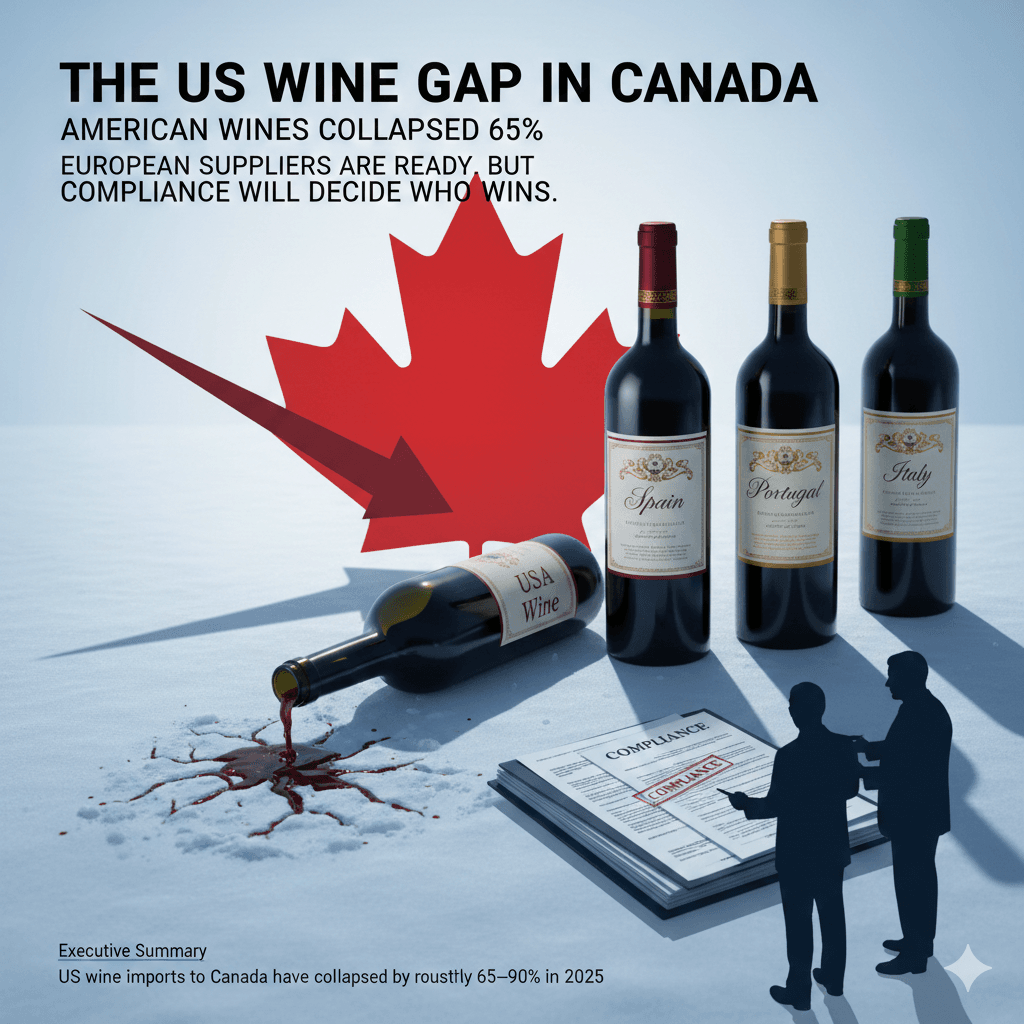
American Wines Collapsed 65%. European Suppliers Are Ready. But Compliance Will Decide Who Wins.
Executive Summary
The "US wine gap" in Canada is real. After tariff disputes and provincial boycotts, US wine imports to Canada have collapsed by roughly 65–90% in 2025, losing significant shelf share at provincial liquor boards like LCBO and SAQ.
At the same time, overall Canadian wine imports are up 5.3% in volume, with Italy, France, and Spain all gaining share. The gap is being filled—the question is by whom.
The opportunity for Canadian importers: Southern Europe offers the right price architecture, the right quality, and the right volume capacity. But the bottleneck isn't finding a winery—it's finding one that passes LCBO/SAQ scrutiny and can repeat shipments reliably.
This is where on-the-ground verification in Europe makes the difference.
What the US Wine Tariffs Collapse Means for Canadian Agents
The numbers tell the story:
- US wines fell from ~20% to ~15% of LCBO bottle sales in a single year, losing their top import position
- Value/volume collapse of 65–90% after 2025 tariff tensions and provincial bans on US alcohol
- Yet Canada's total wine imports grew 5.3% in volume to about 187 million litres in H1 2025
- Spending fell 5.2%—signalling that liquor control boards are actively replacing US volume with other origins at sharper price points
For Canadian importers, this shows up as:
- Sudden gaps in "California" and generic US listings that must be refilled quickly
- New LCBO/SAQ tenders explicitly looking for European replacements at competitive price bands
- A narrow window to capture shelf space before competitors lock in their suppliers
Why Spain, Portugal, and Italy Are Natural Replacements
EU producers already dominate Canada. In 2024, Canada imported about CAD 1.7 billion in EU wine, and in 2025 European origins increased sales further as US volumes collapsed.
Spain specifically increased exports to Canada by 4.6% in value and 9.7% in volume in early 2025, becoming the third supplier by value.
Price Architecture Matches the Gap
- Average import price for all wine into Canada: ~€4.46/litre
- Bottled wine average: ~€6.33/litre
- Bulk wine average: ~€0.68/litre
Southern Europe—Spain, Portugal, southern Italy—is highly competitive in these bands, especially for entry-level, on-promotion, and private-label wines where margins matter.
What Each Origin Offers
| Origin | Strengths | Best Fit For |
|---|---|---|
| Spain | Tempranillo, Garnacha, Cava, strong bulk capacity | Private label, house brands, value sparkling |
| Portugal | Distinctive blends, Vinho Verde, Douro reds, Alentejo value | LCBO/SAQ "discovery" segments, value reds |
| Italy | Puglia, Abruzzo, Sicily—already top supplier by volume | Core listings, sparkling tenders, red blends |
LCBO's product needs sheets explicitly call out sparkling and still wines from Italy, Spain, and Portugal with clearly defined retail price bands—confirming institutional demand for these origins.
The Real Risk: Compliance and Supplier Reliability
The bottleneck is not "finding a winery" in Europe. It's finding one that passes Canadian rules, survives LCBO/SAQ scrutiny, and can repeat shipments.
Label and Regulatory Compliance
- LCBO and SAQ apply detailed rules: mandatory information, allergens, bilingual labelling, health warnings, container deposits, recycling marks
- Non-compliant labels risk delisting or re-stickering costs
- Post-tariff scrutiny is higher: monopolies rely on lab tests and documentation to ensure composition, origin, sulphite levels, and alcohol content are exactly as declared
Operational Reliability
- Many small/medium wineries in Spain, Portugal, and Italy lack experience with Canadian monopolies' forecasting, shipping windows, and sample procedures
- Bulk and blended wines require consistent quality and analytical parameters from one shipment to the next
- A missed spec can trigger rejections, penalties, or urgent re-sourcing
This is where on-the-ground verification changes the risk profile: the work happens in Europe before the LCBO/SAQ system ever sees the product.
A 4-Step Pivot Plan for Canadian Agents
Step 1: Define Volume, Segment, and Target Monopoly
Clarify whether the pivot is for:
- LCBO/SAQ core listings, VINTAGES/SAQ Dépôt, private orders, or other provincial monopolies
- Segment: entry, mid, premium, or private label
Quantify volume expectations per year and per order (e.g., 10,000–30,000 bottles vs. 1–2 containers of bulk) to match with wineries that actually have the capacity and cash-flow tolerance for monopoly business.
Step 2: Create a Technical Brief
A concise specification including:
- Origin preferences within Spain/Portugal/Italy (e.g., La Mancha vs. Rioja; Douro vs. Alentejo; Puglia vs. Sicily)
- Wine style: grape(s), residual sugar, colour, oak regime, target alcohol range, sensory profile
- Target pricing: Canadian retail and back-calculated ex-cellar or FOB, aligned with LCBO/SAQ price tiers
- Packaging details: bottle format, closure type, carton specs, pallet configuration, private-label requirements
Step 3: Build and Vet a Shortlist On the Ground
This is where an on-site sourcing partner adds value:
- Map candidate wineries that match your brief and have export experience to Canada or comparable regulated markets
- Visit facilities to verify production capacity, quality systems, traceability, and documentation practices
- Assess financial and operational stability to support multi-year monopoly listings
- Consolidate samples in Europe for comparative tasting and lab pre-screening before anything is sent to LCBO/SAQ
Step 4: Run Pre-Shipment Lab and Label Checks
Before your first order (and periodically after):
- Independent lab testing in Europe for key parameters (alcohol, sulphites, volatile acidity, residual sugar, heavy metals) against Canadian tolerance limits
- Label review against Canadian and provincial requirements: mandatory fields, bilingual wording, allergen statements, standard drink information, recycling logos
- Pre-shipment inspection: verify batch identity, bottling date, packaging integrity, and load configuration before the container leaves Europe
This reduces the risk of LCBO/SAQ lab rejections, relabelling on arrival, and "one-off" shipments that cannot be replicated for re-orders.
The AMBAEX Model: Your Verification Partner in Southern Europe
AMBAEX operates as a Procurement Intelligence Auditor in Spain, Portugal, and Italy—physically present in Europe and working exclusively on the buyer's side.
We work under a strict Integrity Protocol: no hidden fees, no finder's fees, no commissions from wineries. You pay us. We work for you.
Market Intelligence Pass™ (Identify)
- Identify Spanish, Portuguese, and Italian wineries whose price-quality ratio matches current Canadian import benchmarks and LCBO/SAQ tender price bands
- Screen for export experience, volume capacity, and regulatory readiness
- Deliver a focused shortlist—not a catalogue of "nice wines from a trade fair"
Output: Targeted supplier map aligned to your specific brief and monopoly requirements.
AVS Protocol™ (Verify)
Following ISO 19011:2018 audit guidelines, we conduct on-site verification:
- Production capacity audit: tank space, bottling lines, storage conditions
- Quality systems review: HACCP, IFS/BRC or equivalent, traceability documentation
- Financial stability assessment: ability to support multi-year monopoly listings
- Canada-specific compliance check: analytical parameters, labelling capability, documentation routines
Output: GREEN LIGHT (ready for LCBO/SAQ submission), CONDITIONAL (corrective actions required), or RED FLAG (not suitable for Canadian monopoly business).
Deal Navigator™ (Execute)
- Sample consolidation: collect and consolidate cross-producer samples in Europe, run basic lab screens, prepare structured tasting and data sheets for your tender application
- Label and dossier review: check labels, technical sheets, and certificates against LCBO/SAQ and federal Canadian requirements before submission
- Pre-shipment inspection: verify batch identity, bottling date, packaging integrity, and load configuration before containers leave Europe
- Lab coordination: coordinate third-party lab testing in Europe so export lots match the specs you filed
Output: Shipments that arrive ready for monopoly acceptance—not scrambling for re-stickering or re-testing on arrival.
Ongoing Performance Monitoring
- Track repeat shipments, quality drift, delivery punctuality, and document accuracy
- If a supplier begins to slip, we rapidly propose alternates within the same style/price window
- Protect your LCBO/SAQ listings from supply disruption
The Integrity Protocol: Independence That Protects Your Listings
Some sourcing models create conflicts: agents paid by wineries recommend whoever pays them most, regardless of actual compliance readiness or reliability.
AMBAEX operates differently:
- Paid only by the Canadian agent/importer—not by wineries
- No finder's fees, no hidden commissions
- Not a broker, trader, or inventory holder—no commercial interest in which winery you choose
When we say a winery can handle LCBO/SAQ requirements, it's because we verified it on site—not because they're paying us to say so.
The Gap Won't Stay Open Forever
| Factor | Reality | Source |
|---|---|---|
| US wine collapse in Canada | 65–90% drop in value/volume | Gambero Rosso |
| Canada total wine imports (H1 2025) | +5.3% volume to 187M litres | Vinetur |
| Spain exports to Canada (2025) | +4.6% value, +9.7% volume | Global Affairs Canada |
| Average bottled wine import price | ~€6.33/litre | Vinetur |
| LCBO actively tendering EU wines | Italy, Spain, Portugal in product needs | LCBO |
The US wine gap is creating a once-in-a-decade opportunity for Canadian agents to lock in Southern European suppliers. But the window is closing as competitors move.
The agents who win will be those who can submit compliant, verified, repeatable suppliers to LCBO/SAQ—not just "interesting wines" from a trade show.
Ready to Pivot Before the Gap Closes?
The US wine collapse created the opening. Southern Europe has the supply. LCBO and SAQ are actively tendering.
For Canadian agents looking to capture shelf space with verified Spanish, Portuguese, or Italian suppliers, AMBAEX's Procurement Intelligence Auditor model turns trade show leads into monopoly-ready submissions.
Identify. Verify. Execute.
Submit a focused brief (province, monopoly, target segment, volume, preferred origins) and receive a structured, audited shortlist ready for LCBO/SAQ scrutiny.
info@ambaex.com | ambaex.com/contact
Zero Kickbacks. Physical Verification. Your Wine Sourcing Partner in Southern Europe.