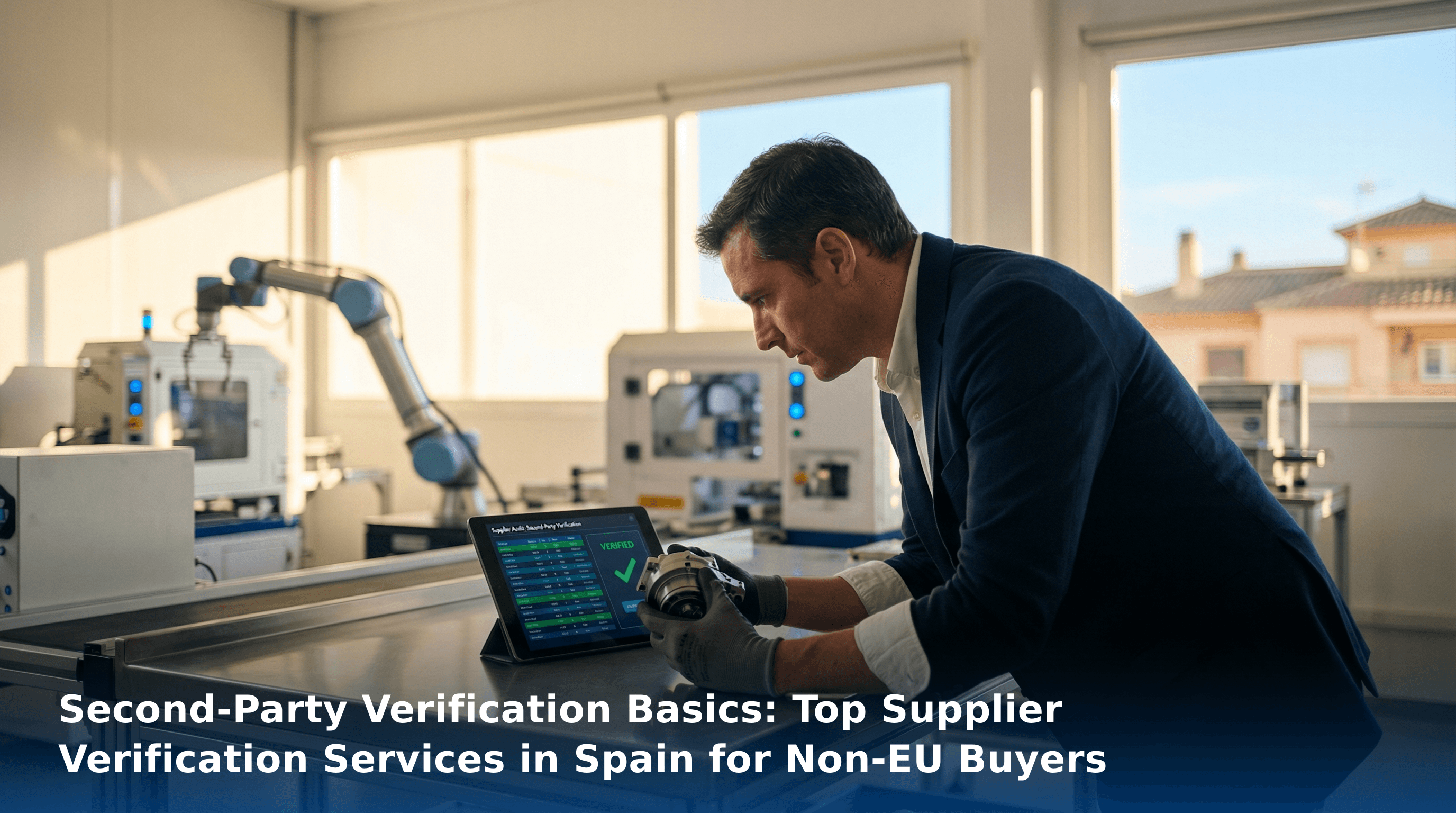
This article explains second-party verification basics, specifically for non-EU buyers to protect investments with Spanish suppliers via local, structured verification services.
- Non-EU buyers require second-party verification for Spanish suppliers.
- Poor supplier choices incur brand damage, compliance issues, and relationship disruption.
- Second-party verification provides independent, pre-transaction factory insight.
- Second-party verification is a buyer-initiated audit against specific standards.
- Unlike third-party, second-party verification tests the buyer's precise deal parameters.
AMBAEX Market Intelligence
Second‑Party Verification Basics: Top Supplier Verification Services in Spain for Non‑EU Buyers
Need to verify a Spanish supplier before wiring funds? Here’s how local, zero‑kickback second‑party teams give you the boots‑on‑the‑ground intelligence you need.
Introduction
If you are a non‑EU buyer, choosing the wrong Spanish supplier can cost far more than one bad container: it can damage your brand, trigger compliance issues and disrupt long‑term customer relationships.
This is where supplier verification services in Spain based on second‑party audits become critical. Instead of trusting only PDFs and sales calls, you get independent eyes and ears inside the factory before you send money or sign multi‑year contracts.
This article explains the basics of second‑party verification, answers common questions from non‑EU buyers and shows how local teams in Spain can protect every transfer with structured, business‑focused verification.
What Is Second‑Party Verification?
Second‑party verification means an audit or verification carried out by you, the buyer, or by a specialist working solely on your side, against your specific standards, risks and contracts.
Unlike generic certifications, second‑party work is designed to answer one simple question: “Is this Spanish supplier safe and reliable enough for our money, our customers and our regulators?”
First, Second and Third Party: The Real Difference
- First party: what the supplier says about itself (self‑assessments, brochures, declarations).
- Second party: checks initiated by the buyer, often run by a local audit partner, tailored to the buyer’s risk profile and markets.
- Third party: generic certification bodies and inspection firms that audit against standards like ISO or BRC.
Third‑party certificates are useful, but only second‑party verification services in Spain are designed to test the exact deal you are about to close, with your volumes, specs and commercial exposure.
FAQ: What Non‑EU Buyers Ask Before Wiring Funds
1. “How do I know this Spanish company is real and properly registered?”
The first layer of supplier verification services in Spain is legal and registry validation: confirming the company’s tax ID (NIF/CIF), commercial registry entries, legal address, directors and legal status.
This “Know Your Business” (KYB) check filters out shell companies, recently created entities with no track record and identity misuse before you even consider a factory visit.
2. “Is a clean registry enough to trust the supplier?”
No. A correct registry simply proves that the entity exists on paper; it says nothing about operational reliability, quality culture, financial stability or export experience.
Second‑party verification adds operational assessment: site visits, process walkthroughs, review of certifications, capacity checks and conversations with management and line staff to see how the business really runs.
3. “What should a basic verification include before I transfer money?”
For non‑EU buyers sending deposits, a basic package of supplier verification services in Spain should cover at least:
- Legal status and registry validation (NIF/CIF, commercial registry, legal representatives).
- Physical visit to the operational address to confirm a real facility, not just a mailbox.
- Validation of licences, sector‑relevant certifications and their current validity.
- Confirmation that the samples you received actually come from the site that will produce your order.
- High‑level financial and stability view (years active, approximate size, customer concentration).
4. “Can I rely only on ISO or BRC certificates?”
Certificates from third parties are positive signals, but they are not a complete answer. They may be outdated, limited to a different site or focused on criteria that are not your main risk.
Second‑party verification tests how those systems work in practice, under real conditions, and whether they actually protect your brand, not just a checkbox on a questionnaire.
7 Pillars of Strong Supplier Verification Services in Spain
Not all inspection or “company check” services are equal. When you look for supplier verification support in Spain, you should insist on these pillars.
1. Pure buyer‑side independence (zero commissions)
Your verification partner must not receive commissions, rebates or “introduction fees” from Spanish factories. They should be paid only by you, with no financial link to potential suppliers.
2. Real, on‑the‑ground presence in Spain
Serious supplier verification services in Spain do not operate purely from behind a screen. They include factory visits, warehouse walk‑throughs and in‑person interviews in Spanish to pick up signals you will never see in a PDF or video call.
3. Integrated legal, operational and commercial view
The best second‑party verification combines KYB/AML checks with factory audits and commercial behaviour analysis: response times, clarity on pricing, openness about issues and readiness to accept audits and contract clauses.
4. Actionable, decision‑ready reports
You do not need a 40‑page checklist; you need a clear recommendation. Strong supplier verification services in Spain end with a simple, defensible position: “approve with conditions”, “only small trial orders” or “do not engage”.
5. Turnaround times aligned with your buying cycle
In international trade, missing a shipment window can be as damaging as picking a bad supplier. Verification services should offer quick desktop checks for early screening and structured audits within defined lead times before you wire large deposits.
6. Sector‑specific expertise
Verifying a nutraceuticals producer, an olive‑oil mill or a ceramics factory requires different lenses. Your second‑party team must understand the technical, regulatory and fraud risks in your exact category.
7. A true second‑party mindset
The core question is not “Does this supplier pass ISO?” but “Is this supplier compatible with our risk appetite, our contracts and our end‑market regulators?” That is the mindset you are buying when you invest in second‑party verification.
A Typical Scenario: The Deposit That Didn’t Leave the Account
Imagine a non‑EU importer finds a Spanish supplier with aggressive pricing and impressive photos. The supplier asks for a 40% deposit to start production, and their certificates look fine at first glance.
Before paying, the importer triggers supplier verification services in Spain. Registry checks are clean, but the on‑site visit reveals that production is subcontracted, the facility is overloaded and the team has no experience shipping to the importer’s market or meeting its specific regulatory requirements.
Armed with this intelligence, the buyer renegotiates the deal: a smaller trial order, lower deposit and clear quality and documentation milestones. The decision is no longer based on trust alone, but on verified facts.
How to Embed Second‑Party Verification into Your Sourcing Process
Second‑party verification delivers the most value when it becomes part of your standard operating procedure, not an emergency reaction.
Step 1: Define risk thresholds and triggers
Decide at what order value, product risk level or new‑supplier situation you will mandate supplier verification services in Spain before any deposit or long‑term contract.
Step 2: Standardise a minimum verification package
Create a baseline checklist for your second‑party partner: legal checks, site confirmation, certification review, basic capacity and export experience, at a minimum.
Step 3: Build and maintain a “verified supplier” panel
Use verification results to create an internal list of approved, conditional and blocked Spanish suppliers, shared across procurement, quality and finance so everyone works from the same risk picture.
Step 4: Link verification to payment terms
Align your payment strategy with verification: no or low deposits before basic checks, larger advances only after full second‑party audits, and better terms for suppliers with consistently strong verification history.