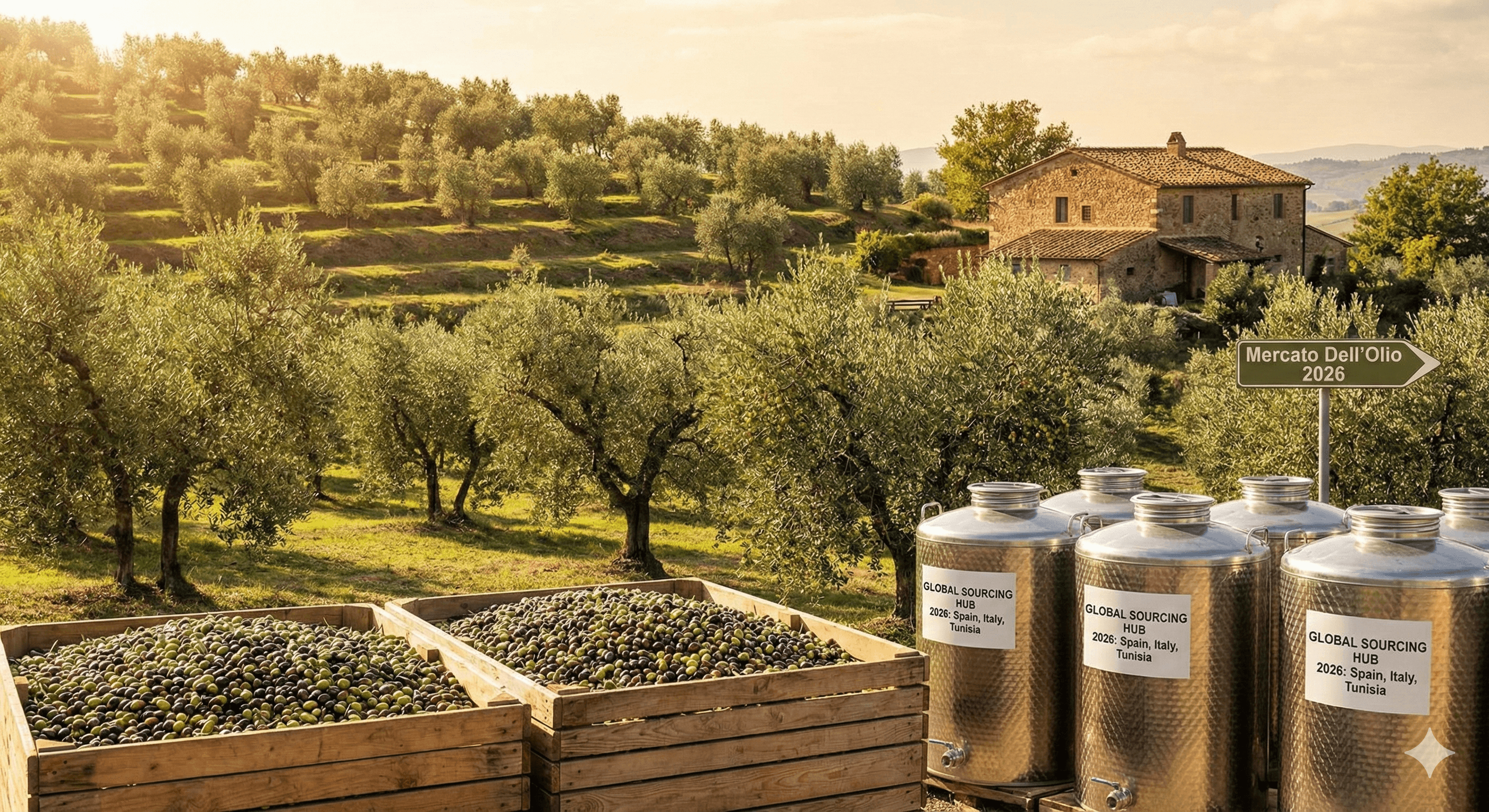
This article analyzes the evolving 2025/26 olive oil market, emphasizing the necessity for non-EU buyers to implement robust origin verification strategies to secure quality amidst fluctuating production and diverse supply dynamics.
- Spain's 2025/26 olive oil output is near expectations, but with lower average quality.
- Italian operators hold significantly higher non-EU olive oil volumes.
- Tunisia strengthens its position as a competitive olive oil supplier.
- Non-EU buyers need clear sourcing strategies to secure desired origin and grades.
- Robust supplier verification is crucial for non-EU buyers in the 2025/26 market.
AMBAEX Market Intelligence
Olive Oil Market 2025/26: Why Non‑EU Buyers Need a Clear Origin and Verification Strategy
Spain, Italy and Tunisia are reshaping the olive oil landscape. For non‑EU buyers, this is a chance to secure the right qualities and origins – if you have a clear sourcing and verification plan.
Introduction
The 2025/26 olive oil campaign in Europe looks more balanced than the crisis years of 2022/23 and 2023/24, but it is far from “back to normal”. Production, stocks and non‑EU inflows are moving in ways that directly affect how non‑EU buyers should plan their sourcing.
In Spain, cumulative output by January is slightly above 1.0 million tonnes – close to sector expectations – yet with lower average quality and rising stocks across mills and packers. This contrasts with 2024/25, when production trended towards roughly 1.3 million tonnes and helped cool the extreme price spikes of previous short harvests. See the January 2026 and January 2025 market reports from Certified Origins – Olive Oil Market Report, January 2026 and Certified Origins – Olive Oil Market Report, January 2025 for detailed figures.
At the same time, Italian operators are holding significantly higher volumes of non‑EU olive oil than a year ago, while Tunisia consolidates its role as a competitive and flexible supplier for European packers, as highlighted in recent coverage of the Italian sector’s resilience and sourcing patterns: Olive Oil Times – Italian Olive Oil Sector Demonstrates Resilience.
For non‑EU buyers in the GCC, Asia or North America, this combination of higher European stocks and strong non‑EU availability points to a more balanced market than in recent crisis years, but also to a more segmented one. The buyers who will benefit most are those who build a clear strategy to secure the right types of olive oil – origin, grade and certification – that match their market needs, supported by robust verification of suppliers and claims.
What Changed From 2025?
The main shift from the 2024/25 to the 2025/26 season is not only in volume but in the composition of stocks and the role of non‑EU origins. Spain remains the volume anchor, but with lower average quality and a notable build‑up of stocks, especially at bottler level, which signals a more cautious, price‑sensitive value chain. The January 2026 report from Certified Origins underlines higher carry‑over risks if current sales and import flows continue.
Olive Oil Times reports AEMO expects a lower share of extra virgin and more virgin/lampante oil in Spain in 2025/26 due to rains and frost, implying a weaker overall quality profile. Wikifarmer also mentions heavy rains, disrupted harvests and a widening gap between top EVOO and lower‑grade oils, which supports saying “average quality is under pressure” rather than “all oil is lower quality.”
In 2024/25, recovering production towards approximately 1.3 million tonnes in Spain and improved availability in other Mediterranean countries helped ease the extreme price tension caused by two very short campaigns. Market commentary from industry platforms such as the Olive Oil World Congress points to the way Spain has consolidated global leadership on volume and exports over the past campaigns.
Italy’s situation adds another layer. Recent data show Italian operators holding substantially more non‑EU olive oil than in the previous year, with Tunisia featuring prominently in both bulk and contract supply. This reflects a structural trend: Italy increasingly positions itself as a blending, branding and re‑export hub, leveraging both EU and non‑EU origins for different market segments, as described in Olive Oil Times – Italian Olive Oil Sector Demonstrates Resilience.
Compared with 2025, non‑EU buyers now face a market where the risk of immediate shortage is lower, but the complexity of origin and quality choices is higher. This is exactly the kind of environment where a deliberate sourcing and verification strategy pays off.
How Non‑EU Buyers Can Use This Market Window
In the short term, higher stocks in Spain and larger non‑EU volumes in Italy create more room to negotiate on standard grades and blends, especially where Spanish oils are combined with Tunisian or other non‑EU origins. Market reports show that buyers are already using increased availability to cap prices and push for more competitive offers in mainstream categories: see the coverage on buyer strategies and quality gaps in Wikifarmer – Buyers Cap Olive Oil Prices as Spanish Rains Disrupt Harvest.
Medium term, the key is to actively monitor Tunisian and other non‑EU offers alongside Spanish and Italian quotes, instead of treating EU origins as the default. Industry overviews of trade flows and entry conditions to the European market show that non‑EU origins such as Tunisia, Morocco and Turkey are increasingly integrated into EU supply chains and export strategies: CBI – Entering the European Market for Olive Oil and GTAIC – European Olive Oil Market Trends.
If current production, stock and import dynamics continue, the transition into the next campaign should be smoother than the extreme volatility experienced in 2022/23 and 2023/24. This gives non‑EU buyers a window to move from reactive purchasing to planned contracts and multi‑origin sourcing, using the present balance to lock in better medium‑term conditions instead of chasing spot cargoes at the last minute.
However, taking advantage of this window requires clarity on which product segments you actually need – and which origin and grade combinations make sense for each one.
Designing an Olive Oil Portfolio that Matches Your Market
Non‑EU buyers rarely buy “olive oil” as a single product. Instead, they supply multiple segments: retail extra virgin brands, foodservice blends, industrial oils for mayonnaises or ready meals, and niche organic or Halal lines. Each of these segments has different expectations on flavour, colour, labelling, certifications and price points.
Guides for international buyers consistently stress the importance of matching origin and grade to the target market. For example, Spanish extra virgin olive oil is often valued for its strong brand recognition and competitive pricing in private label, while Italian origin can carry a premium in certain retail channels. Meanwhile, Tunisia and other non‑EU origins are frequently used to balance cost and supply security, especially in bulk and foodservice applications. Practical guidance for selecting Spanish EVOO and understanding regional profiles can be found in resources such as Alibaba Wellness – How to Choose Spanish Extra Virgin Olive Oil and more general olive oil guides like GourmieGoods – The Ultimate Guide to Olive Oil.
For non‑EU buyers, a robust market‑aligned portfolio typically includes:
- Retail EVOO lines with clear origin positioning (Spain, Italy, blends or “Mediterranean”), stable flavour profile and packaging that reflects local consumer expectations.
- Foodservice and industry blends that prioritise cost‑in‑use and technical performance, often mixing Spanish, Portuguese, Greek and Tunisian oils to hit target pricing while meeting minimum quality and regulatory requirements.
- Niche products such as organic, PDO/PGI, Halal or Kosher oils, where origin and certification are crucial and the risk of mislabelling or inconsistent quality can be higher if suppliers are not thoroughly vetted.
The more diversified your portfolio, the more important it becomes to verify that each supplier can truly deliver the promised grade, origin and certification – especially when labels use broad terms like “EU” or “non‑EU” instead of a clearly stated country.
Why Verification is Fundamental in a Multi‑Origin Market
As European packers combine Spanish, Italian and non‑EU oils to serve different segments, non‑EU buyers are exposed to more complex supply chains and a wider spectrum of quality and documentation practices. Independent reports and audits have repeatedly shown that a significant share of suppliers fail initial checks on hygiene, traceability or documentation when examined by buyer‑side teams, which matches the experience of many procurement and quality managers working with EU suppliers.
In this context, verification is no longer just a “nice‑to‑have” compliance step. It becomes the mechanism that connects your market‑side strategy (what your customers and regulators expect) with the realities of specific mills, bottlers and traders on the ground. This is where second‑party, buyer‑side verification in Spain, Italy and key non‑EU origins adds concrete value.
A strong verification approach for non‑EU olive oil buyers should include at least three layers:
- Document and registry checks to confirm that each supplier is a real, properly registered company with the right licences and certifications for your category (for example food safety schemes, organic control bodies, Halal/Kosher authorities).
- On‑site evaluation of mills and packing plants, including process walkthroughs, sampling, traceability checks and review of how origin and blends are controlled in practice – not only on paper.
- Commercial behaviour and performance review covering lead times, complaint handling, openness about blends and origins, and willingness to accept contract clauses on testing, rejections and corrective actions.
By embedding this kind of second‑party verification into your olive oil sourcing process, you can use the current market balance to your advantage: negotiate better conditions without increasing risk, diversify origin mix while protecting brand promises, and align every contract with what your regulators and customers will see on the label.
This is the core of AMBAEX’s work with non‑EU buyers: translating market data from sources like Certified Origins – Olive Oil Market Reports, trade analysis from CBI and sector news from Olive Oil Times into concrete supplier selection, contract design and second‑party verification steps tailored to your specific markets.