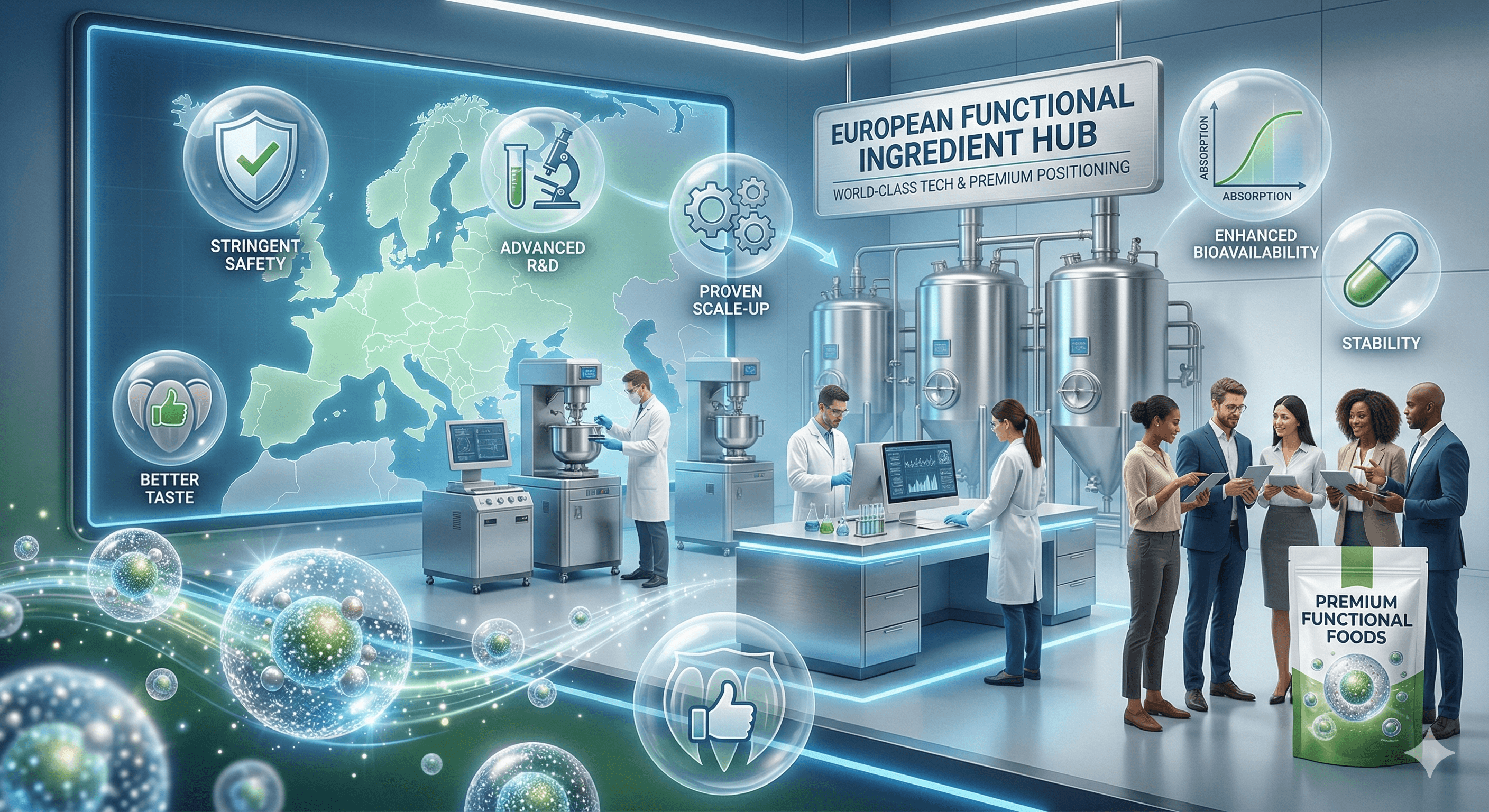
This article explores how non-EU beverage and nutraceutical brands are leveraging European nanoencapsulation technologies to enhance ingredient stability and bioavailability, ensuring more effective and stable products.
- Nanoencapsulation protects sensitive ingredients in beverages and nutraceuticals from degradation.
- European suppliers lead in nano-enabled drinks and supplements innovation.
- Nano-sized carriers improve ingredient dispersibility, stability, and absorption.
- Enhanced bioavailability means consumers absorb a higher percentage of the active ingredients.
- Nanoencapsulation helps maintain the taste and appearance of beverages.
AMBAEX Market Intelligence
Nanoencapsulated Ingredients in Beverages and Nutraceuticals: Why Non‑EU Brands Look to Europe
Functional beverages and nutraceuticals live or die on two things: whether the active ingredients actually survive in the product, and whether they are absorbed in the body. Nanoencapsulation helps with both, which is why European suppliers are investing heavily in nano‑enabled drinks and supplements.
Functional beverages and nutraceuticals live or die on two things: whether the active ingredients actually survive in the product, and whether they are absorbed in the body. Nanoencapsulation helps with both, which is why European suppliers are investing heavily in nano‑enabled drinks and supplements according to encapsulation research.
Why Beverages and Nutraceuticals Need Nanoencapsulation
Drinks and supplements are packed with sensitive compounds—omega‑3, carotenoids, vitamins, probiotics, plant extracts—that are easily degraded by light, oxygen, heat and pH. In aqueous systems like juices or plant milks, oils and hydrophobic actives separate, oxidise or create turbidity and off‑flavours. In capsules and powders, poor solubility and large particle size can result in low bioavailability, meaning the consumer absorbs only a small fraction of the declared dose as documented in formulation studies.
Nanoencapsulation tackles these issues by trapping actives inside nano‑sized carriers (nanoemulsions, nanoliposomes, solid lipid nanoparticles), which improve dispersibility in water, protect against degradation and enhance absorption in the gut. The result is drinks that stay stable and clear on the shelf, and nutraceuticals that deliver more effect per milligram of ingredient according to delivery system research.
Nanoencapsulated Ingredients in Beverages
In beverages, nanoencapsulation is mainly used to keep hydrophobic ingredients stable and invisible, while preserving taste and appearance as noted in beverage technology literature.
- Omega‑3 and other oils: Nanoemulsified fish or algal oils can be incorporated into juices, flavoured waters, dairy drinks and plant milks without visible oil droplets or “ringing”. The nano‑scale droplets are more resistant to creaming and coalescence, which maintains clarity and uniformity over shelf life according to stability studies.
- Carotenoids and fat‑soluble vitamins: Encapsulation helps keep carotenoids, vitamin D and other fat‑soluble vitamins soluble in aqueous systems, reducing precipitation and colour fading under light exposure as demonstrated in beverage applications.
- Polyphenols and plant extracts: Nanocarriers can mask bitterness and astringency from green tea extracts, curcumin or other botanicals, allowing higher doses without unpleasant taste or turbidity according to sensory research.
For non‑EU brands, this means they can launch fortified drinks that are visually appealing, shelf‑stable and pleasant to drink, while genuinely delivering functional doses of active ingredients.
Nanoencapsulated Nutraceuticals: Capsules, Powders and Gummies
In nutraceuticals, the main benefit of nanoencapsulation is improved bioavailability and, in some cases, targeted release as documented in supplement research.
- Curcumin, resveratrol and other poorly soluble actives: Nanoencapsulated forms can dramatically increase apparent solubility and surface area, leading to higher absorption in the intestine compared to conventional powders. This allows formulators to reduce the dose while maintaining or improving efficacy.
- Probiotics: Encapsulation helps protect probiotic strains from gastric acid and bile salts, increasing survival rates through the stomach and into the intestine. This can translate into higher viable counts at the site of action.
- Omega‑3 and fat‑soluble vitamins in softgels and powders: Encapsulation reduces oxidation and fishy aftertaste, and supports claims around stability and potency over the product’s shelf life according to formulation data.
For brands selling in markets where consumers scrutinise label claims, showing that you are using nanoencapsulated forms with documented bioavailability improvements can be a strong differentiator.
Why Source Nanoencapsulated Drinks and Ingredients from Europe
Europe combines advanced nanoencapsulation R&D with strict food safety and labelling regulations, creating a relatively small but highly credible pool of suppliers as noted in European market analysis.
- Regulatory oversight: Engineered nanomaterials in food and supplements must be safety‑assessed and correctly labelled, so European suppliers are used to providing particle‑size data, toxicology dossiers and guidance on compliant labelling. This documentation can support your own regulatory submissions in non‑EU markets.
- Established encapsulation players: Major European ingredient companies and specialist SMEs supply nano‑enabled systems for omega‑3, vitamins, probiotics and botanical extracts, with application support for beverages and nutraceutical formats.
- Export experience: Many of these firms already export to Asia, the Middle East and the Americas, so they understand certification, documentation and logistics requirements.
For a non‑EU buyer, this means less technical risk, clearer evidence for marketing and regulatory purposes, and a stronger “European quality” story for consumers.
What to Check When Evaluating EU Suppliers
To move beyond buzzwords and make solid sourcing decisions, you need a clear technical and commercial checklist when speaking to potential European partners according to sourcing best practices.
Technical points
- What is the encapsulation system (nanoemulsion, nanoliposome, solid lipid nanoparticle, polymeric nanoparticle)?
- What is the typical particle size range and distribution, and how is it measured?
- What stability data do they have in your intended matrix (pH, temperature, light, storage time)?
- For nutraceuticals, do they have comparative bioavailability data versus non‑encapsulated forms?
Regulatory and quality points
- How is the ingredient classified under EU law, and what safety assessments or opinions are available?
- What information do they provide for nano‑labelling and for local regulators in your market?
- Which quality and food‑safety systems do they operate (e.g. HACCP/FSMS, GFSI schemes)?
Commercial points
- Minimum order quantities and lead times for your target formats (bulk ingredient vs. finished drink/supplement).
- Availability of formulation support or co‑development for your specific product concept.
- Export track record to your region or similar regulatory environments.
Working with a sourcing and audit partner in Europe can help you filter suppliers against these criteria, verify their claims and manage sampling and technical dialogue. That way, you can bring nanoencapsulated beverages and nutraceuticals to market with greater confidence in performance, compliance and long‑term supplier reliability.
Turn European Nanoencapsulation into Your Beverage and Nutraceutical Advantage
European suppliers have mastered the science of keeping sensitive ingredients stable, bioavailable and consumer‑friendly in drinks and supplements according to industry research. For non‑EU brands, this means you can now offer functional beverages that stay clear and stable on the shelf, and nutraceuticals that deliver measurable bioavailability improvements—without compromising on taste or appearance.
AMBAEX helps buyers in Asia, the Middle East and the Americas identify, evaluate and monitor European suppliers of nanoencapsulated beverage ingredients and finished nutraceutical products—with on‑the‑ground presence in Spain, Portugal and Italy.
Discuss your beverage and nutraceutical nanoencapsulation sourcing requirements →
info@ambaex.com | ambaex.com/contact
Zero Kickbacks. Physical Verification. Procurement Intelligence in Southern Europe.