This article examines how second-party audits in Italy, like those offered by Ambaex, mitigate remote sourcing risks for LCBO agents procuring premium DOC/DOCG Italian wines, ensuring compliance and quality.
- Italian wine accounts for a significant portion of LCBO sales.
- Remote sourcing of Italian wine carries compliance and quality risks.
- Second-party audits verify Italian DOC/DOCG winery certifications.
- Audits ensure LCBO/SAQ compliance for premium Italian SKUs.
- Ambaex provides factory audit services for Italian wine sourcing.
AMBAEX Market Intelligence
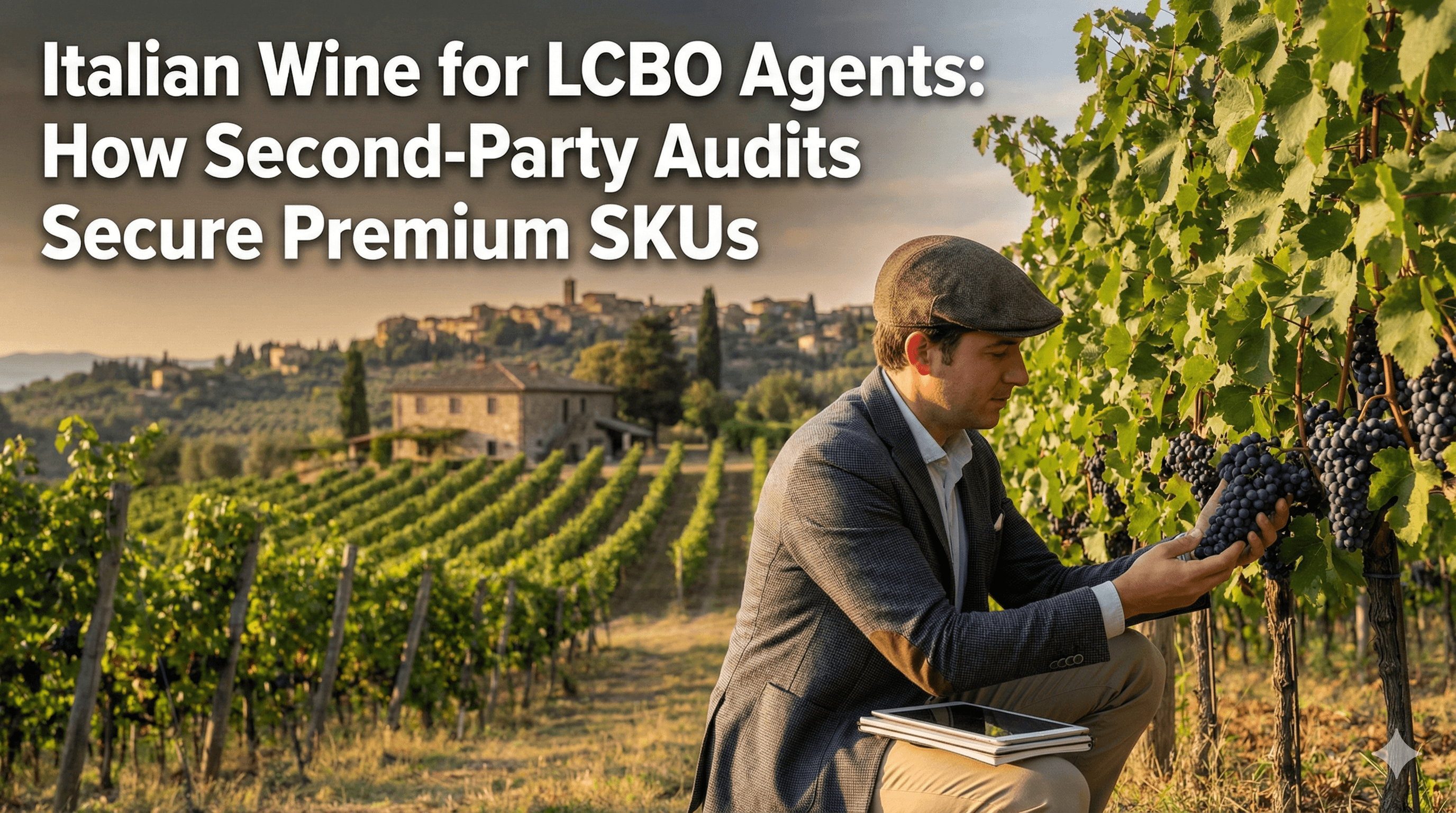
Italian Wine for LCBO Agents: How Second-Party Audits Secure Premium SKUs
Italy Tops Canada's Import Table—But Remote Sourcing Risk Doesn't Disappear at Premium Price Points
Executive Summary
Italian wine sits at the top of Canada's import table. Imports from Italy reached approximately C$457–607 million in 2024, growing by more than 12–15% in value even as U.S. volumes collapsed under tariffs. For LCBO agents, Italy is the natural "halo" and premium pillar in portfolios where Spanish and Portuguese wines supply value and volume.
But premium price points don't eliminate remote sourcing risk. Long digital supplier lists, opaque factory operations, and compliance pressure remain—especially when coordinating multi-country portfolios across Spain, Portugal, and Italy from a desk in Ontario.
The solution: A second-party supplier audit in Italy, integrated with procurement-as-a-service Europe, verifies that your DOC/DOCG partner meets LCBO/SAQ requirements before you commit. Here's where Ambaex's factory audit service Italy plugs into your premium wine sourcing.
The Remote Sourcing Risk: Premium Doesn't Mean Problem-Free
Canada's wine import reality favours Italy. In 2024, imported wines accounted for roughly 75% of LCBO wine sales, with Italy ranking among the top foreign suppliers—LCBO sales of Italian wines exceeding US$300M in recent years. The demand is there. The shelf space is there.
What's missing is verified supplier intelligence.
LCBO agents evaluating Italian wineries face the same opacity that plagues any remote procurement relationship. You're working with digital supplier lists assembled from trade shows, export directories, and broker introductions. You're assessing capacity, compliance, and commercial fit through emails, video calls, and sample shipments.
The problems this creates are specific to Italian wine sourcing:
- Documentation gaps: Does the winery actually hold the DOC/DOCG certifications it claims? Are lab analysis protocols aligned with LCBO's ISO 17025 expectations?
- Label compliance uncertainty: Can the winery adapt designs for Canada's bilingual requirements? Will they accept the label constraints SAQ explicitly outlines?
- Capacity vs. volume mismatch: Can this 50,000-bottle producer actually deliver the 200,000-bottle program you're planning?
- Experience with regulated markets: Has this winery ever shipped to a state monopoly, or are you their compliance education project?
Third-party certifications—ISO, organic, BRCGS—confirm that a system meets a standard. They don't confirm that a specific winery can meet your capacity, price, and labelling requirements.
This is where a second-party supplier audit closes the gap.
How Italian SKUs Complement Spanish and Portuguese Lines
Before diving into audit methodology, it's worth understanding why Italy matters strategically for LCBO agents building European portfolios.
Market Weight in Canada
In 2024, Canada's wine imports by origin were led by France (about C$680M), Italy (C$607M), the U.S. (C$557M), Spain (C$168M), and Australia (C$149M). Italian exports to Canada reached around €175–198 million in 2024–H1 2025, growing roughly 12–15% in value and 4–7% in volume—making Canada one of Italy's fastest-growing key markets.
Portfolio Logic for LCBO Agents
Use Italian SKUs for:
- Premium DOC/DOCG reds (Chianti Classico, Valpolicella Ripasso, Barolo, Brunello) that create halo and justify higher price bands in LCBO/VINTAGES
- Recognisable, high-velocity whites and sparkling wines (Pinot Grigio, Prosecco, Soave) where consumers already expect Italian origin
Use Spanish and Portuguese SKUs for:
- Value red and white segments, private labels, and bulk—Spain with ~20M hl exports and low average prices; Portugal with ~347M L exports at ~€2.79/L
- Discovery/value tiers (Ribera del Duero, Vinho Verde, Douro blends) that support strong margins in the C$11–16 range while keeping shelf prices below Italian and French benchmarks
Together, this multi-country mix allows an LCBO agent to keep price architecture coherent: Italy for premium and flagship lines; Spain and Portugal for sharp value and volume.
But coherent architecture requires verified suppliers in each country—and that's where remote sourcing risk multiplies. Managing separate relationships with Italian, Spanish, and Portuguese brokers creates compliance inconsistency, documentation gaps, and margin leakage.
How a Second-Party Supplier Audit in Italy Closes the Gap
A second-party audit, per ISO 19011 principles, is an external audit conducted by or on behalf of the buyer. It's not a generic certification—it's verification tied to your specific procurement requirements.
What a Factory Audit Service Italy Covers for Wine Suppliers
- Facility verification: Physical inspection of production capacity—tanks, bottling lines, barrel stock—against claimed output and your volume requirements
- DOC/DOCG documentation: Review of consorzio certifications, inspection records, and geographic origin compliance
- Lab capability assessment: Are analysis protocols aligned with LCBO/SAQ parameters? ISO 17025 equivalency?
- Label compliance review: Willingness and capability to adapt artwork for Canadian bilingual requirements
- Regulated market experience: Track record with monopolies, state boards, or similarly demanding buyers
- Traceability audit: Vineyard-to-bottle documentation, batch tracking, chain of custody
The Outcome: Verified Suppliers, Not Just Names
The audit produces a structured report scoring the winery on production capability, compliance readiness, traceability, and commercial viability. The recommendation is clear: approve, approve with conditions, or reject and re-source.
This feeds directly into your procurement decision—live intelligence, not a certificate for the supplier's marketing materials.
Book a Multi-Country Sourcing Call (Spain–Portugal–Italy → Canada)
If you're an LCBO agent building a European portfolio, stop managing piecemeal relationships with separate country brokers. Ambaex coordinates sourcing and verification across Spain, Portugal, and Italy from a single brief.
On your sourcing request, include:
- Target province(s) (Ontario, Quebec, others) and channel (LCBO core, VINTAGES, consignment, private label)
- Desired origin mix (Italy halo SKUs, Spain value, Portugal complement)
- Segments and annual volumes per SKU
- Compliance requirements (LCBO, SAQ, FSVP, or other)
Ambaex uses on-the-ground teams in Spain, Portugal, and Italy to propose a coordinated, LCBO/SAQ-ready supplier matrix—verified through second-party audits, not just names on an email list.
Contact: info@ambaex.com