AMBAEX · SOURCING INTELLIGENCE · SEAFOOD
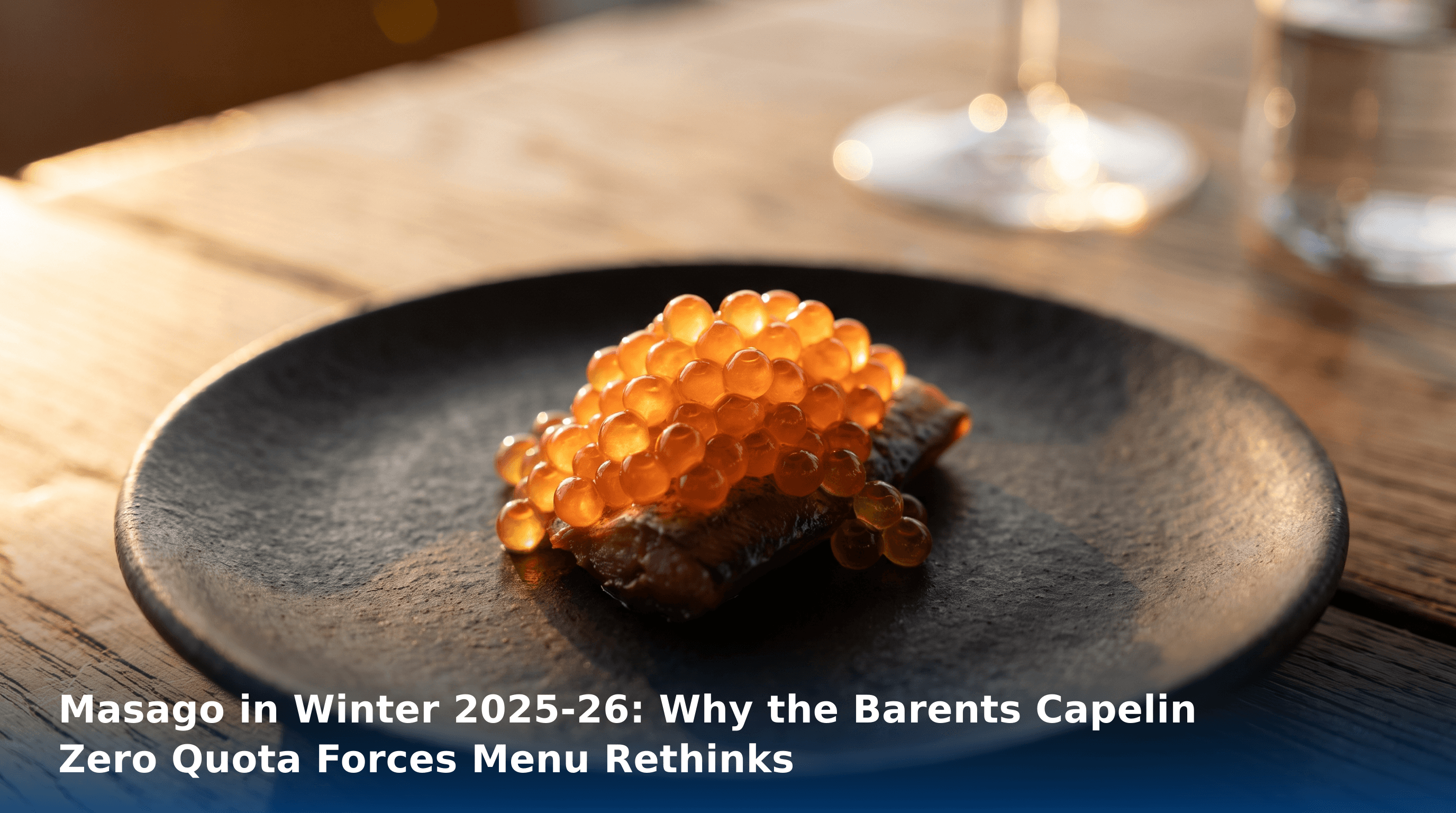
Masago in Winter 2025-26: Why the Barents Capelin Zero Quota Forces Menu Rethinks
Capelin roe (masago) is a workhorse ingredient in sushi, catering, and foodservice: it delivers texture, colour, and a "premium" feel at a relatively low cost. But in 2026, that cost is no longer predictable.
Capelin roe (masago) is a workhorse ingredient in sushi, catering, and foodservice: it delivers texture, colour, and a "premium" feel at a relatively low cost. But in 2026, that cost is no longer predictable (Seafood Media).
1. What Has Happened to Barents Sea Capelin
Joint assessments by Norway and Russia (IMR/PINRO) showed a mature biomass of approximately 123,600 tonnes in autumn 2025, the lowest level since 1995 (IMR/PINRO).
Under the management rule, the probability of maintaining the spawning biomass above the reference point (200,000 tonnes) is 0% if fishing takes place. That is why a zero quota was recommended for 2026, confirming the closure also implemented in 2025 (IMR/PINRO).
The Norwegian‑Russian fisheries commission adopted that recommendation: there will be no commercial fishing of capelin in the Barents Sea in 2026 (Norwegian Government).
2. Consequences for Masago Supply
With the Barents closed, the supply of capelin roe depends almost entirely on the Icelandic fishery (and to a lesser extent Greenland), whose 2025-26 quota was set around 197,000 tonnes (FiskerForum).
Iceland is already a key supplier to Japan, where capelin roe is used extensively in sushi and processed products (Seafood Media). When Japanese demand is strong and Northeast Atlantic supply is restricted, prices tend to rise and availability becomes more irregular for European buyers (Seafood Media).
For a HORECA operator in Ireland or the EU, this means: higher risk of shortages in winter and less ability to negotiate price if you rely 100% on traditional masago.
3. Why Spherification Pearls Are Gaining Ground
Faced with this volatility, many product development teams are testing direct‑spherification pearls (plant/algae‑based) as a functional alternative to masago:
- Supply stability: cost follows commodities like sugar, alginates, and seaweed extracts, not fishing quotas subject to biomass collapses.
- Format control: size, colour, and flavour are more standardised across batches — useful for chains and central purchasing.
- Different sensory profile: spherified pearls offer a "liquid burst" distinct from the "dry crunch" of capelin roe. In applications with sauce, frying, or warm assembly (e.g., tempura rolls with spicy mayo), that difference can be perceived as an upgrade; in very traditional and minimalist references, it may not fit.
This is not about "replacing at any cost". It is about designing the menu according to channel and ticket value:
- Catering and delivery: prioritise stability, controlled cost, and "burst" experience.
- High‑ticket traditional sushi bar: keep masago on key pieces and use spherification on volume lines or promotions.
4. What Buyers and Chefs Can Do Now
If your operation depends on masago, this winter is a good time to:
- Review contracts: do you have fixed pricing and guaranteed volume for Q4‑2025 / Q1‑2026?
- Diversify sources: combine Icelandic masago with spherification pearls on specific references.
- Adjust the menu: move traditional masago to items where "crunch" is critical; use pearls on rolls and specialities where "burst" is an advantage.
- Run controlled trials: test pearls on 2‑3 high‑turnover SKUs and measure customer acceptance and real margin.
Conclusion
The Barents capelin zero quota is not an anecdote. It is a reminder that "cheap and stable" ingredients can become volatile from one year to the next. For HORECA operators who want to protect margins without sacrificing customer experience, a combination of traditional masago + spherification pearls is an increasingly sensible strategy (IMR/PINRO).
Ready to secure your masago supply?
Ambaex helps foodservice buyers source alternative ingredients and verify supply chains in Spain, Portugal, and Italy. Let's talk about your sourcing strategy.