The India-EU FTA slashes tariffs on EU goods, offering Indian buyers lower costs and wider supplier choices, but on-the-ground verification remains vital to ensure supplier compliance and performance.
- India-EU FTA cuts tariffs on 96% of EU goods.
- EU exports to India projected to double by 2032.
- Tariffs on machinery, chemicals, and pharmaceuticals will be largely scrapped.
- Verification of EU suppliers remains crucial for Indian buyers.
- FTA creates a market of 2 billion consumers when EU and India are combined.
AMBAEX Market Intelligence
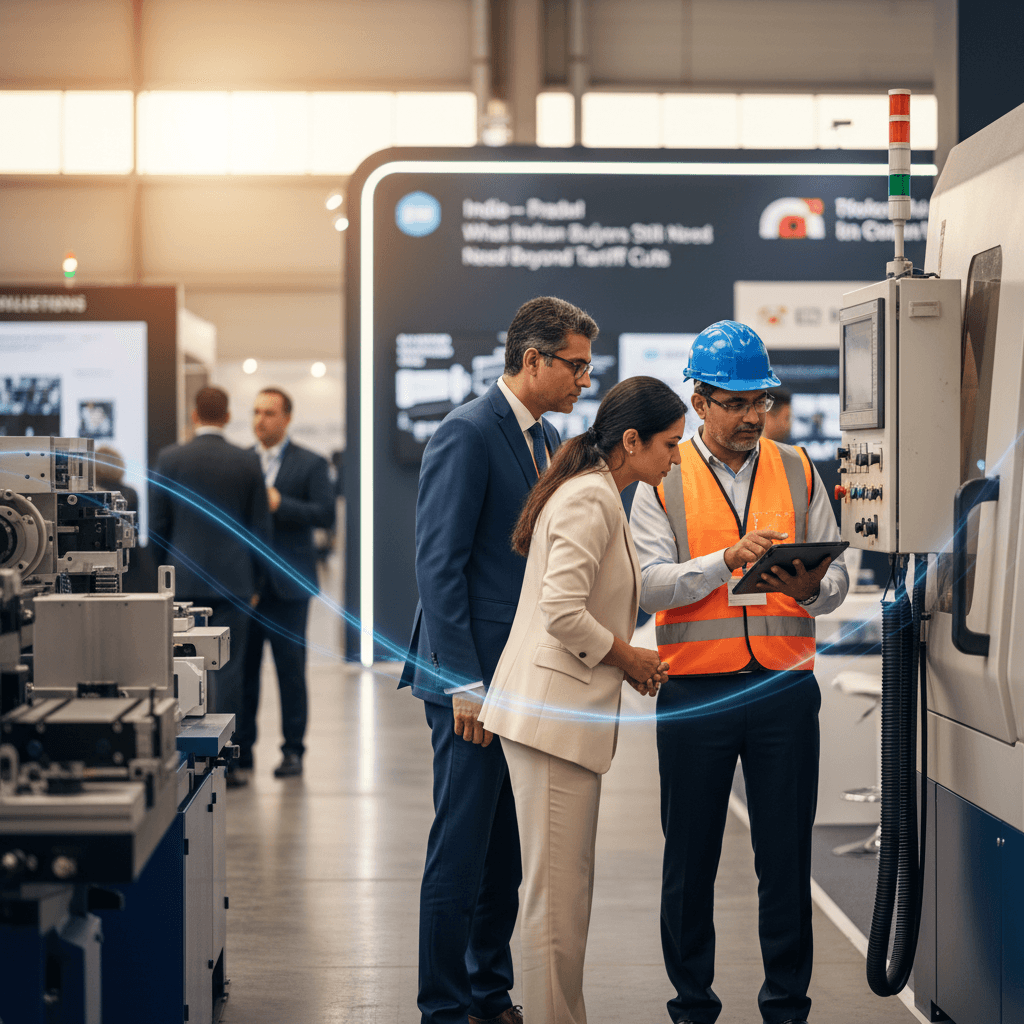
India–EU Free Trade Deal: What Indian Buyers Still Need Beyond Tariff Cuts
Why Cheaper European Machinery, Components and Food Products Don't Replace On‑the‑Ground Supplier Verification in Spain, Portugal and Italy
Executive Summary
The new India–EU Free Trade Agreement (FTA) will cut or eliminate tariffs on roughly 96.6% of EU goods exports to India, saving European exporters an estimated €4 billion a year in duties and making high‑value imports more affordable for Indian businesses over time according to European Commission data and EU trade policy documents.
Tariffs of up to 44% on machinery, 22% on chemicals and 11% on pharmaceuticals will be largely scrapped, while duties on premium European wines are set to fall from around 150% to as low as 20–40%, and olive‑oil tariffs will drop from about 45% to zero as reported by Al Jazeera and detailed in Economic Times coverage.
For Indian buyers, this means a wider choice of EU suppliers, lower landed costs and a stronger strategic corridor into Spain, Portugal and Italy—but it does not remove core risks around capacity, documentation, compliance and real‑world performance on the factory floor.
The practical question: As tariffs fall and EU suppliers compete harder for Indian business, how do you decide whom to trust, and how do you make sure tariff savings are not wiped out by quality failures, delays or hidden non‑compliance?
What the India–EU FTA Actually Changes for Indian Buyers
The FTA is designed to double EU goods exports to India by 2032 by cutting tariffs on around 96% of EU exports, creating a market of roughly two billion consumers when the EU and India are combined, according to European Commission projections.
For Indian importers, the most tangible changes are in cost structures and supplier availability across machinery, chemicals, pharmaceuticals, food and beverages and selected consumer goods as detailed in economic analyses and trade reports.
| Category | Pre‑Deal Duties (Illustrative) | FTA Effect for Indian Buyers |
|---|---|---|
| Machinery and equipment | Tariffs up to about 44% on many European machines. | Large removal or reduction of duties, lowering capex for factories, logistics and processing lines. |
| Chemicals and inputs | Duties up to roughly 22% on EU chemicals. | Tariff elimination in most cases, making industrial and specialty chemicals cheaper. |
| Pharmaceuticals | Import duties up to about 11% on EU medicines and intermediates. | Near‑total removal of tariffs, improving access to high‑spec products. |
| Wines and spirits | Wine tariffs around 150%; high duties on spirits. | Wine duties stepping down to ~20–40%, cuts on spirits and beer, improving affordability for retail and HORECA. |
| Olive oil and processed foods | Olive oil around 45%; high tariffs on juices and processed foods. | Olive‑oil tariffs cut to zero; reduced duties on processed foods and fruit juices. |
At the same time, the EU maintains its dense framework of product standards, sanitary and phytosanitary (SPS) rules and documentation requirements, and India keeps its own regimes such as FSSAI and BIS—so real‑world trade still runs through a bureaucratic maze where misunderstanding or mis‑documentation can be as costly as tariffs as outlined in EU trade documents.
The Hidden Gap: Tariff Relief vs. Operational Reality
EU data shows that trade agreements tend to accelerate flows: in 2024, EU goods exports to its preferential partners grew about twice as fast as exports to non‑FTA countries, and services trade with these partners reached about €1.3 trillion, growing more than three times faster than with others according to European American Chamber of Commerce analysis.
As the India–EU FTA takes effect, Indian buyers can expect more European suppliers, more aggressive pricing and more unsolicited outreach—but larger pipelines also mean more room for mis‑selection, misrepresentation and avoidable risk.
What the FTA Does Not Tell You About a Supplier
| FTA Reality | What It Doesn't Cover |
|---|---|
| Tariffs are lower on EU machinery, components and food products. | Whether the factory actually has the capacity, maintenance and process control to deliver consistently. |
| Customs procedures are streamlined on paper, with commitments to facilitate trade. | Whether the supplier's documentation practices are robust enough to avoid FSSAI, customs or port delays in India. |
| IP and standards cooperation are strengthened, improving the legal framework. | Whether the specific plant you are dealing with respects those standards in day‑to‑day operations. |
| EU exports are expected to double to India by 2032. | Which producers are real manufacturers versus intermediaries or brokers posing as factories. |
In other EU agreements, trade expanded but the pattern was clear: companies that combined tariff opportunities with structured due diligence and supplier monitoring captured the value; those that chased price alone absorbed the failures as documented in trade implementation reports.
Why On‑the‑Ground Verification Becomes More Important, Not Less
As tariffs fall, your landed‑cost calculations will look better on paper, but the proportion of your risk tied to operational failures—quality, delays, compliance problems—actually rises, because one major incident can wipe out the gains from several years of duty savings.
This is especially true in Southern Europe (Spain, Portugal, Italy), where a mix of world‑class exporters and smaller, less formal operations coexist under the same EU regulatory umbrella.
Key Risk Areas Under the FTA Wave
- Capacity over‑promising: suppliers eager to exploit new demand from India may overstate capacity, leading to delays, partial shipments or last‑minute subcontracting.
- Documentation gaps: even technically compliant factories can have weak traceability, batch records or export documentation, triggering customs or FSSAI issues at Indian ports.
- Broker vs. producer confusion: trading companies may present themselves as manufacturers, limiting your control over quality and transparency in the real supply chain.
- Standard mismatch: a plant can be "EU compliant" yet still fail specific Indian labelling, documentation or halal/vegetarian segregation expectations for your customers.
In this environment, second‑party audits and procurement‑intelligence style verification are not a luxury; they become the mechanism through which serious Indian buyers decide which of the many EU options unlocked by the FTA are actually safe, scalable and aligned with their domestic obligations.
What Effective Supplier Verification Looks Like for Indian Buyers
For Indian procurement teams, the goal is not to "inspect everything" but to build a simple, repeatable lane: from initial FTA‑driven opportunity, to screened shortlist, to on‑site verification and then ongoing monitoring.
Done correctly, this turns the India–EU FTA from a generic policy win into a concrete set of cost, reliability and speed advantages on your P&L.
1. FTA‑Aware Shortlisting
- Start from categories where the FTA impact is largest for you—e.g. machinery, chemicals, pharma inputs, high‑duty F&B imports such as European wines, olive oil and processed foods.
- Use tariff‑schedule information and rules of origin to identify which EU products and origins actually qualify for lower duties in your HS codes.
- Build a long list of 10–20 potential suppliers per category from Spain, Portugal and Italy, including both trade‑fair contacts and direct approaches.
2. Remote Pre‑Screening With Basic Verification
- Check legal entity, ownership and basic financial signals through public registries and trade databases.
- Request core documents: certifications, process descriptions, sample labels and export history, focusing on India or similar markets.
- Eliminate suppliers that cannot provide coherent documentation or that show obvious inconsistencies between marketing claims and paperwork.
3. Second‑Party, On‑Site Audits in Southern Europe
- Conduct targeted on‑site audits at shortlisted factories in Spain, Portugal and Italy, focusing on process control, capacity, hygiene, documentation and export readiness.
- Verify that certificates (quality, food safety, organic, sustainability, etc.) are valid, current and belong to the legal entity you are contracting.
- Assess management quality, corrective‑action culture and their familiarity with Indian market expectations (labelling, certifications, halal/vegetarian controls where relevant).
4. Decision‑Ready Dossiers and Ongoing Monitoring
- Translate audit findings into GREEN / CONDITIONAL / RED‑FLAG ratings per supplier, with clear recommendations on volumes, contract length and conditions.
- Set up periodic re‑checks, especially after scale‑up or major process changes, so that one‑off due diligence becomes a living system rather than a one‑time event.
Turning the India–EU FTA Into a Sourcing Advantage: A Simple 4‑Step Playbook
The difference between "FTA as headline" and "FTA as advantage" lies in how systematically you combine tariff benefits with supplier verification.
Here is a simple framework Indian buyers can implement immediately.
Step 1: Quantify the Opportunity
- Identify your top 5–10 categories where EU suppliers are relevant (e.g. CIP‑critical machinery, food and beverage imports, chemicals).
- Estimate duty savings per category using FTA tariff schedules—prioritise the ones where reduced duties have the biggest potential impact on landed cost.
Step 2: Build a Verified EU Supplier Funnel
- For each priority category, build a long list of EU suppliers from trade fairs (Gulfood, Anuga, Alimentaria), industry directories and inbound approaches.
- Run remote pre‑screening and select a smaller subset for on‑site second‑party audits in Spain, Portugal and Italy.
Step 3: Lock In Tariff Savings Through Contracts
- Negotiate contracts that explicitly capture tariff‑pass‑through (so part of the EU exporters' €4 billion annual duty savings flows into your prices).
- Include clauses on documentation quality, corrective‑action timelines and re‑audit rights tied to volume and performance.
Step 4: Institutionalise EU Supplier Verification
- Make second‑party audits and supplier dossiers a standard prerequisite for any new high‑value EU supplier, especially under the FTA.
- Track performance data (claims, delays, documentation issues) across EU suppliers and feed it back into future sourcing rounds.
When your board or management asks, "Are we really capturing the benefits of the India–EU FTA?", this framework gives you a concrete answer: lower duties, yes—but also better‑verified, more reliable European partners and fewer surprises.
Beyond Tariff Cuts: Why Indian Buyers Need an Independent Eye in Southern Europe
The India–EU Free Trade Deal opens a powerful corridor: cheaper European machinery, components and food products, more supplier options and a deeper strategic link with Spain, Portugal and Italy.
What it does not provide is an independent view of who is actually ready to deliver for your Indian customers, under real capacity, documentation and compliance pressure.
The next edge will belong to Indian buyers who combine the macro‑benefits of the FTA with disciplined, on‑the‑ground verification of their European suppliers.
Discuss how to build an India–EU FTA‑ready supplier verification lane →
info@ambaex.com | ambaex.com/contact
Zero Kickbacks. Physical Verification in Spain, Portugal and Italy. Procurement Intelligence for Indian Buyers.