
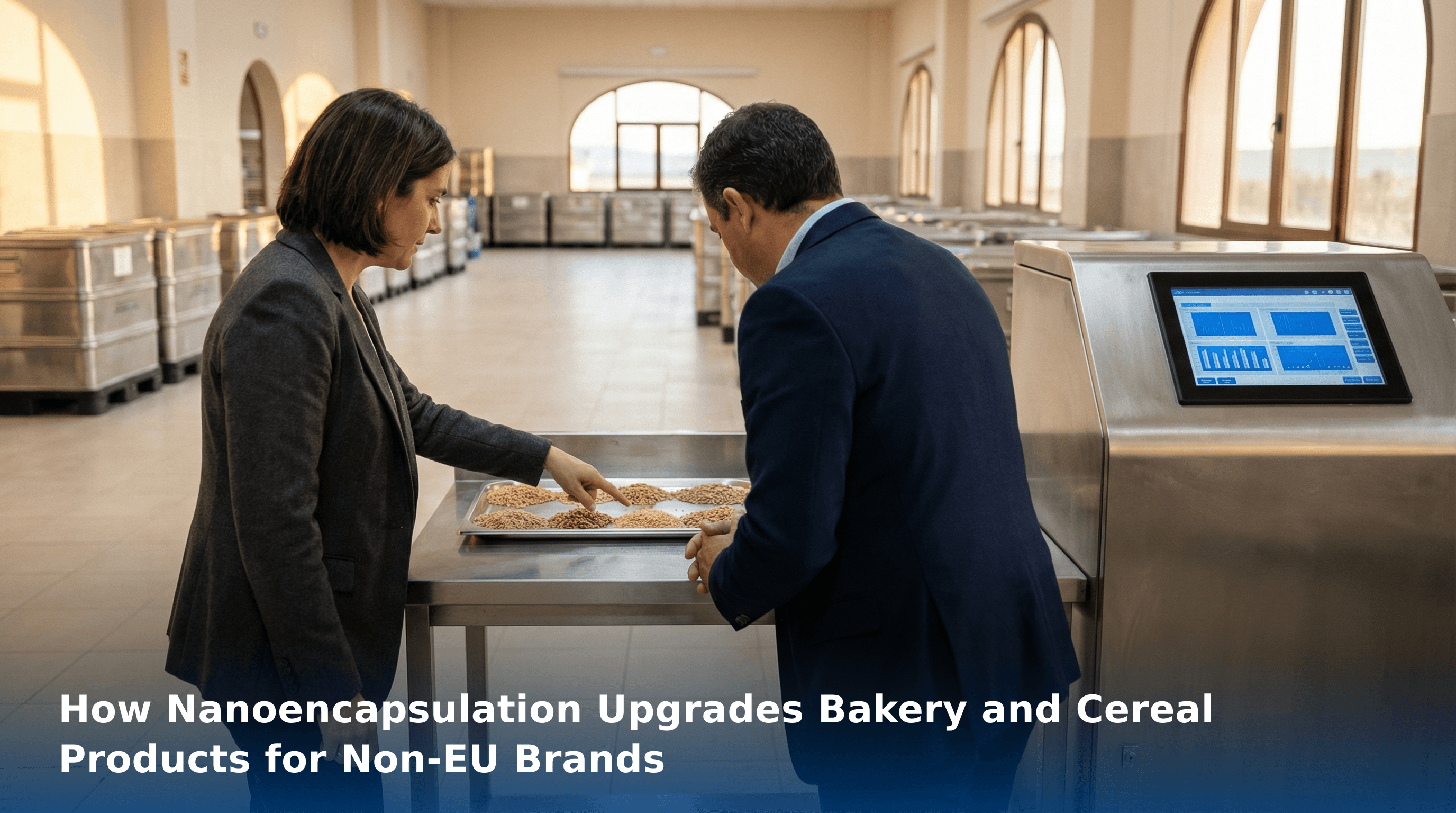
Nanoencapsulation enables non-EU bakery and cereal brands to fortify products with sensitive nutrients, ensuring bioavailability and taste without compromising texture.
- Nanoencapsulation protects sensitive nutrients during baking.
- It mitigates off-flavors from functional ingredients.
- This technology ensures nutrient bioavailability in the gut.
- It allows for fortification without taste compromise.
- Ideal for omega-3s, plant sterols, and antioxidants.
AMBAEX Market Intelligence
How Nanoencapsulation Upgrades Bakery and Cereal Products for Non‑EU Brands
Fortified breads and cereals are no longer just about adding vitamins to a label; they are about delivering real health benefits without compromising taste or texture.
Nanoencapsulation gives bakery and cereal manufacturers a way to hide sensitive nutrients inside tiny carriers, so they survive mixing and baking, avoid off‑flavors, and remain bioavailable in the gut.
Why Bakery and Cereals Are a Perfect Match for Nanoencapsulation
Bakery and breakfast cereals are eaten daily and have predictable consumption patterns, which makes them ideal vehicles for functional ingredients like omega‑3, plant sterols and polyphenols. The challenge has always been that these ingredients are highly sensitive to heat, oxygen and mechanical stress, and they can impart fishy, bitter or rancid notes that consumers reject as documented in food science literature.
Nanoencapsulation addresses exactly these pain points by embedding oils or bioactives inside solid or gel‑like particles that protect them during dough preparation, proofing and baking. This means non‑EU brands can launch fortified bakery products with real nutritional upgrades, while keeping the eating experience very close to a standard bread or cereal according to peer‑reviewed studies.
What Nanoencapsulated Ingredients Can Do in Bakery Applications
The most common nanoencapsulated ingredients in bakery and cereals are long‑chain omega‑3 fatty acids, plant sterols and antioxidant‑rich extracts as highlighted in food technology research.
- Omega‑3 fatty acids (from fish or algae oils) can be nanoencapsulated in protein or carbohydrate matrices, which reduce contact with oxygen and limit oxidation during baking according to bioavailability studies.
- Plant sterols and stanols can be embedded in lipid‑based nano‑carriers, improving their dispersibility in dough and maintaining functionality after baking as described in European patent filings.
- Polyphenols from cocoa, tea or fruit can be encapsulated to reduce bitterness and improve stability, while still delivering antioxidant benefits according to academic research programs.
For non‑EU buyers, the key benefit is the ability to offer bakery products that genuinely contribute to heart health, cognitive support or antioxidant intake, without requiring consumers to change their eating habits or accept strange flavors as noted in functional food market analysis.
Evidence from European Trials and Patents
European R&D has already tested nanoencapsulation in real bakery applications, not just in the lab according to EU-funded research projects.
One study on functional bread with nanoencapsulated omega‑3 showed that encapsulation significantly reduced the formation of oxidation markers during baking compared to unencapsulated oil, and that sensory panels perceived less fishy or rancid notes in the fortified bread. The nano‑particles were designed to withstand mixing and proofing, then gradually release the oil during digestion rather than in the oven as reported in the Journal of Food Engineering.
A European patent on encapsulated omega‑3 for baked goods describes systems where oil is trapped in a solid particle with a melting point above typical dough temperatures but below digestion temperatures, so it stays protected through baking and is released later in the gastrointestinal tract according to the patent documentation. These data points show that the technology is robust enough for industrial bakery lines, not just small‑scale trials.
Product Concepts You Can Actually Launch
If you are a non‑EU buyer, here are concrete product ideas that European suppliers can support using nanoencapsulated ingredients based on current market capabilities.
- Family bread with hidden omega‑3: soft sandwich bread or rolls with a meaningful omega‑3 dose per serving, no fishy smell, and the same crumb and crust as standard bread using patented encapsulation systems.
- Heart‑health breakfast cereal: extruded flakes or granola clusters containing nanoencapsulated plant sterols, positioned for cholesterol support following EU guidance on functional foods.
- Kids' biscuits with brain‑support nutrients: sweet or semi‑sweet biscuits enriched with nanoencapsulated omega‑3 and vitamins, with no noticeable change in taste as seen in successful European product launches.
These products can be produced as private‑label or under your own brand by European bakeries that already handle functional formulations and export, using encapsulated ingredients supplied by EU encapsulation specialists according to industry market reports.
What to Ask EU Suppliers About Their Technology
When you talk to potential European partners, you need to move beyond the marketing word "nano" and get to specifics that affect your cost, risk and claims as recommended by procurement specialists.
Important questions include:
- Encapsulation system: what carrier materials are used (proteins, starches, lipids), what is the typical particle size, and how stable are the particles under mixing and baking conditions? as examined in formulation studies
- Stability data: do they have comparative data showing oxidation levels, sensory changes and nutrient retention vs unencapsulated ingredients after baking and storage? according to published research
- Regulatory status: is the system compliant with EU rules on engineered nanomaterials, and do they provide documentation for labelling and safety assessment? per EU regulatory guidance
- Process integration: how is the ingredient added (in flour, in premix, in slurry), and what changes are needed in your existing process (if you co‑manufacture)? as detailed in production protocols
Suppliers who can answer these questions with clear data and documentation are much more likely to deliver consistent product performance and support your claims in export markets according to industry sourcing best practices.
How a Sourcing Partner in Europe Can Help
For a non‑EU buyer, the main risk is not having visibility on which EU bakeries and ingredient firms really master nanoencapsulation versus those who only experiment with it. A sourcing and audit partner based in Europe can:
- Identify bakeries and cereal manufacturers with proven nanoencapsulated products and export track record.
- Verify their technology and quality systems through targeted audits focusing on encapsulation, stability data and regulatory documentation.
- Coordinate sampling, pilot runs and specification negotiation, so you only commit when performance is validated.
This turns nanoencapsulation from a buzzword into a practical tool to increase the value of your bakery and cereal portfolio, supported by European technology and regulatory standards as demonstrated in European research initiatives.
Turn European Nanoencapsulation into Your Bakery Advantage
European R&D has already proven that nanoencapsulation works in real bakery conditions—protecting sensitive nutrients through mixing, proofing and baking while maintaining the taste and texture consumers expect according to peer‑reviewed studies. For non‑EU brands, this means you can now offer fortified breads, cereals and biscuits that actually deliver on their health promises without compromising on eating experience.
AMBAEX helps buyers in Asia, the Middle East and the Americas identify, evaluate and monitor European suppliers of nanoencapsulated ingredients and finished bakery products—with on‑the‑ground presence in Spain, Portugal and Italy.
Discuss your bakery nanoencapsulation sourcing requirements →
info@ambaex.com | ambaex.com/contact
Zero Kickbacks. Physical Verification. Procurement Intelligence in Southern Europe.