This article advises CFOs and procurement teams on mitigating risks in olive oil sourcing from Spain and Italy, emphasizing due diligence, audits, and verifiable quality to combat fraud and climate-related volatility.
- Olive oil sourcing presents significant P&L risks due to climate shocks and fraud in Spain/Italy.
- Prioritize verifiable quality and authenticity over solely focusing on price.
- Conduct second-party audits and IOC-aligned testing to ensure supply chain integrity.
- Climate-driven volatility has caused record olive oil price spikes and production collapses.
- Secure supply through robust contracts with embedded safeguards.
AMBAEX Market Intelligence
Liquid Gold or Liability? How CFOs and Procurement Teams Can De‑Risk Olive Oil Sourcing in Spain and Italy
From Climate‑Driven Volatility and Fraud to Verified, Audit‑Ready Supply Lines for Non‑EU Buyers
Executive Summary
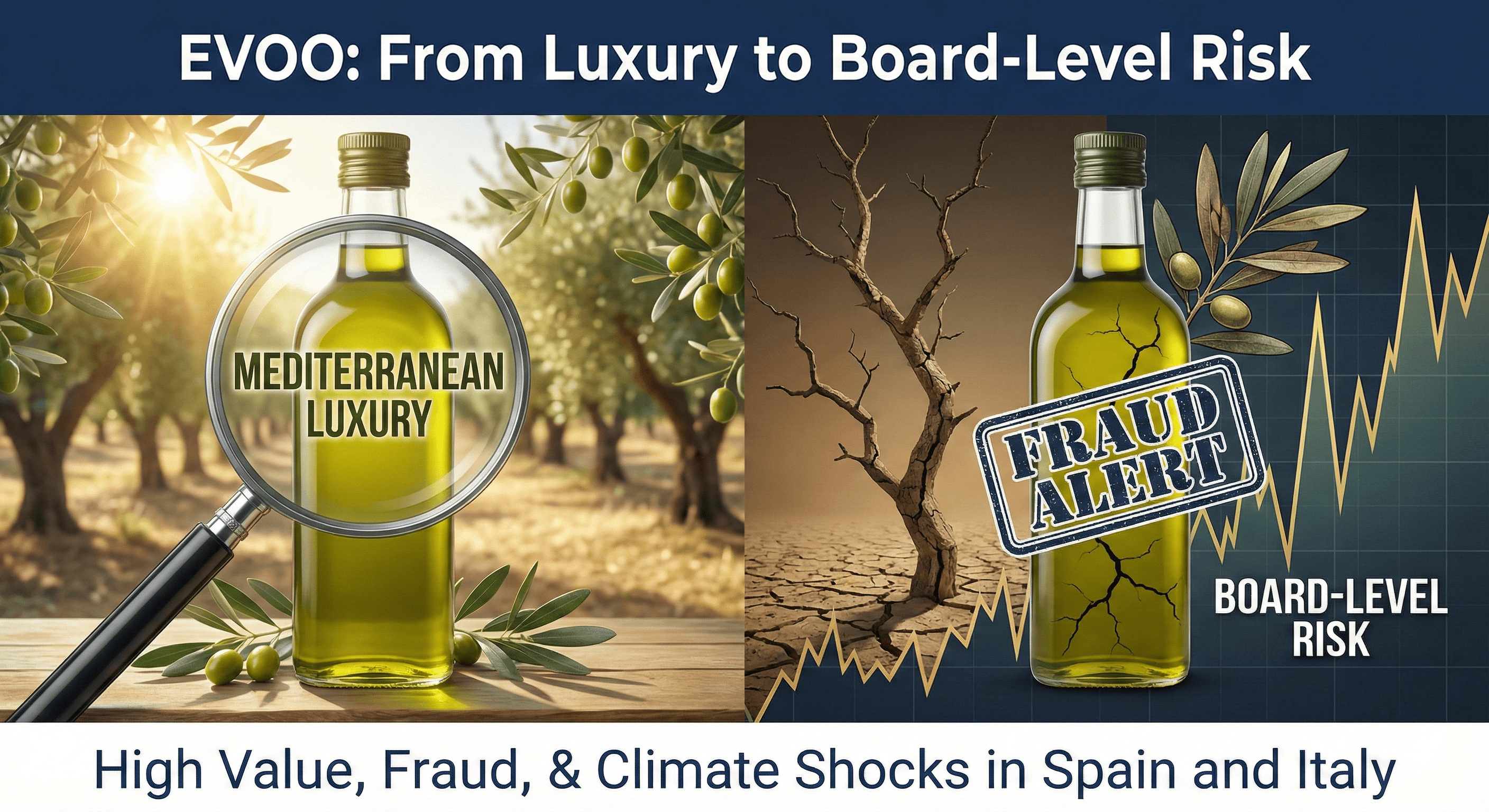
Extra virgin olive oil (EVOO) is no longer just a “Mediterranean luxury” on the P&L; it is a high‑value, fraud‑exposed ingredient where climate shocks in Spain and Italy have turned normal volatility into board‑level risk.
Record price spikes, production collapses and well‑documented fraud schemes—from seed‑oil adulteration to “Italian” labels on non‑Italian blends—mean that a wrong supplier choice can trigger recalls, regulator action and reputational damage that dwarfs any short‑term purchasing gains.
This guide reframes olive oil procurement as a risk‑asset to be actively managed: we summarise the current supply context, show how scams are structured, and then translate that into a concrete, AMBAEX‑style due‑diligence model built on second‑party audits, IOC‑aligned testing and contract safeguards.
For CFOs and procurement leaders, the key message is simple: in Southern European olive oil, the question is not “Can we get it cheaper?” but “Do we have defensible proof it is what we claim to our customers?”
I. Market Context: Why Olive Oil Risk Has Escalated
The last seasons have created a perfect storm for fraud and quality shortcuts: sharp cost inflation on the supply side, strong global demand for “healthy” fats, and patchy oversight in long, international supply chains.
Understanding this context is the first step in building a risk‑aware sourcing strategy rather than reacting to each crisis as an isolated surprise.
Climate Shocks and Supply Crunch
- Spain’s drought and heatwaves: as the world’s largest producer, Spain’s poor 2022–23 harvests squeezed global availability and pushed wholesale prices to historic highs, often more than double 2022 levels in some origins.
- Italy’s Xylella devastation: the Xylella fastidiosa outbreak in Puglia—traditionally responsible for around half of Italy’s olive oil—has killed tens of millions of trees over the last decade, eroding productive capacity and pushing more buyers onto a smaller pool of unaffected groves and regions.
- Partial recovery, persistent risk: more recent Spanish campaigns have shown signs of recovery in volume, but against a backdrop of climate uncertainty and higher structural costs, keeping prices elevated and temptation to cut corners intact.
Why This Matters to Finance and Procurement
- Price volatility is no longer just a budgeting issue; it correlates strongly with fraud incentives, making “cheap” offers in tight markets especially dangerous.
- For brands and retailers, olive oil is a reputational lightning rod: one publicised fraud case can damage trust across all private‑label and branded SKUs, not just the olive‑oil line.
- Regulators and media now treat food fraud as a deliberate crime, not a minor quality defect; fines, delistings and litigation are increasingly common outcomes.
II. Anatomy of Common Olive‑Oil Scams in Southern Europe
Most fraud schemes are variants of a few core patterns; knowing how they work allows you to design controls that target real risk instead of relying on generic “certificates on file”.
1. “Italian Flag” and Agromafia Operations
- Fake Italian identity: low‑cost seed oils or bulk non‑Italian olive oils are imported, tinted or blended, then bottled under “extra virgin” labels decorated with Italian flags, heritage imagery and references to well‑known regions.
- Margin mechanics: with seed oils at a fraction of real EVOO cost, fraudsters can undercut market prices while still earning multiples of their input cost, making these schemes highly attractive in tight markets.
- Export focus: much of this product is pushed into Northern Europe, North America and other non‑Mediterranean markets where buyers equate “Italian” with quality but lack local controls or cultural familiarity to question inconsistencies.
2. Blending and Adulteration in Spain and Italy
- Seed‑oil addition: sunflower, soybean or other cheap oils are blended into olive oil and still sold as 100% EVOO; chemical deodorisation can mask defects that would otherwise show up in taste and smell.
- Lampante mislabelling: lampante oil—legally unfit for human consumption until refined—is sometimes reclassified and bottled as virgin or extra virgin without proper treatment.
- Vague origin declarations: labels using terms like “Mediterranean blend” or “European origin” can hide multi‑country mixes of varying quality and traceability, making it difficult to link a defect to a specific region or mill.
3. Paper‑Based Manipulation
- Over‑reliance on documents: fraudsters bank on distant buyers accepting certificates, invoices and photos without on‑site verification.
- Recycled or falsified certificates: the same lab reports or organic certificates may be presented for multiple SKUs, harvests or even producers, while harvest dates and batch codes are adjusted only on packaging artwork.
- Shell intermediaries: trading companies with minimal physical infrastructure present themselves as “mills” or “producers”, making liability and physical control ambiguous when issues arise.
III. AMBAEX View: From Price‑Hunting to Risk‑Weighted Procurement
From our work on the ground in Spain and Italy, one pattern stands out: the most costly olive‑oil failures did not stem from a lack of certificates, but from a lack of independent verification and realistic risk thresholds built into the buying process.
For CFOs, this means moving from a purely price‑driven sourcing model to a risk‑weighted one, where due diligence spending is seen as an insurance premium against legal, reputational and write‑off exposures that can easily run into seven figures.
IV. Five Defense Mechanisms Procurement and Finance Should Enforce
The following controls are designed to be practical for real businesses: each can be built into your sourcing policies, supplier manuals and contracts, and executed through internal teams or independent second‑party auditors like AMBAEX.
1. Treat Price as a Risk Indicator, Not a Victory
- Set internal warning thresholds: implement a rule that any EVOO offer materially below reference market levels (adjusted for quality and format) automatically triggers escalation and deeper checks.
- Make “too cheap” a red‑flag, not a success story: reward teams for landing compliant, traceable supply at sustainable prices—rather than the lowest nominal unit cost on paper.
- Benchmark landed costs, not ex‑works alone: include lab testing, audits, insurance and potential recall risk in your economic comparisons; often, “slightly more expensive and fully verified” is cheaper over the life of a contract.
2. Institutionalise Laboratory and Sensory Verification
- Independent testing as standard: make third‑party physico‑chemical and organoleptic testing (aligned with IOC methods) mandatory for first shipments and random lots thereafter, instead of relying solely on supplier‑provided COAs.
- Use accredited panels and labs: work only with laboratories and tasting panels recognised by the International Olive Council or your national authorities for official control; include them in your approved‑provider list.
- Link specs to action: define in advance what happens if a batch is downgraded from extra virgin to virgin or shows sensory defects—price adjustments, relabelling, destruction or claims—so testing feeds directly into financial decisions.
3. Strengthen Traceability and Origin Assurance
- Prioritise PDO/PGI where it fits your portfolio: while not fraud‑proof, European geographical indications add a regulated oversight layer and clearer regional identity.
- Demand batch‑level documentation: harvest year, mill location, tank numbers and bottling dates should be traceable back to specific lots, not just generic “country of origin” statements.
- Favour integrated or single‑estate models for premium SKUs: when oil is grown, milled and bottled under one controlled chain, your exposure to opaque intermediaries is reduced.
4. Monitor Public Regulatory Signals
- Use alerts as intelligence, not noise: assign someone in quality or compliance to review public alerts and enforcement reports related to olive oil; patterns often reveal recurring problem regions, operators and fraud methods.
- Cross‑check suppliers against known issues: if a producer, brand or region has appeared in recent alerts, build that into your risk scoring and audit frequency.
- Feed findings into sourcing strategy: if a particular profile (e.g. anonymous “Mediterranean blends”) is repeatedly flagged, treat that category as inherently higher‑risk and adjust controls accordingly.
5. Bake Audit Rights and Quality Triggers Into Contracts
- Explicit audit and sampling rights: contracts should grant you or your appointed second‑party auditor the right to visit facilities, access production records and pull samples at origin or destination without excessive notice.
- Clear quality definitions and remedies: define “extra virgin” in line with IOC/EU criteria, and specify financial and operational consequences for non‑conformity (downgrade, reprocessing, replacement, penalties).
- Time‑bound product expectations: require harvest and bottling dates on packaging, and define acceptable shelf‑life and storage conditions; oil that “meets the spec” in the lab but is badly stored in the supplier’s warehouse is still a liability.
V. How AMBAEX Operates for Non‑EU Buyers in Spain and Italy
AMBAEX is built to be the independent layer between your procurement budgets and Southern European reality: we work only for the buyer, with no kickbacks or commissions from mills or traders, and we are physically present in the regions where your olive oil is produced.
For CFOs and procurement teams, that means you can outsource the “boots‑on‑the‑ground” part of due diligence without giving up control over standards, data or decisions.
What We Do on Your Behalf
- Pre‑selection and background checks: we separate real mills and cooperatives from pure brokers, assess their export history and check for past regulatory issues before you spend time negotiating.
- Second‑party audits using ISO‑style fundaments: our site visits focus on real‑world production conditions, documentation and traceability, and how well your supplier aligns with destination‑market requirements.
- Sampling and test coordination: we organise representative sampling at tanks or filling lines and coordinate testing with accredited labs and sensory panels, ensuring chain‑of‑custody integrity.
- Decision‑ready reports: you receive a structured dossier with risk ratings, non‑conformities, photos, process maps and recommendations—material that finance, quality and legal can all work with.
VI. The Business Case: Compliance Cost vs. Fraud Cost
For many organisations, the barrier to robust olive‑oil due diligence is not conceptual but budgetary: verification is seen as “extra cost” rather than an integral part of the cost of goods sold.
From AMBAEX’s perspective, the equation looks different when you factor in real exposures.
Four Lines on the CFO’s Scorecard
- Direct financial loss: write‑offs of non‑compliant or downgraded product, emergency re‑labelling, extra logistics and lab costs when things go wrong.
- Regulatory and legal exposure: fines, forced withdrawals, or lawsuits if adulterated or mislabelled oil reaches consumers under your brand.
- Reputational damage: loss of trust from retailers, foodservice customers and end‑consumers, which can depress sales across adjacent categories.
- Opportunity cost: management time spent firefighting instead of developing new products, channels or markets.
Against this, the cost of a structured verification programme—audits, testing and ongoing monitoring—usually amounts to a small percentage of annual olive‑oil spend, especially when distributed across multiple SKUs and seasons.
In other words: treating olive oil as a high‑risk asset and funding its verification properly is not a luxury, but a rational allocation of risk capital.
From Liquid Gold to Reliable Asset: Work With an Independent Partner
If olive oil represents a material spend or brand pillar in your business, you cannot afford to base decisions on samples, certificates and price lists alone.
AMBAEX works on the ground in Spain and Italy as your second‑party auditor—no kickbacks, no trading margins—so that your CFO and procurement team can sign off on Southern European olive‑oil supply with evidence, not assumptions.
Before you sign the next contract or private‑label brief, make sure someone you trust has walked the mill, checked the tanks and read the paperwork in the local language.
Discuss an olive‑oil supplier verification plan for your organisation →
info@ambaex.com | ambaex.com/contact
Zero Kickbacks. Physical Verification. Procurement Intelligence in Spain and Italy.