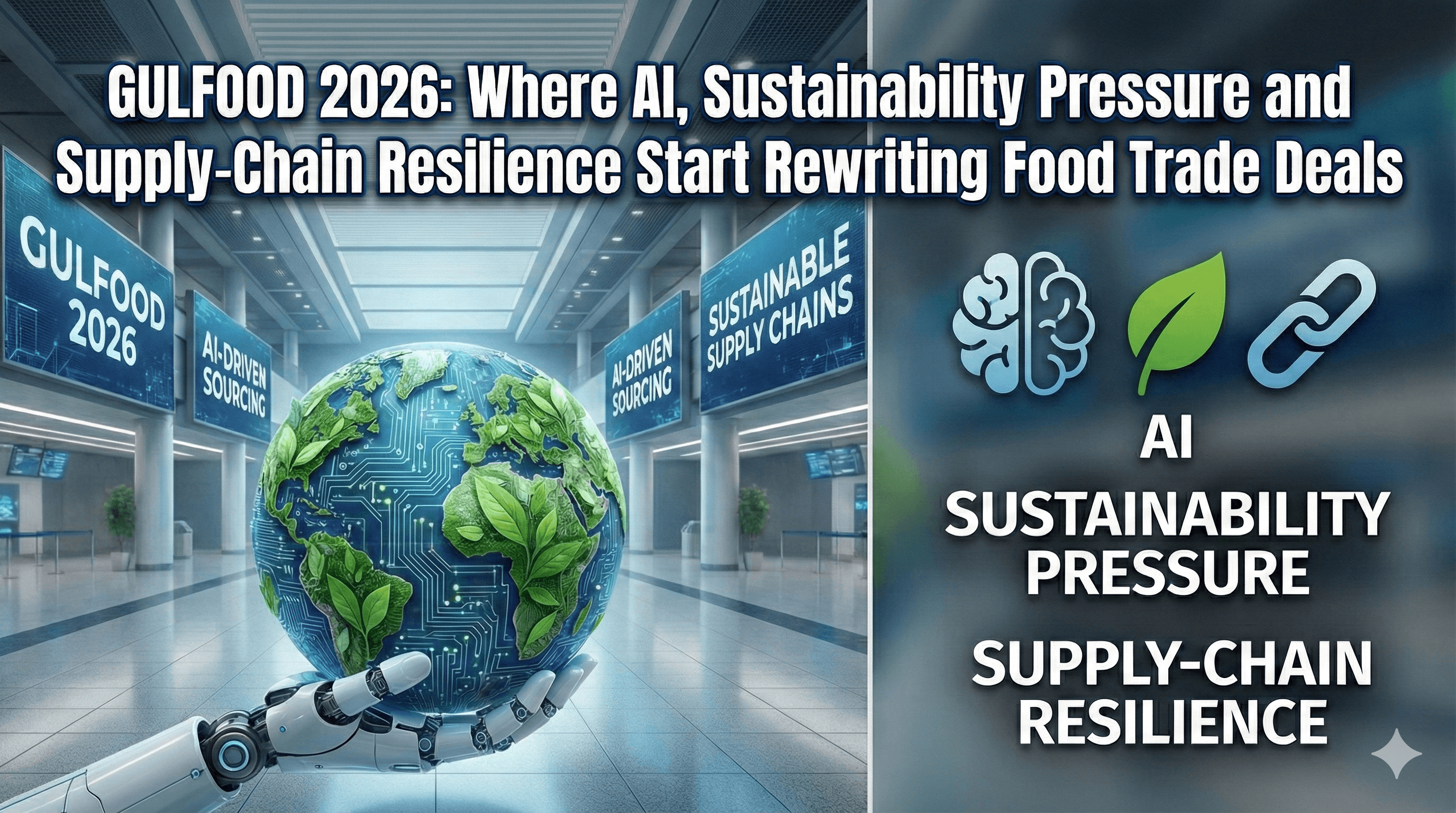
Gulfood 2026 in Dubai serves as a real-time barometer for global food trade, highlighting the normalization of AI in sourcing, 'greenhushing' due to sustainability pressures, and the move towards regional supply chain resilience.
- Gulfood 2026 showcases AI's growing role in food sourcing decisions.
- Companies are adopting 'greenhushing' strategies amid sustainability regulations.
- Supply chains are prioritizing regionalization and logistics resilience.
- Contract reliability and data transparency are now crucial procurement factors.
- Dubai is solidifying its position as a global hub for food trade discussions.
AMBAEX Market Intelligence
Gulfood 2026: Where AI, Sustainability Pressure and Supply-Chain Resilience Start Rewriting Food Trade Deals
Why Dubai’s Two-Venue Mega Fair Has Become a Live Dashboard for How 2026–27 Food Contracts Will Really Be Negotiated
Executive Summary
Gulfood 2026 has opened across both Dubai World Trade Centre and the expanded Dubai Exhibition Centre, bringing together more than 8,500 exhibitors from over 195 countries and turning 280,000 m² of fully sold-out space into a live testbed for how food trade will work in 2026–27.
What is happening in the aisles this year confirms three structural procurement trends: the rapid normalization of AI in sourcing decisions, the rise of “greenhushing” as suppliers become quieter about sustainability under regulatory pressure, and a hard shift from pure globalization to regional and logistics resilience in supply chains.
For GCC and other non‑EU buyers, Gulfood is no longer a five‑day product showcase; it is a real‑time sourcing barometer where contract reliability, data transparency and supply‑chain architecture matter as much as price and flavour.
Gulfood 2026 by the Numbers: A Different Kind of Trade Signal
This year’s edition marks the first time in its 31‑year history that Gulfood runs simultaneously at Dubai World Trade Centre and the Dubai Exhibition Centre at Expo City, doubling its footprint versus the previous edition and signalling that Dubai is acting as a consolidated HQ for global food buying conversations.
With 8,500+ exhibitors and national pavilions from more than 195 countries, Gulfood now concentrates enough supply, demand and policymaker presence that it behaves like a “real‑time dashboard” for food trade sentiment: who is doubling down on exports, which categories are tightening, and where logistics or regulatory friction is quietly building up.
Three design choices underline this shift:
- The launch of Gulfood Logistics brings freight, cold chain and warehousing into the same decision space as ingredients and brands, acknowledging that food security is increasingly a logistics and documentation problem, not just a production one.
- India’s status as Official Partner Country, with a large delegation aligned with the India–UAE CEPA, showcases how trade agreements and export promotion are now integral to what buyers see on the floor.
- Emerging suppliers from Malaysia, Albania and other fast‑moving export hubs are using Gulfood to reposition themselves around GCC demand flows, not generic global buyers.
Trend 1 – AI Moves From Buzzword to Deal Infrastructure
Outside the fairgrounds, the global procurement software market is forecast to reach almost USD 9.8 billion by the end of 2025 and roughly USD 18.3 billion by 2032, with annual growth expected in the low‑double digits according to market studies often cited in Procurement Trends 2026.
Within Gulfood, these macro trends translate into a very different way of working for serious buying teams:
- Before Gulfood: buyers are using AI‑enabled spend analysis and supplier discovery tools to narrow thousands of potential exhibitors into focused shortlists that match tariff structures, certification needs and logistics constraints.
- During Gulfood: “copilot” tools help teams log stand interactions, benchmark indicative prices against historic data, and flag suppliers whose answers are inconsistent with public filings or trade‑database records.
- After Gulfood: agent‑style systems can automatically classify leads, generate RFQs and route candidates into structured due‑diligence and audit pipelines, instead of leaving them as unstructured business cards and Excel lists.
In parallel, risk‑management thinking around AI is moving centre stage. Governance frameworks inspired by regulations like the EU AI Act are starting to show up in corporate policies, pushing procurement teams to ask: which AI tools were used to generate this supplier shortlist, who can audit the models, and what human oversight is mandatory before a contract is signed?
At Gulfood 2026, that translates into a subtle but powerful shift: the most advanced buyers are not asking “Do you use AI?” but “How will your systems plug into ours so we can keep control of risk, data and decision‑making?”
Trend 2 – Greenhushing: When Sustainability Goes Quiet Under Pressure
While EU instruments such as the Corporate Sustainability Reporting Directive (CSRD) and the Ecodesign for Sustainable Products Regulation raise the bar for traceability and product‑level sustainability information, many companies are reacting by communicating less, not more, about their environmental claims.
Studies referenced in OECD and South Pole analyses describe this as “greenhushing”: a deliberate downplaying of climate and ESG messaging for fear of greenwashing accusations, legal liability or reputational backlash.
On the Gulfood floor, greenhushing looks like this:
- Booths full of “natural”, “eco‑friendly”, “responsible” language and imagery, but with limited access to data behind water use, deforestation‑free sourcing or labour conditions.
- Suppliers that claim compliance with emerging EU and UK regulations on packaging waste, deforestation or human‑rights due diligence, but struggle to provide product‑level evidence or third‑party attestations when pressed.
- Government‑backed pavilions promoting sustainability themes while leaving the mechanics of traceability and auditability to the small print.
For GCC and other importing blocs, this creates a new risk dynamic: investors, regulators and end‑customers increasingly demand verifiable ESG performance, while a growing share of suppliers have become more cautious and less vocal about their actual data.
In practice, that means buyers at Gulfood 2026 who rely on label claims or generic CSR brochures will carry more regulatory and reputational risk than those who build explicit requirements into contracts: product passports, mass‑balance rules, third‑party social and environmental audits, and clear escalation pathways when data is incomplete.
Trend 3 – From Globalisation to Regional and Logistics Resilience
Across industries, surveys like McKinsey’s Global Supply Chain Leader Survey show that around 60–64% of executives are actively regionalising supply chains, while monitoring firms such as QIMA report that nearshoring already represents about 15% of sourcing for many European brands.
Gulfood 2026 confirms the same pivot in food trade:
- GCC retailers and foodservice groups are no longer looking for a single “hero” supplier per category; they are building power‑of‑two or power‑of‑three sourcing lanes spanning Southern Europe, the Mediterranean, South Asia and ASEAN.
- Questions at stands increasingly focus on multi‑plant capacity, backup manufacturing sites and alternative ports of loading, reflecting lessons from Red Sea disruptions, Black Sea grain interruptions and container‑rate spikes.
- The new Gulfood Logistics segment makes cold storage, reefer capacity, port connectivity and last‑mile partners part of the same conversation as recipes and certifications.
Economic analysis from bodies like the OECD has already flagged how tariffs, wars and shipping disruptions are dragging global growth forecasts down toward the 3% mark for 2026; at Gulfood, this macro trend shows up as contract clauses on lead‑time guarantees, secondary routes, emergency stock positions and shared responsibility for freight shocks.
In other words, the real question buyers are asking in Dubai this year is not only “Who can supply?” but “Who can keep supplying when the next disruption hits?”
How the Way Deals Are Done at Gulfood Is Quietly Changing
Ten years ago, many Gulfood deals followed a simple pattern: discover products at the stand, negotiate price and basic terms over a few meetings, and confirm with a follow‑up visit or sample shipment.
Gulfood 2026 suggests a more complex, data‑driven choreography:
- Pre‑qualified meetings: AI‑supported mapping and screening before the show means that serious buyers arrive with pre‑ranked lists and specific information requests, not open‑ended “let’s see what we find” agendas.
- Cross‑functional delegations: procurement managers walk the halls with colleagues from finance, logistics and sustainability, so discussions about price are immediately tested against working capital, freight constraints and ESG commitments.
- Verification‑first mindset: credible suppliers emphasise export‑ready documentation, third‑party audits, and alignment with trade agreements; buyers increasingly park decisions until independent verification and risk assessments are completed after the fair.
- Structured follow‑through: conversations at the booth are quickly translated into digital pipelines — RFQs, technical due‑diligence requests, factory‑audit mandates — instead of staying as informal intent.
The net impact is clear: Gulfood is becoming the start of an evidence‑based sourcing lane, not the end of a traditional “meet and sign” cycle.
What Serious Buyers Should Do With Gulfood’s 2026 Signals
For GCC retailers, importers, sovereign buyers and industrial users, the fair now functions as an early‑warning and early‑opportunity system for the next 12–18 months of food trade.
Three practical moves stand out:
- Build an AI‑enabled but governance‑controlled sourcing pipeline: use AI to scan exhibitors, cluster opportunities and forecast landed‑cost scenarios, but insist on human review, clear data ownership and audit trails in any tool that influences supplier selection.
- Turn sustainability vagueness into contractual clarity: treat greenhushing as a signal to specify what evidence you need — traceability systems, third‑party certifications, product‑level emissions or labour data — and make it part of supplier performance reviews.
- Redesign supplier portfolios for resilience, not just price: think in regions and corridors (India–UAE, Mediterranean, Southern Europe, ASEAN) and ensure each critical category has at least two viable production bases and logistics paths into your market.
In practice, that usually requires an independent partner on the ground — to audit factories, verify documentation, validate logistics claims and translate regulatory language between exporting and importing jurisdictions.
Gulfood as a Barometer, Not Just a Showcase
Gulfood 2026 makes one thing unmistakable: global food trade is no longer defined only by where food is grown or processed, but by whether suppliers can prove, with data and resilience, that they can keep moving it to your shelves under stress.
If your team walks away from Dubai with catalogues and handshake prices but no structured plan for AI, sustainability proof and supply‑chain resilience, are you really using Gulfood as the strategic barometer it has become — or just as a very large tasting room?
info@ambaex.com | ambaex.com/contact
Zero Kickbacks. Physical Verification. Procurement Intelligence for Food Buyers in a Turbulent World.