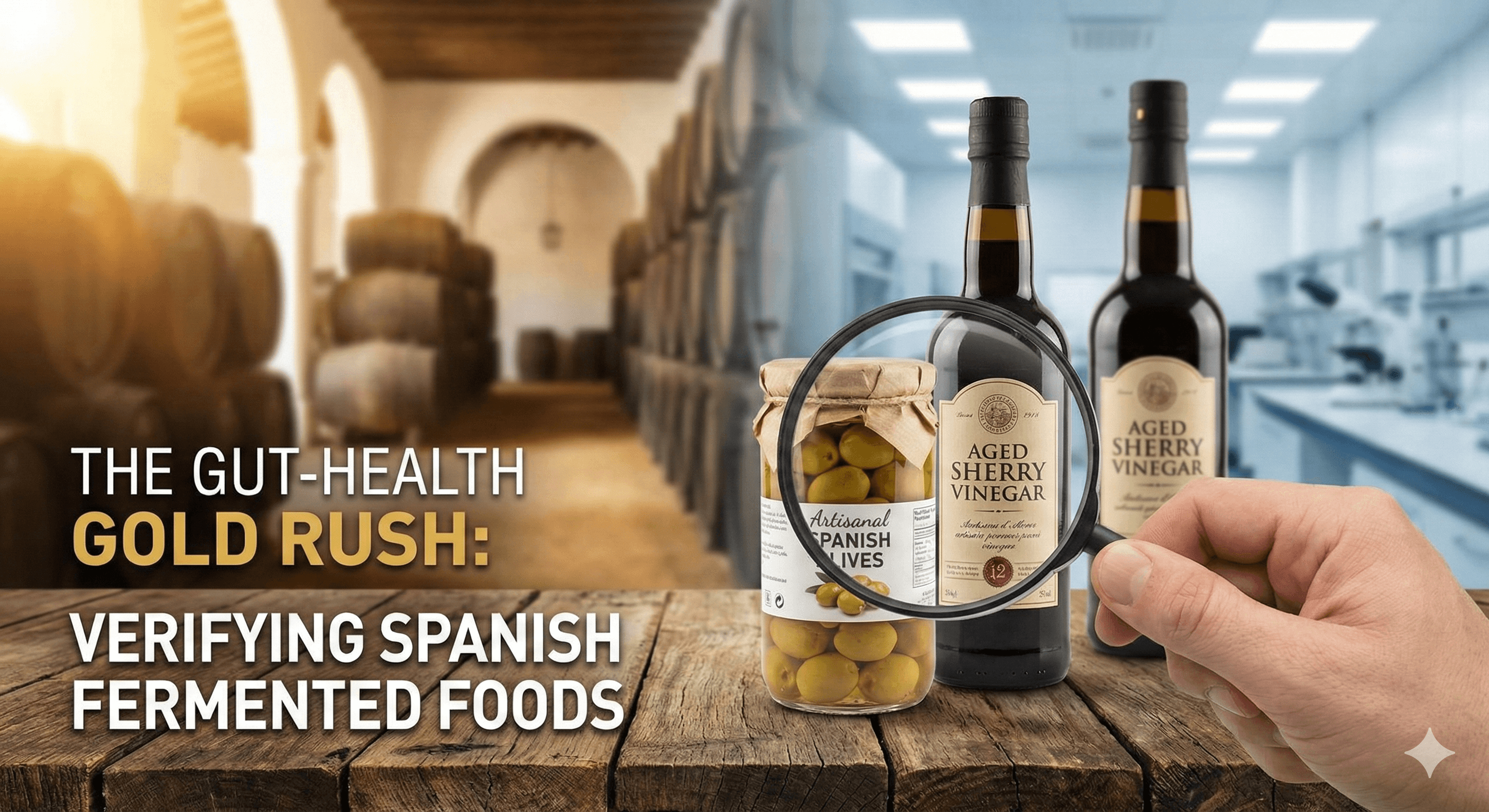
This article outlines how US food importers can leverage FSVP compliance to mitigate risk, reduce costs, and accelerate supplier approvals when sourcing premium products from Southern Europe.
- FSVP compliance can be a competitive advantage for Southern European food sourcing.
- Effective FSVP implementation reduces product, supplier, and documentation risk.
- Southern Europe offers strong food products with EU-level traceability.
- 4 in 10 food importers fail FSVP inspections, often lacking a program entirely.
- FSVP compliance unlocks access to premium products and enhances market success.
AMBAEX Market Intelligence
FSVP Compliance as Competitive Advantage: How US Importers Can Win with Southern European Sourcing
Turn FDA Requirements into Risk Mitigation, Cost Savings, and Faster Supplier Approvals
Executive Summary
US importers are under pressure to diversify food sourcing into Southern Europe and, at the same time, to tighten FSMA compliance. Those two trends can work together—if FSVP is treated as a risk-mitigation and ROI tool, not just a regulatory burden.
Spain, Portugal, and Italy offer strong products, EU-level traceability, and brand value that supports premium positioning in the US market. But European suppliers don't always speak FSVP language, and FDA expects you to bridge that gap.
The opportunity: The same on-the-ground work needed to comply with FSVP can directly reduce product, supplier, and documentation risk—and pay for itself by preventing failures before they reach US ports.
FSVP: From "Extra Work" to Built-In Risk Mitigation
Under FDA's Foreign Supplier Verification Programs (FSVP) rule, US importers must perform risk-based activities to verify that imported food meets US safety standards.
At a minimum, FSVP requires importers to:
- Identify hazards — known or reasonably foreseeable hazards for each food
- Evaluate risk — assess the risk posed by the food and the foreign supplier's performance
- Approve suppliers — determine appropriate verification activities (on-site audits, testing, record review)
- Maintain written records — FSVP documentation for each food/supplier combination, including hazard analyses, verification activities, and corrective actions
FDA guidance is explicit: on-site audits, testing, and supplier record reviews are not optional "nice to haves"—they are listed as primary verification tools.
Yet FSVP remains a weak point for many importers. Industry analysis indicates that roughly 4 in 10 food importers fail FSVP inspections, with the most common violation being having no FSVP at all—not an incomplete one.
That is pure, avoidable risk.
For procurement teams sourcing from Southern Europe, this creates an opportunity: build FSVP compliance into your sourcing process from day one, and the same work that satisfies FDA also reduces supplier risk and prevents costly failures.
Why Southern Europe Is Attractive—And Where FSVP Bridges the Gap
Spain, Portugal, and Italy offer compelling advantages for US food importers:
- Strong agrifood sectors — processed foods, olive oil, wine, canned seafood, specialty ingredients with established export infrastructure
- EU-level regulation — traceability expectations and food safety systems that can support FSMA goals when properly documented
- Brand value — quality perception that supports premium positioning in US retail and foodservice
At the same time, European suppliers don't automatically translate into FSVP compliance:
- Hazard analyses are structured for EU law, not US expectations
- Documentation is in Spanish, Portuguese, or Italian, organised for local inspections—not FDA review
- Suppliers assume GFSI certification is sufficient, while FDA requires importers to evaluate hazards, performance, and verification activities case-by-case
FSVP is the bridge between what your European suppliers do and what FDA expects you to prove.
How FSVP Delivers ROI When Sourcing from Southern Europe
Handled correctly, FSVP work in Spain, Portugal, and Italy drives three measurable outcomes:
1. Risk Mitigation
Early detection of weak suppliers reduces the likelihood of detentions, refusals, recalls, and brand damage. Problems caught in Valencia cost hundreds; problems caught at US ports cost thousands.
2. Cost Savings
Avoiding a single failed container, recall, or major quality issue typically offsets the cost of several audits and verification projects. FSVP verification is insurance that pays for itself.
3. Efficiency
A standardised FSVP package for Southern European suppliers cuts internal review time, speeds approvals, and simplifies FDA inspections. Instead of scrambling for documents, your team walks in prepared.
Instead of treating FSVP as overhead, procurement teams can use it to build a repeatable "Southern Europe sourcing template" that compresses lead times for future products and suppliers.
The AMBAEX Model: Your FSVP Execution Partner in Southern Europe
AMBAEX works as a Procurement Intelligence Auditor in Spain, Portugal, and Italy, using audit principles aligned with ISO 19011:2018—integrity, impartiality, and evidence-based conclusions.
We operate under a strict Integrity Protocol: no hidden fees, no finder's fees, no commissions from suppliers. You pay us. We work for you.
For US importers, our role is clear: execute the local, on-site parts of FSVP in a way that improves risk, ROI, and efficiency.
Stage 1: FSVP-Ready Supplier Audits (AVS Protocol™)
We conduct on-site audits tailored to FSVP requirements:
- Hazard analysis translation — review the supplier's existing food safety system (HACCP, HARPC, GFSI) and translate it into a hazard analysis your FSVP Qualified Individual can understand and assess
- Supplier performance evaluation — compliance history, non-conformances, corrective actions, robustness of traceability and documentation
- FDA-critical factors — raw materials, processing controls, sanitation, employee hygiene, storage and distribution conditions
Output: Risk evaluation and supplier approval grounded in actual site conditions—not just paper. Structured audit reports drop directly into your FSVP files.
Stage 2: Documentation Translation and FSVP Packaging
FSVP expects importers to understand and assess foreign-language documents used in hazard analysis and verification. We handle this on the ground:
- Review supplier documentation — SOPs, test records, certificates, corrective action logs in Spanish, Portuguese, or Italian
- Extract FSVP-relevant content — hazards, controls, verification activities, non-conformances, evidence of implementation
- Deliver in FDA-ready format — English documentation that matches FDA guidance and common FSVP templates
Output: Less time interpreting documents, more time deciding. Stronger confidence during FDA inspections because FSVP records are clear and consistent.
Stage 3: Verification Activities with Real Risk Reduction (Deal Navigator™)
FSVP explicitly lists verification activities—on-site audits, sampling/testing, record review—as tools to be selected based on risk. We deliver:
- On-site audits at a frequency aligned with your risk assessment and FDA expectations
- Pre-shipment inspections to verify labels, batch records, and documentation packages before goods leave Europe
- Periodic re-evaluation when new hazards emerge or supplier performance changes—mirroring FSVP's requirement to reassess risks
Output: Reduced probability of detentions, recalls, or rework. Clear linkage between verification spend and concrete risk reduction.
The Integrity Protocol: Independence That Supports Compliance
FDA and internal audit teams look closely at conflicts of interest in supplier verification. AMBAEX is structured to pass that scrutiny:
- Paid only by the importer — not by suppliers, not by factories
- Not a broker, trader, or inventory holder — no commercial interest in which supplier you choose
- Operating under ISO 19011 audit principles — impartiality and independence built into our methodology
This makes it easier to demonstrate to your own compliance team that supplier evaluation and verification were based on evidence, not commercial incentives.
Ambaex performs independent second‑party audits for buyers. Our reports support your own FSVP / regulatory due‑diligence process but do not replace official certifications or filings with authorities such as the FDA in other words we don't certify, we verify
FSVP Compliance at a Glance
| FSVP Requirement | Common Gap | AMBAEX Solution |
|---|---|---|
| Hazard identification | EU hazard analyses don't match FDA format | On-site review + translation into FSVP-ready documentation |
| Supplier evaluation | Reliance on certificates without performance data | AVS Protocol™ audit with compliance history and corrective action review |
| Verification activities | No on-site audits or pre-shipment checks | Physical audits + PSI before containers leave Europe |
| Foreign-language documents | Records in Spanish/Portuguese/Italian, not assessed | Local-language review + English FSVP packaging |
| Re-evaluation | No system for ongoing supplier monitoring | Periodic re-audits aligned with risk changes |
| Independence | Verification influenced by commercial relationships | Zero-kickback model—paid only by importer |
Turning Southern Europe + FSVP into Competitive Advantage
Procurement teams who see FSVP as "paperwork" will continue to burn time and money fixing avoidable problems.
Those who treat FSVP as a structured risk-mitigation and ROI framework can:
- Build a high-performing Southern European supplier base faster — standardised verification compresses approval timelines
- Reduce total landed cost volatility — cutting failures, not just prices
- Walk into FDA inspections prepared — organised, defensible programmes rather than scrambling for missing documents
For food sourced from Spain, Portugal, and Italy, AMBAEX acts as your FSVP execution engine on the ground—turning distance, language, and regulatory complexity into managed risks, better deals, and a stronger supply chain.
Ready to Turn FSVP into ROI?
The same work that satisfies FDA can reduce supplier risk, prevent costly failures, and speed up your Southern European sourcing.
For US procurement teams importing food from Spain, Portugal, or Italy, AMBAEX's Procurement Intelligence Auditor model makes FSVP compliance a competitive advantage—not a compliance burden.
Identify. Verify. Execute.
Book a 30-minute discovery call. No obligation. No pressure.
info@ambaex.com | ambaex.com/contact
Zero Kickbacks. Physical Verification. Your FSVP Partner in Southern Europe.