This article alerts wine buyers to fraudulent practices in the Spanish wine market, where brokers misrepresent themselves as wineries, selling inexpensive wine as premium DO products for illicit profit.
- Brokers pass off cheap table wine as premium DO products.
- Fraudulent margins can reach millions of euros annually.
- Verify suppliers have vineyards, tanks, & barrel rooms.
- Trading companies may lack quality control.
- Field audits in Spain are crucial before wiring funds.
AMBAEX Market Intelligence
Bodega vs. Broker: How to Spot a Reseller in the Spanish Wine Market
Why That "Winery Partner" Might Be an Office With Price Lists—And How to Verify Before You Wire
Executive Summary
Not every company offering Spanish wine is a winery. Many are brokers—trading companies with no vineyards, no tanks, and no real control over quality. They present themselves as "your Spanish winery partner" while functioning as margin-taking intermediaries relabelling other people's wine.
This isn't paranoia. In multiple Spanish fraud cases, the protagonists were not farmers or estate wineries but trading companies passing off cheap table wine as premium DO products—generating millions in fraudulent margins.
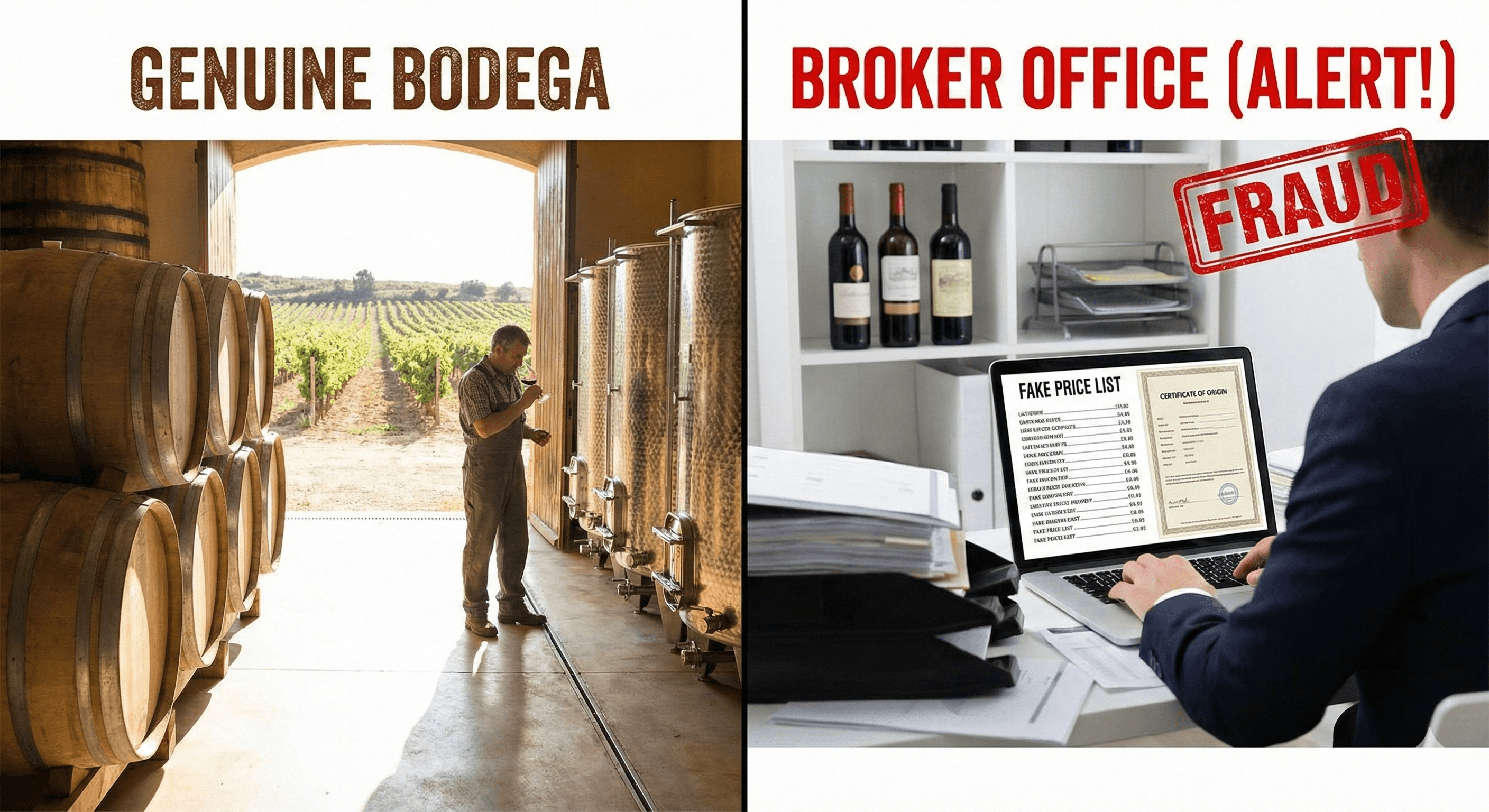
The practical question for buyers: Is your supplier a bodega with fermentation tanks, barrel rooms, and vineyards—or an office with price lists and other producers' labels on the wall?
A field audit in Spain answers that question before you wire the deposit.
Why This Fear Is Justified: Real Fraud Cases
Spanish wine fraud isn't theoretical. Guardia Civil investigations have repeatedly uncovered trading companies and off-site bottlers relabelling wine as higher-value appellations.
Case 1: Grupo Reserva de la Tierra (Catalonia)
One of Spain's largest wine fraud cases involved a trading company that allegedly passed off millions of bottles of cheap table wine as DO Terra Alta, Montsant, Priorat, and others.
- At least 22 million bottles sold under false DO labels
- Estimated €14 million per year in fraudulent margins
- The operation presented itself as a legitimate wine group to foreign buyers
This is exactly the type of operator who appears at trade shows, sends professional samples, and signs export contracts—while having no vineyards, no production facilities, and no quality control.
Case 2: Fake Málaga DO (La Rioja Bottlers)
Guardia Civil uncovered 18,400+ bottles marketed as Málaga and Manilva DO wines—but traced back to bottling companies in La Rioja using cheaper grapes from other regions.
- Wine sourced from non-DO regions at bulk prices
- Relabelled with fake DO seals and premium branding
- Sold to export markets at DO price points
Case 3: La Rioja Label Fraud Ring
Investigators found fraud rings in La Rioja removing supermarket labels from cheap wines and reapplying fake premium labels—marketing them as Rioja DO or Málaga DO to unsuspecting buyers.
The pattern is consistent: off-site bottlers and trading companies with no production facilities, exploiting the gap between what buyers expect (a bodega) and what they actually receive (a broker's margin).
Bodega vs. Broker: What You're Actually Buying
The difference between a real winery and a trading company is not visible on a website or in a sample bottle. It's visible on the ground.
Real Bodega (What Buyers Expect)
| What You Should See | Why It Matters |
|---|---|
| Fermentation tanks | Proves they actually make wine, not just relabel it |
| Barrel rooms | Indicates aging capacity and quality investment |
| Bottling lines | On-site bottling = traceability and control |
| Vineyards (owned or contracted) | Source of grapes is known and verifiable |
| Cellar master / winemaker on site | Someone accountable for quality decisions |
| Lab and traceability records | Batch-to-vineyard documentation exists |
| DO inspection certificates | Regulatory body has verified the facility |
Broker's Office (What Many Buyers Actually Get)
| What You'll Find | What It Means |
|---|---|
| Small office in a city | No production capacity whatsoever |
| No tanks, no barrels, no bottling | They source from undisclosed third parties |
| Walls covered with other producers' labels | They resell, not produce |
| Generic export certificates | Paperwork doesn't trace to their own facility |
| Price lists for multiple regions/styles | They aggregate from various sources |
| No winemaker, no cellar master | Nobody accountable for what's in the bottle |
The question isn't whether brokers exist. They do, and some operate legitimately. The question is whether you know you're buying from one—and whether you're willing to pay a 20%+ margin for no physical control over quality or origin.
The Hidden Broker Premium: 15–25% (or More)
In many Spanish wine export chains, the hidden broker margin between ex-cellar and CIF price runs 15–25%—especially when a trader controls the documentation and DO seals.
Fraud cases reveal even wider margins:
- Brokers buying bulk wine at €25–35 per hectolitre
- Relabelling as DO wine and selling for €50–70+ per hectolitre
- Effective markup: 100% or more by mislabelling as higher-value appellations
Even legitimate brokers add margin without adding value. They don't improve the wine—they just handle paperwork and take a cut.
What You're Paying For
| Scenario | What You Get | Hidden Cost |
|---|---|---|
| Direct from bodega | Ex-cellar price, full traceability, winemaker contact | None |
| Through legitimate broker | Convenience, aggregation, paperwork handling | 15–25% margin |
| Through fraudulent broker | Mislabelled wine, fake DO, compliance risk | 20–100%+ margin + rejection risk |
The buyer must decide: Is a 20%+ margin for no physical control acceptable? Or would you rather pay a one-time verification fee to know exactly who you're buying from?
Red Flags: How to Spot a Broker Pretending to Be a Bodega
Before you visit or engage an auditor, these warning signs suggest you're dealing with a broker, not a producer:
Documentation Red Flags
- Address is in a city or industrial park—not a wine region
- Company name doesn't match DO records—search the Consejo Regulador website
- Certificates reference a different legal entity—they may be reselling someone else's certified wine
- No winemaker or cellar master named—just "commercial director" or "export manager"
- Website shows multiple regions and styles—real bodegas rarely produce Rioja, Priorat, AND Ribera del Duero
Communication Red Flags
- Reluctance to arrange a facility visit—"We work with partner wineries"
- Samples arrive with generic labels—not the final export label
- Pricing is suspiciously flexible—real bodegas have cost structures; brokers negotiate margins
- They claim "exclusive" access to famous DOs—real producers don't need intermediaries to export
- Contracts reference "sourcing" or "procurement"—not "production" or "vinification"
The Simplest Test
Ask for a facility visit. A real bodega will welcome you to their tanks, barrels, and bottling line. A broker will make excuses, offer to meet at a restaurant, or suggest you visit "one of their partner wineries" instead.
The AMBAEX Model: Verify on the Ground
AMBAEX operates as a Procurement Intelligence Auditor in Spain, Portugal, and Italy. For wine sourcing, our role is simple: determine whether your "supplier" is a bodega or a broker before you sign the contract.
We work under a strict Integrity Protocol: no hidden fees, no finder's fees, no commissions from wineries. You pay us. We work for you.
AVS Protocol™ — Winery Verification Audit
We conduct on-site verification to answer the questions that matter:
- Does the "supplier" have tanks and vineyards that match the declared annual volume?
- Do DO or organic certificates belong to that legal entity—and are they current?
- Do they bottle on-site or through transparent contract bottling with full paper trail?
- Can they demonstrate batch-to-vineyard traceability for the wines they're offering?
- Is there a winemaker accountable for quality decisions?
Output: GREEN LIGHT (verified bodega with production capacity), CONDITIONAL (legitimate contract bottling with transparent sourcing), or RED FLAG (broker with no production facilities—proceed with caution or walk away).
What We Check
| Verification Point | What We Look For |
|---|---|
| Legal entity match | Company name on DO register matches supplier contract |
| Production capacity | Tanks, barrels, bottling lines present and operational |
| Vineyard ownership/contracts | Documented grape sources that match declared volume |
| DO certification | Current Consejo Regulador inspection certificates |
| Traceability records | Batch records linking finished wine to vineyard/harvest |
| Bottling arrangement | On-site or transparent contract bottling with documentation |
| Winemaker presence | Named individual accountable for production decisions |
If the "supplier" cannot show production facilities or capacity, they are a broker. The buyer must decide if paying a 20%+ margin for no physical control is acceptable—or if they'd rather source direct from a verified bodega.
The Integrity Protocol: Why Independence Matters
Some sourcing agents are paid by the wineries they recommend. That creates an obvious conflict: they benefit from introducing you to whoever pays them the highest commission—including brokers who mark up other people's wine.
AMBAEX operates differently:
- Paid only by the buyer—not by wineries or brokers
- No finder's fees, no hidden commissions
- Not a broker, trader, or inventory holder—no commercial interest in which supplier you choose
When we say a supplier is a verified bodega, it's because we walked their facility and checked their records—not because they're paying us to say so.
Bodega vs. Broker: Quick Reference
| Characteristic | Real Bodega | Broker |
|---|---|---|
| Location | Wine region (DO zone) | City office or industrial park |
| Facilities | Tanks, barrels, bottling line | Desk, computer, phone |
| Vineyards | Owned or contracted, documented | None |
| Staff | Winemaker, cellar workers | Sales and admin only |
| DO certificates | In their legal name, current | Reference other entities |
| Traceability | Batch-to-vineyard records | Invoices from undisclosed sources |
| Pricing | Based on production costs | Based on margin opportunity |
| Facility visit | Welcomed | Avoided or deflected |
Need a Real Bodega, Not a Phantom Broker?
The Spanish wine market has real producers making excellent wine at competitive prices. It also has brokers adding 20%+ margins while contributing nothing to quality or traceability.
AMBAEX verifies Spanish and Portuguese wineries on site—determining whether your "supplier" has tanks, vineyards, and DO credentials, or just an office and a price list.
Before you wire the deposit, know who you're buying from.
See how AMBAEX verifies Spanish and Portuguese wineries on site →
info@ambaex.com | ambaex.com/contact
Zero Kickbacks. Physical Verification. Your Wine Sourcing Partner in Southern Europe.