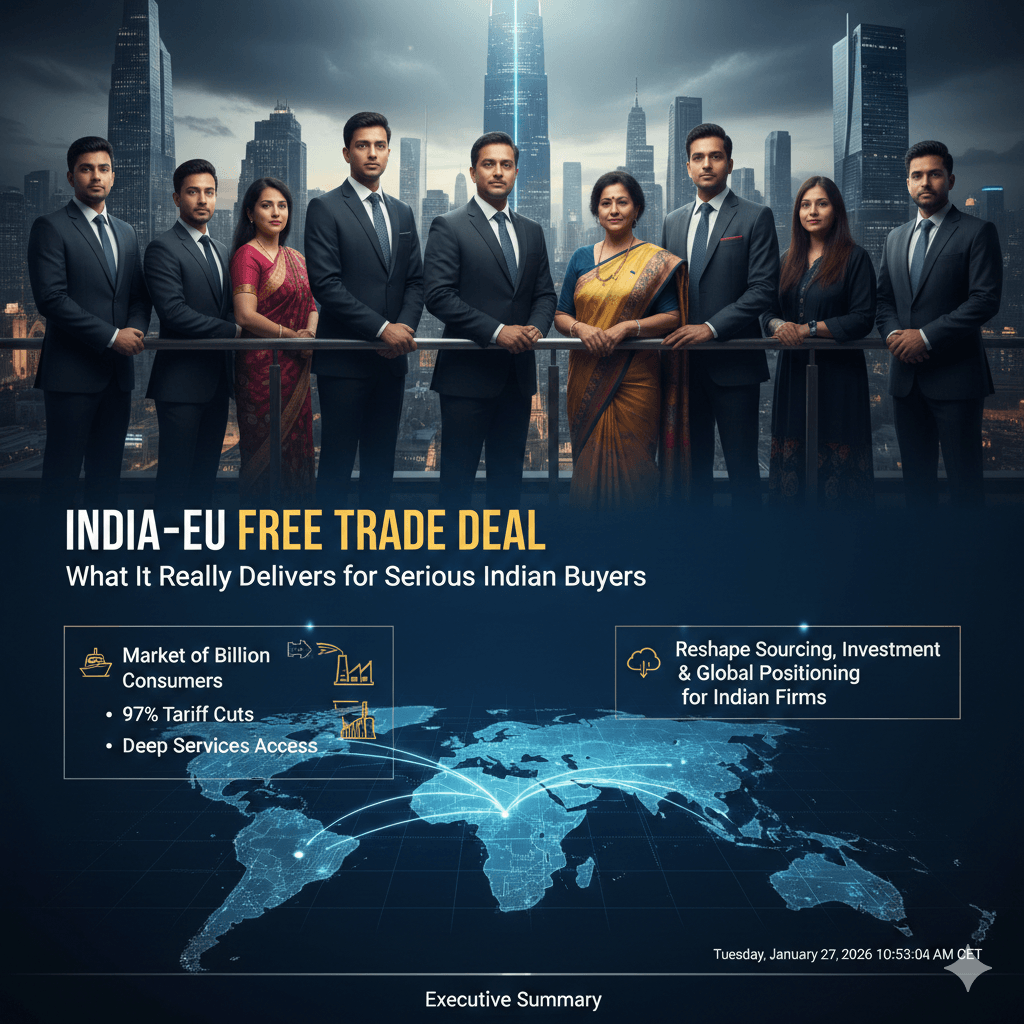
The India-EU FTA establishes a market of two billion consumers, eliminates or reduces tariffs on 97% of exports, and enhances market access for goods and services.
- India-EU FTA creates a 2-billion-consumer market.
- Tariffs cut on 97% of EU exports to India.
- EU is India's largest trading partner (€120B in goods).
- Expanded access for Indian service providers.
- Boosted global leverage for Indian firms.
AMBAEX Market Intelligence
India–EU Free Trade Deal: What It Really Delivers for Serious Indian Buyers
How a Market of 2 Billion Consumers, 97% Tariff Cuts and Deep Services Access Can Reshape Sourcing, Investment and Global Positioning for Indian Firms
Executive Summary
India and the European Union have concluded a landmark Free Trade Agreement (FTA) that will effectively create a market of around two billion people and nearly one quarter of global GDP once implemented. [Source: European Commission]
The EU is already India's largest trading partner, with trade in goods reaching about €120 billion in 2024 and trade in services €59.7 billion in 2023, and the deal locks in and expands this position. [Source: EU Trade Policy]
Under the agreement, tariffs will be eliminated or cut on almost 97% of European exports to India, while India secures improved and predictable access for its exports and service providers into a high‑value, highly regulated market. [Source: Al Jazeera]
The practical question for Indian buyers: How do you translate tariff cuts, regulatory cooperation and investment provisions into lower landed costs, more choice of EU suppliers, stronger supply chains and better leverage in global negotiations?
India–EU Trade Today: The Baseline
Before the FTA, EU–India trade in goods reached about €113–120 billion in 2023–2024, with India enjoying a merchandise trade surplus and the EU accounting for roughly 11–12% of India’s total trade. [Source: Indian Embassy, Brussels]
In goods, the EU’s main exports to India are machinery and appliances, transport equipment and chemicals, while its main imports from India include machinery, chemicals, base metals, mineral products and textiles. [Source: EU Trade Policy]
Trade in services has grown rapidly: bilateral services trade reached around €50–60 billion in 2022–2023 (roughly USD 59 billion), led by information technology and business services. [Source: Stat Times]
| Metric | Latest Data (Pre‑FTA) |
|---|---|
| Trade in goods (2023) | €113.2 billion total; Indian exports €64.9 billion; EU exports €48.3 billion. [Source] |
| Trade in goods (2024) | ~€120 billion total; EU is 11.5% of India’s total trade. [Source] |
| Trade in services (2022–2023) | €50.7–59.7 billion bilateral services trade. [Source] |
| EU rank for India | EU is India’s largest trading partner. [Source] |
| India’s rank for EU | Ninth largest partner for EU exports and imports of goods (2023). [Source] |
For Indian buyers, this baseline means the FTA is not starting from zero; it is amplifying an already dense trade relationship where EU suppliers are central in machinery, chemicals, pharmaceuticals and advanced inputs. [Source: EU Trade Policy]
Core Features of the India–EU FTA That Matter to Buyers
The FTA is described by leaders as the “mother of all deals” because it removes or reduces tariffs on approximately 96.6–97% of EU goods exports to India, saving up to about €4 billion in duties annually on European products. [Source: FashionNetwork]
For India, the agreement opens and stabilizes access to a large, high‑income market in goods and services while embedding cooperation on investment, green transition and standards. [Source: PIB, Govt. of India]
Key Tariff and Market-Access Provisions
- Elimination or deep cuts in tariffs on EU machinery, chemicals and pharmaceuticals, where current duties can reach 44%, 22% and 11% respectively. [Source: Economic Times]
- Gradual reduction of tariffs on EU automotive imports from around 110% to 10% under an annual quota of 250,000 vehicles, improving access to European vehicles and components. [Source: Al Jazeera]
- Removal of tariffs on EU aircraft and spacecraft for almost all products, supporting India’s aviation and aerospace buyers. [Source: Economic Times]
- Tariff cuts on wines and spirits (wine duties down to around 20–30%, cuts on spirits and beer), and elimination of tariffs on fruit juices and processed foods, olive oil, margarine and many vegetable oils. [Source: Al Jazeera]
- Enhanced access for EU service suppliers in financial and maritime services, complemented by India’s existing strength in IT and business services. [Source: EU Trade Policy]
- EU support of about €500 million over two years for India’s green transition, linked to emissions‑cutting efforts and climate‑related cooperation. [Source: Economic Times]
In parallel, the EU expects its exports to India to roughly double by 2032 under the FTA, which implies significantly larger volumes, more supplier options and increased competition among European firms seeking Indian partners. [Source: European Commission Q&A]
Hard Evidence: How EU FTAs Typically Benefit Partner Buyers
Beyond this bilateral deal, data from the EU’s broader network of trade agreements gives hard evidence of how such deals reshape trade flows, prices and resilience for partner economies. [Source: EACCNY]
In 2024, EU goods exports to its 76 preferential trade partners grew about twice as fast as exports to countries without FTAs (1.4% vs 0.7%), while trade in services with these partners reached about €1.3 trillion and grew more than three times faster than with non‑FTA partners. [Source: European Sting]
| Indicator (EU with FTA partners) | Recent Evidence |
|---|---|
| Goods export growth (2024) | 1.4% vs 0.7% to non‑FTA countries. [Source] |
| Services trade (2023) | €1.3 trillion with preferential partners, growing >3× faster than with non‑FTA partners. [Source] |
| Export diversification | EU FTAs helped reroute exports to partners like Mexico, Norway, Switzerland and the UK when sales to Russia declined. [Source] |
| Import resilience | FTAs supported increased imports of gas and raw materials from countries like Algeria, Kazakhstan, Norway and Chile after sanctions on Russia. [Source] |
For Indian buyers, this track record suggests that once the India–EU FTA is in force, European suppliers will be more willing to commit long‑term, diversify product lines and invest in India‑specific solutions because the rules of the game are clearer and more predictable. [Source: EACCNY]
What Changes for Indian Buyers on the Ground?
Indian importers and industrial buyers can expect three main shifts: lower landed costs in key categories, a broader field of European suppliers, and deeper integration of services and technology into sourcing relationships. [Source: Al Jazeera]
1. Lower Landed Costs in Strategic Inputs
| Category | Pre‑Deal Situation | Post‑Deal Benefit for Indian Buyers |
|---|---|---|
| Machinery and equipment | Duties on EU machinery up to about 44% increased capex and operating costs. [Source] | Tariff cuts and eliminations lower capex for factories, logistics and processing lines, improving ROI on modernization. [Source] |
| Chemicals and industrial inputs | Many EU chemicals faced duties up to about 22%. [Source] | Lower tariffs reduce input costs for pharmaceuticals, agrochemicals, specialty chemicals and manufacturing. [Source] |
| Pharmaceuticals and medical supplies | Duties up to around 11% on some EU pharma products. [Source] | Tariff cuts make high‑spec medicines, devices and intermediates more affordable for hospitals and manufacturers. [Source] |
| Automotive and components | Car import duties often around 110% limited volumes and choice. [Source] | Gradual reduction to around 10% under quota improves access to EU vehicles, components and technologies. [Source] |
| Food and beverages | High tariffs on wine, spirits, beer, processed foods and certain oils constrained premium imports. [Source] | Duty reductions (e.g. wine to about 20–30%) and eliminations on processed foods and oils lower prices and expand product ranges for retailers and HORECA. [Source] |
For serious buyers, these cost shifts can justify renegotiation of long‑term contracts, re‑evaluation of EU vs non‑EU sourcing and recalculation of total cost of ownership across high‑value projects. [Source: Economic Times]
2. More Suppliers, More Competition, Better Terms
- EU officials expect EU exports to India to roughly double by 2032, implying more European firms actively prospecting and investing in the Indian market. [Source: European Commission]
- EU exports to India already support around 800,000 European jobs, and the FTA is expected to create many more, which increases the internal EU incentive to compete for Indian business with better terms and service. [Source: Economic Times]
- For Indian buyers, more EU entry means greater leverage in negotiating payment terms, technology transfer, after‑sales support and localization commitments.
3. Deeper Services and Technology Integration
- The FTA provides preferential access for EU providers in areas such as financial and maritime services, while India continues to export IT and business services at scale. [Source: EU Trade Policy]
- This two‑way services integration allows Indian buyers to structure deals that combine goods, financing, logistics and digital services within more predictable regulatory frameworks.
- Over time, this can translate into bundled offerings (equipment plus maintenance, software, training and financing) from EU suppliers that are more competitive on total lifecycle value.
In addition, the FTA’s climate and sustainability dimensions—backed by about €500 million in EU support—can encourage joint India–EU projects in green infrastructure, clean energy and low‑carbon manufacturing, where Indian buyers access both technology and concessional support. [Source: PIB, Govt. of India]
Strategic Opportunities by Sector for Indian Buyers
The deal’s structure creates different opportunity profiles across sectors, but several stand out as especially attractive for Indian corporates, SMEs and institutional buyers. [Source: EU Trade Policy]
Industrial and Manufacturing Buyers
- Reduced tariffs on machinery and industrial equipment can accelerate factory upgrades, automation and energy‑efficient retrofits, particularly for export‑oriented clusters. [Source: EU Trade Policy]
- Lower‑cost access to EU components and capital goods can make Indian production more competitive globally, including in sectors where India and the EU both seek to diversify away from other suppliers.
Healthcare, Pharma and Chemicals Buyers
- Tariff cuts on EU pharmaceuticals and chemical intermediates can improve quality and reliability of inputs for Indian generic producers and healthcare providers. [Source: Economic Times]
- Regulatory cooperation within the FTA can support faster mutual recognition and smoother conformity assessment, lowering non‑tariff barriers alongside customs duties. [Source: European Commission Q&A]
Food, Beverage and Retail Buyers
- For Indian retailers, HORECA operators and distributors, lower duties on EU wines, spirits, beers, processed foods and specialty oils can expand premium portfolios and improve margins. [Source: Al Jazeera]
- At the same time, Indian agricultural and food exporters gain more predictable access to EU consumers, which can underpin long‑term sourcing contracts and joint ventures.
Infrastructure, Aviation and Mobility Buyers
- Elimination of tariffs on EU aircraft and spacecraft products supports airlines, aerospace manufacturers and infrastructure players seeking advanced equipment and components. [Source: Al Jazeera]
- Automotive and mobility players can re‑evaluate import vs local assembly strategies for high‑end vehicles and technologies, given the step‑down in duties and clearer long‑term rules. [Source: Al Jazeera]
Because the EU is strongly emphasizing intellectual‑property protection (trademarks, designs, copyrights, trade secrets) in the agreement, Indian buyers working with EU technology suppliers gain more legal certainty around licensing, R&D partnerships and co‑development arrangements. [Source: European Commission Q&A]
Risk, Resilience and Negotiation Power for Indian Buyers
EU data on its FTAs shows that trade agreements can enhance supply‑chain resilience by making it easier to reroute trade when geopolitical shocks or sanctions hit specific markets. [Source: European Sting]
For Indian buyers, integrating more deeply with EU supply chains under an FTA framework can reduce over‑dependence on any single partner country and diversify both suppliers and logistics options.
Key Risk and Resilience Benefits
| Benefit | What It Means for Indian Buyers |
|---|---|
| Diversified sourcing | Easier to source critical inputs (e.g. machinery, chemicals, energy‑related products) from multiple EU countries if other routes become constrained. [Source: EACCNY] |
| Regulatory predictability | Disputes and rule changes are managed through FTA mechanisms, reducing sudden policy‑risk on both sides. [Source: European Commission Q&A] |
| Standards alignment | Closer alignment with EU standards improves global acceptability of Indian products and processes and reduces re‑testing or re‑certification costs. [Source: European Commission Q&A] |
| Investment flows | Higher EU investment (over €100 billion already in India) can deepen local supplier bases and technology ecosystems that Indian buyers rely on. [Source: Stat Times] |
In negotiations, Indian buyers can leverage the FTA by asking EU suppliers to pass through tariff savings, commit to local value addition, integrate green‑transition targets and align contracts with the agreement’s dispute‑resolution and sustainability provisions. [Source: European Commission Q&A]
A Practical Playbook: How Indian Buyers Can Use the FTA
Turning treaty text into real value requires deliberate action from procurement and leadership teams in India. [Source: EU Trade Policy]
Step 1: Map Exposure and Opportunity
- List all categories where you currently source from EU suppliers (or where EU could be a viable alternative) and identify current tariff lines and landed costs.
- Overlay FTA schedules to estimate post‑deal tariff reductions over time for each category and supplier country. [Source: Economic Times]
Step 2: Re‑benchmark Total Cost of Ownership
- Recalculate total cost of ownership for EU vs non‑EU suppliers in machinery, chemicals, components, food and beverages and services once tariff cuts phase in. [Source: EU Trade Policy]
- Factor in not just duties, but reliability, standards compliance, technology content, IP protection and logistics risk.
Step 3: Renegotiate and Diversify
- Use the prospect of increased EU competition to renegotiate terms with existing suppliers, asking explicitly for tariff‑pass‑through clauses and improved service bundles.
- For critical inputs, add at least one FTA‑enabled EU supplier to your panel, even if as a secondary source for resilience.
Step 4: Integrate Services, Finance and Sustainability
- Structure deals that combine goods with EU financial, maritime, engineering and digital services where the FTA gives preferential access. [Source: EU Trade Policy]
- Explore EU–India green‑transition funding lines to co‑finance efficiency upgrades, clean‑energy projects and low‑carbon technologies that rely on EU equipment. [Source: PIB, Govt. of India]
Finally, Indian buyers should build internal or outsourced capacity for trade‑agreement intelligence—systematically tracking FTA implementation, safeguard measures, rules of origin and sector‑specific annexes to avoid leaving value on the table. [Source: EACCNY]
From Text to Transactions: Independent Intelligence for India–EU Sourcing
The new India–EU FTA turns an already significant relationship—€120 billion in goods trade and nearly €60 billion in services—into a structured, rules‑based platform with powerful cost, access and resilience benefits for Indian buyers. [Source: Stat Times]
For firms that treat it as a strategic tool, not just background noise, the agreement can underpin smarter capex decisions, stronger supplier portfolios and more credible diversification away from single‑market dependencies.
The next competitive edge will belong to Indian buyers who can read this deal not as diplomacy, but as a pricing, risk and leverage instrument embedded into every major EU‑linked contract.